

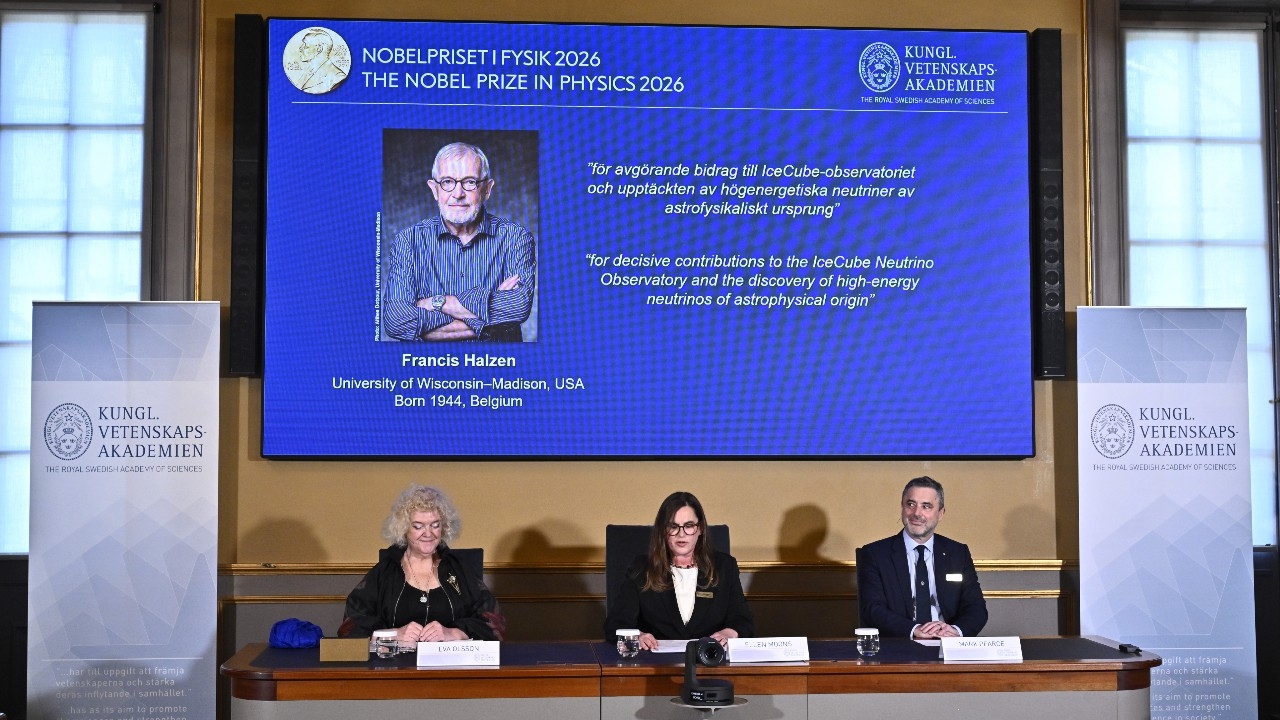
The Royal Swedish Academy of Sciences announced the 2026 Nobel Prize in Physics to Belgian scientist Francis Halzen of the University of Wisconsin–Madison, USA, for his "outstanding contributions to the IceCube Neutrino Observatory and the discovery of high-energy neutrinos originating from astrophysical phenomena."
Halzen proposed the concept that Antarctic ice can be used to detect particles called neutrinos. His scientific leadership was key in developing the IceCube Neutrino Observatory, which installed light-detecting sensors in approximately one cubic kilometer of ice beneath the Antarctic ice sheet.
Using IceCube, researchers can detect neutrinos generated by cosmic processes that release immense energy in remote parts of the universe, enabling scientists to study phenomena inaccessible by traditional astronomical methods.
Neutrinos are abundant in nature but rarely interact with matter, making them almost undetectable. These particles can pass through Earth and human bodies unnoticed because they interact very weakly with matter.
Only in very rare instances do neutrinos collide with atomic nuclei, producing light signals detectable by specialized instruments, allowing scientists to confirm the presence of neutrinos.
Scientists have long known the universe contains natural particle accelerators capable of releasing particles with energies roughly a million times greater than what human-made accelerators on Earth can achieve.
However, these sources remain largely mysterious. Scientists seek answers about their nature, location, and the key processes occurring within them.
Extremely high-energy neutrinos arise alongside other particles but have the unique property of traveling to Earth almost without changing direction or losing energy, delivering direct information from cosmic sources—data unattainable by other means.
Halzen first proposed detecting neutrinos at the South Pole in 1988, leveraging the clarity and purity of Antarctic ice. When neutrinos collide with atomic nuclei, brief flashes of light occur, which embedded sensors in the ice can detect and track.
The Antarctic ice offers advantages such as low background noise and geological stability without earthquakes disrupting measurements. Halzen's concept gained support, and within a few years, scientists began testing sensor installations in the ice.
Because high-energy cosmic neutrinos are rare, detecting enough requires a huge volume of ice. The IceCube Observatory was built to cover about one cubic kilometer of ice and was completed in 2011.
Soon afterward, researchers detected the first group of high-energy neutrinos, and within a few years published results indicating these neutrinos originated beyond our solar system.
This marked the serious beginning of searching for cosmic neutrino sources and opened new avenues for studying the universe.
Continuous data on neutrino interactions recorded by IceCube helps researchers better understand the extreme cosmic environments that produce high-energy neutrinos.
Scientists also hope neutrino studies will uncover previously unknown cosmic phenomena and provide insights into high-energy events in the universe from perspectives different from light or other particles.
Mark Pearce, Chair of the Nobel Committee for Physics, said Halzen led an international team of researchers and engineers to build a highly capable instrument, and his scientific vision paved the way for a new form of astronomy.
The discovery of high-energy neutrinos from astrophysical sources is not just identifying a particle type but opening a new window for exploring the cosmos, allowing scientists to directly trace extreme energy processes from distant origins in the universe.
/SourceNobel Prize