

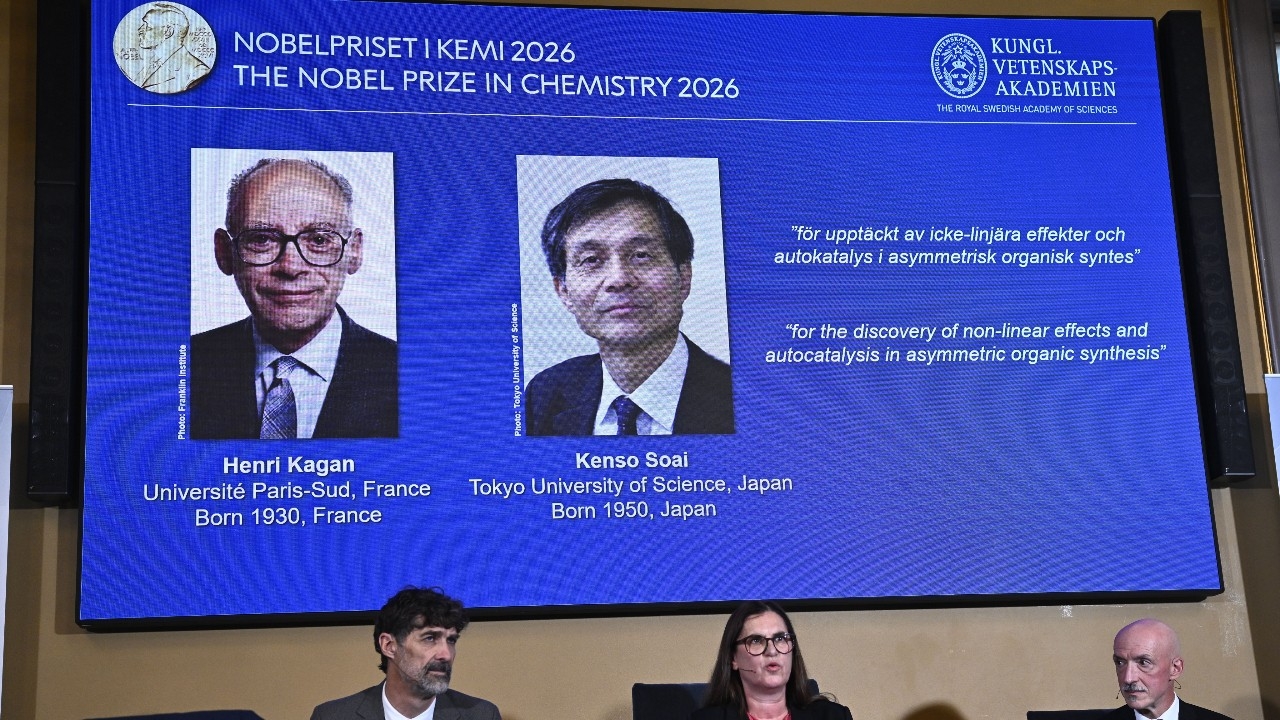
The Royal Swedish Academy of Sciences has awarded the 2026 Nobel Prize in Chemistry to Henri B. Kagan from France and Kenzo Soai from Japan for "the discovery of non-linear effects and autocatalysis in asymmetric organic synthesis," which solves an ancient mystery about the origin of molecular asymmetry in living organisms and holds great significance for the modern pharmaceutical industry.
Scientists have found that some molecules, such as amino acids, exist in two forms that are mirror images of each other, similar to left and right hands. Although both forms share the same chemical composition, living organisms predominantly utilize only one molecular form.
This phenomenon is called homochirality, meaning that biological systems select molecules with the same "handedness" or structural orientation. The term derives from Greek words meaning "same" and "hand."
For example, all amino acids have two mirror-image forms, but proteins inside living cells are composed exclusively of one form, while the other form is relatively rare in nature.
For over a century, chemists have struggled to understand how such chemical asymmetry arises because reactions that produce both molecular forms typically yield nearly equal amounts of each.
However, controlling the production of a single molecular form is critically important, especially in drug development, since mirror-image molecules can have different biological properties, and only one form may provide the desired therapeutic effect.
This year's Nobel Prize in Chemistry honors discoveries that enable chemists to steer chemical reactions toward producing homochirality.
Kagan made a major breakthrough in 1986 by discovering a new method to control chemical reactions, allowing the creation of one mirror-image form of a molecule in much higher proportion than previously thought possible.
Subsequently, Soai built on this work, and in 1995 published key research demonstrating that he could design a chemical reaction with the potential to lead to homochirality.
In 2003, Soai succeeded in demonstrating a reaction that produces only one of two mirror-image molecular forms, an unprecedented achievement outside biological processes.
The Nobel Committee stated that Kagan and Soai's work has unraveled a chemical mystery over a century old: how homochirality can arise spontaneously.
Heiner Linke, Chair of the Nobel Committee for Chemistry, said Kagan and Soai answered a chemical puzzle over 100 years old, and their developed chemical reactions represent outstanding achievements.
This discovery is crucial for chemistry, particularly in designing reactions for drug production, as it allows chemists to control molecular configurations, a key factor in developing drugs and compounds that precisely interact with biological systems.
.sourceNobel Prize