

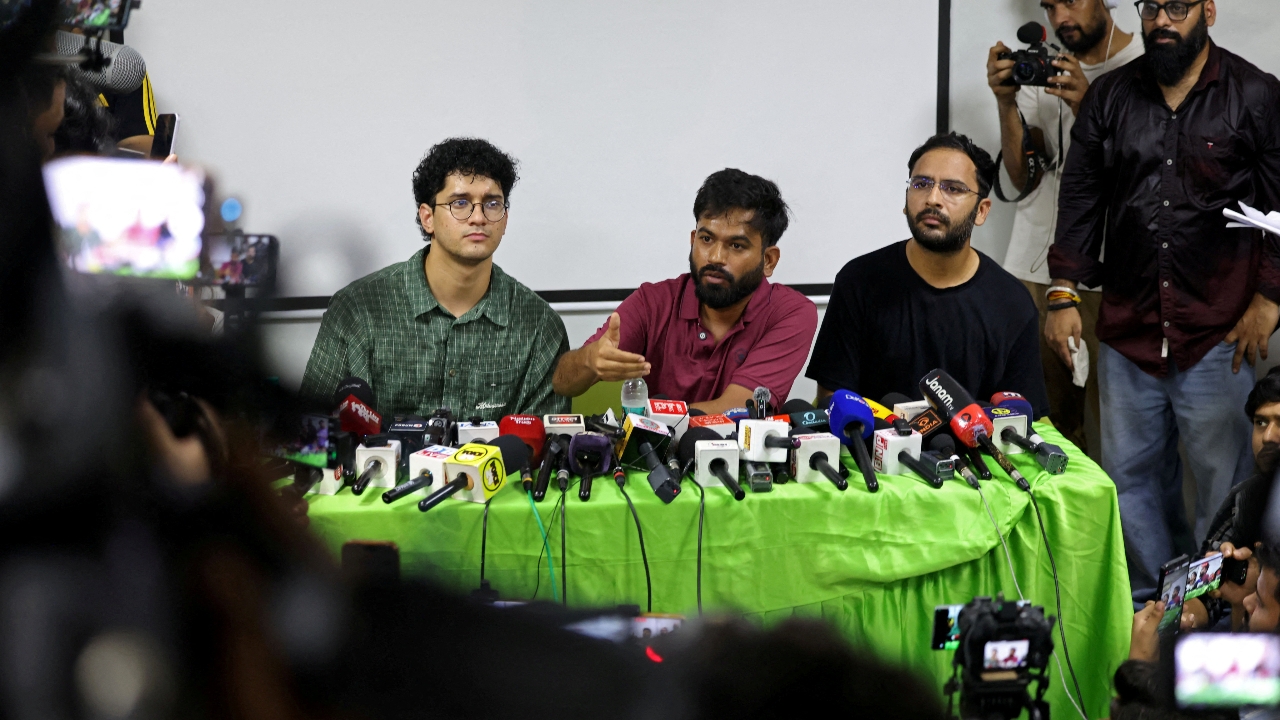
A court in New Delhi ordered the release of Abhijit Dipke, Ashutosh Ranka, and Sourav Das, leaders of the "Cockroach Party," after police detained them on a plane. Meanwhile, protesters are preparing to rally again demanding the resignation of the Election Commission of India Chief following allegations of irregularities in updating the voter registry, which triggered widespread detentions across New Delhi.
A court in New Delhi, India, ordered the release of Abhijit Dipke, founder of the Cockroach Party (CJP), along with Ashutosh Ranka and Sourav Das, two other party leaders, today (11 Oct) after all three were detained by police on preventive grounds while arriving in New Delhi on a flight from Mumbai last Saturday.
The three were removed from the plane after landing and taken to appear before an administrative judge at the Delhi Cantonment police station before being released later. The CJP announced the news on platform X, stating, "Finally, Delhi police had to release Abhijit Dipke, Ashutosh Ranka, and Sourav Das; cockroaches never die."
Police stated that Dipke had been informed of his grandmother’s death and offered assistance to return home. Meanwhile, Ashinkya Shinde, a CJP leader assigned to lead the protests, confirmed that demonstrations will continue "until Rajesh Kumar, the Election Commission Chief, resigns."
The CJP called on supporters to rally again at Jantar Mantar in New Delhi on Sunday after Saturday’s protest faced heavy security measures, with police blocking gathering areas and detaining many protesters.
Indian media reports vary on the number of detainees, ranging from about 3,000 to several thousand across New Delhi, while CJP leader Ashinkya Shinde claimed at a press conference that over 15,000 people have been detained. However, this figure has not been independently verified.
Among those detained are opposition politicians and former chief ministers, including Arvind Kejriwal of the Aam Aadmi Party (AAP), Mamata Banerjee of the Trinamool Congress, Pinarayi Vijayan from the Left Front, and Manik Sarkar, along with activists and some journalists.
Additionally, reports indicate that Thruf Rathi, an Indian YouTuber with about 33 million followers, was detained at his home in Gurugram, while police and paramilitary forces totaling around 25,000 personnel were deployed to maintain order.
Earlier, environmental activist Sonam Wangchuk warned he might begin a hunger strike or march if detainees are not released by Sunday, while Neha Bora and some protesters were released from police custody on Saturday evening.
Delhi Chief Minister Rekha Gupta stated that the capital will not allow anyone to paralyze it, accusing the CJP of acting as a proxy supporting the Congress and AAP parties.
These protests were triggered by allegations that the Election Commission of India (ECI) conducted the voter registry update under the "Summary Revision of Electoral Rolls" (SIR) process in a non-transparent manner. Protesters demand that Rajesh Kumar, ECI Chief, resign and that the process be halted.
Opposition parties and critics fear the registry update could disenfranchise millions of voters and might politically advantage Prime Minister Narendra Modi’s Bharatiya Janata Party (BJP).
Indian media citing ECI data report that the registry update begun in 2025 removed over 133 million names from draft electoral rolls. However, the ECI denies allegations of misconduct, stating the update aims to remove duplicates, ineligible voters, and illegal immigrants from abroad.
The Election Commission maintains that all decisions were unanimous and lawful, although Indian Express reported that some key decisions on the update may have been made without approval from two of the three election commissioners.
Police prohibited public gatherings citing security concerns and insufficient prior notice. Additionally, dozens of metro stations were closed, over 200 trains cancelled, and mobile internet services temporarily suspended near protest sites.
Congress leader Rahul Gandhi urged India’s youth to continue protesting, expressing support for the demonstrators, while Amnesty International criticized the lockdown-like restrictions on gatherings.
The United Nations Human Rights Office called on India to release those detained arbitrarily and expressed concern over mass detentions. However, India’s UN delegation in Geneva rejected these concerns as baseless.
BJP spokesperson Sambit Patra said the CJP failed to create disorder, while political analyst Nilanjan Mukhopadhyay suggested the protests might become a greater challenge in the coming months.
Although India’s next general election is not scheduled until 2029, Uttar Pradesh—the country’s most populous state—is set to hold elections next year. The protests are thus a significant political issue that could influence India’s political climate going forward.
The CJP began in May as an online political satire movement before expanding into a large protest group. Previous July protests involved demands regarding exam scandals, leading to the resignation of the Education Minister. The current movement aims to pressure the Election Commission Chief to resign and to halt what it views as an unfair voter registry update.