

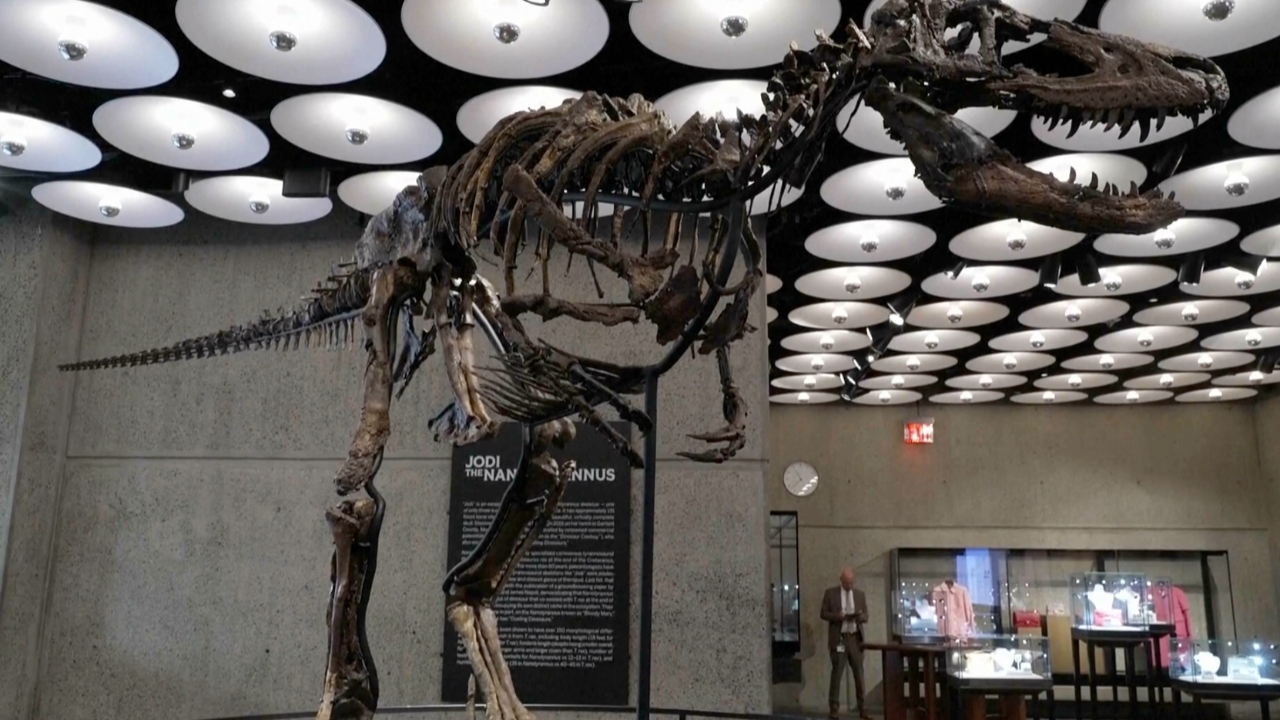
Sotheby's is presenting the skeleton of a "Nanotyrannus," a smaller and more agile predatory dinosaur related to T. rex, on display in New York ahead of the auction on 27 October, with an estimated price up to $9 million USD, or over 300 million baht.
The rare dinosaur fossil skeleton named "Jodi" is on public display at Sotheby's headquarters in the Upper East Side of Manhattan, New York City, on 13 October, ahead of its auction later this month.
The fossil is of a Nanotyrannus, a predatory dinosaur closely related to Tyrannosaurus rex or T. rex, but smaller and more agile. The skeleton stands about 2 meters tall and nearly 6 meters long, with an estimated auction price between $6-9 million USD, or over 200-300 million baht.
Cassandra Hatton, Sotheby's Vice President and Global Head of Science and Natural History, revealed that Nanotyrannus has been a scientific debate for decades since the first skull believed to be its was discovered in 1942. Some scientists once thought it was just a juvenile T. rex.
However, research published last October supports the conclusion that Nanotyrannus is a distinct genus from T. rex. Scientists studied growth rings inside the fossil bones and found evidence that the specimen was fully grown, not a juvenile dinosaur.
Both species lived around 67 million years ago but had clearly different physical traits and hunting methods. Nanotyrannus measured about 5.5 meters, roughly half the size of a fully grown T. rex, with longer arms, larger claws, and up to 17 tooth sockets, compared to about 12 in T. rex.
T. rex's teeth are thick and sturdy, banana-shaped, ideal for crushing bones and consuming whole prey. Nanotyrannus had slender, blade-like teeth suited for slicing meat, and a body built for faster movement.
Hatton stated that this discovery changes the previous understanding that T. rex was the sole large predator dominating the Cretaceous ecosystem. Instead, the two predators likely coexisted but targeted different prey.
Nanotyrannus fossils are extremely rare, with only three nearly complete skeletons scientifically known worldwide, making them valuable for collection and research. Experts also emphasize the important role of private fossil hunters in discovering and preserving fossils that reveal the history of ancient life.
Source:AP
Click to read related newsInternational News