

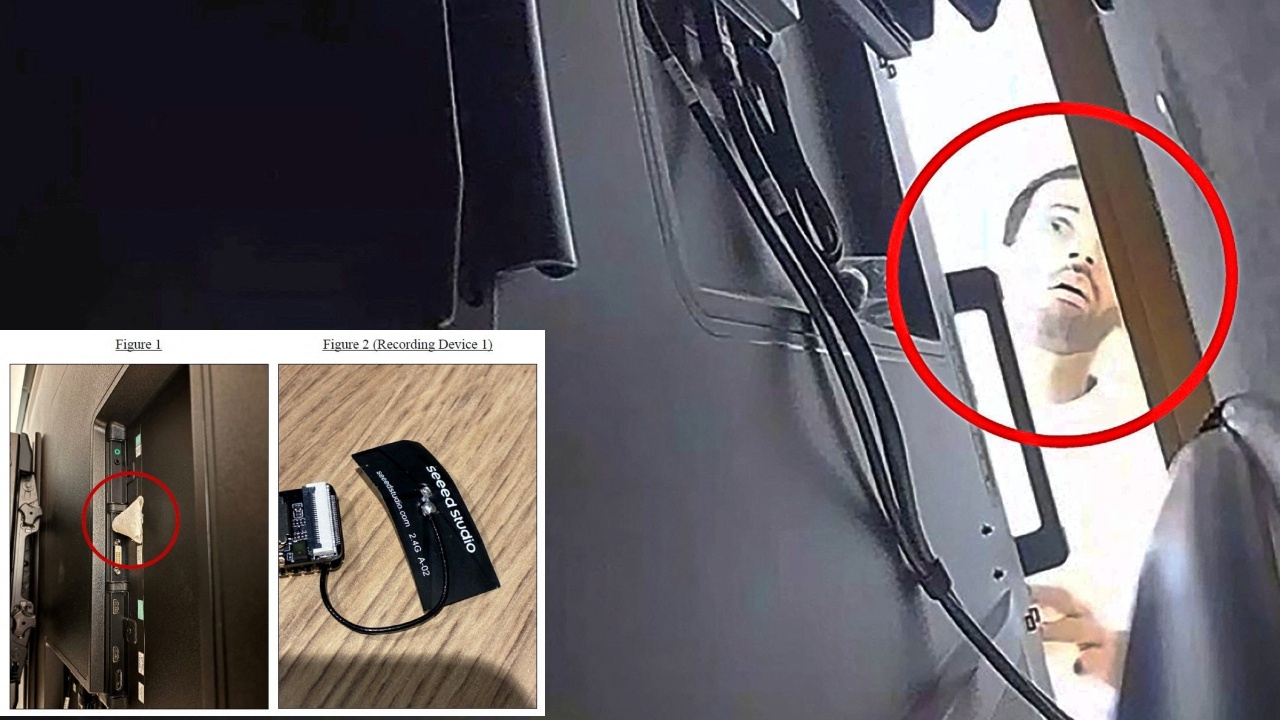
U.S. federal prosecutors have charged "Abdulrahman Alfosan," a Saudi engineer at OpenAI, accused of secretly installing a small audio recording device hidden inside a paper towel roll near the USB port behind a television in the company’s executive meeting room in San Francisco. Authorities are investigating whether his aim was to record information related to the company's artificial intelligence technology. .
Abdulrahman Alfosan, an engineer at OpenAI, the developer of the ChatGPT chatbot, has been criminally charged in the United States for allegedly installing electronic equipment to eavesdrop on conversations without authorization, according to a statement from the U.S. Department of Justice.
Alfosan, 35, a Saudi national, had worked as an engineer at OpenAI since July 2025. Authorities stated that the recording device was installed in one of the company’s executive meeting rooms in San Francisco, California, around 28 September, before employees discovered it on 30 September.
According to documents filed by the Federal Bureau of Investigation (FBI), the device was about the size of a thumb, equipped with a microphone and capable of connecting to a camera. It was concealed inside a paper towel roll and plugged into a USB port behind the television in the meeting room. The data stored on the device was encrypted, making it inaccessible at the time.
FBI Director Kash Patel stated that the suspect allegedly hid the recording device in the executive meeting room to secretly capture sensitive conversations about the company’s advanced artificial intelligence technology. Officials believe the target was to collect information on OpenAI’s AI products.
The FBI further reported that the suspect used productivity tools and chatbots to research sensitive areas within the company, including how to create, customize, install, and conceal recording devices, as well as capabilities such as Wi-Fi connectivity, real-time audio listening, and data encryption on memory cards. Additionally, he used AI tools to gather information about the meeting room schedules and system capabilities continuously for about a month until 16 September.
Authorities indicated that on 5 October, Alfosan returned to check the device in the meeting room again. CCTV footage was used to link him to the scene. On the same day, OpenAI security staff found an unattended bag elsewhere in the building. Upon inspection, the bag contained his wallet, identification documents, and another recording device similar to the one found in the meeting room.
OpenAI revealed that the company discovered the device and notified the FBI, using its internal AI models to analyze the device and trace its origin, leading to the identification of the employee allegedly responsible. The company also stated there is evidence suggesting the employee may have planned to install additional recording devices in sensitive office areas to secretly record meetings.
However, OpenAI stated there is currently no indication that the suspect accessed or improperly removed model source code or customer data. The company has terminated the employee, and the FBI continues to investigate the case.
Alfosan appeared in court on 13 October, but there is no confirmation whether he has legal representation. If found guilty, he could face a maximum sentence of five years in prison, a fine up to $250,000, and three years of supervised release after imprisonment.
Documents state that Alfosan has been a lawful permanent resident in the United States since September 2020. His LinkedIn profile indicates he studied at the Massachusetts Institute of Technology (MIT) and the University of California, Berkeley, and previously worked at Meta and Microsoft. However, Reuters reported it has not independently verified these details, and the Saudi Arabian embassy in the U.S. has not immediately responded to requests for comment.
This case arises amid growing concerns about the security of AI research and technology, which are important both economically and strategically. Meanwhile, separate reports indicate OpenAI is in preliminary talks to acquire Trail of Bits, a startup specializing in detecting and fixing vulnerabilities in open-source software, though negotiations are early and may not succeed.
Earlier, OpenAI also disclosed it had terminated three researchers after an investigation found they violated company policies on handling sensitive information. The researchers published a letter explaining their dismissal and expressed concerns that the decision could create uncertainty among employees and undermine a culture that encourages researchers to report safety concerns.