

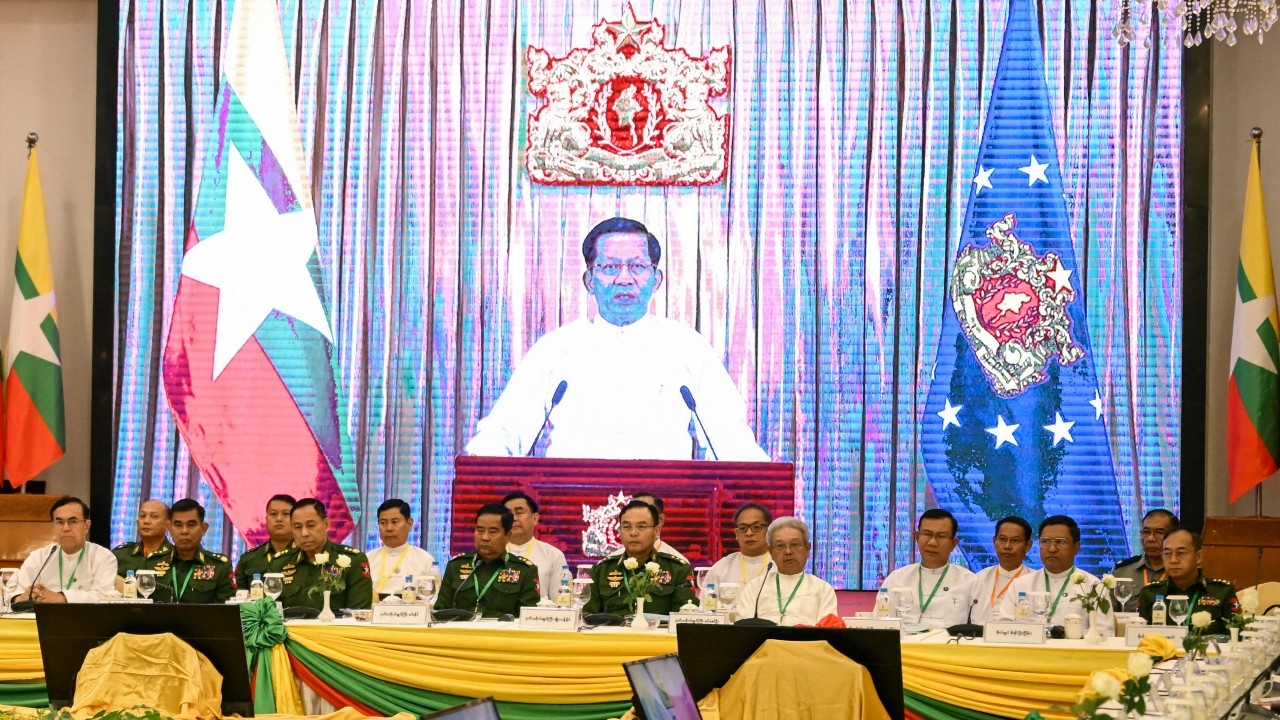
Sources revealed that the US and Myanmar's military-backed government held talks in Tokyo last week, marking their second meeting within one month. This follows President Donald Trump's administration's efforts to restore contact with Myanmar's military leaders. Key issues included cracking down on call center scam gangs harming Americans and the possibility of accessing Myanmar's rare mineral resources.
Reuters reported that the US and Myanmar's military-backed government held talks in Tokyo, Japan, last week. This was their second discussion in one month, reflecting the US government's efforts to re-engage with Myanmar's military leaders after cutting ties and imposing pressure following the 2021 coup.
Three sources familiar with the talks told Reuters that it was unclear which issues the latest discussions covered. All sources, including a US official, requested anonymity due to the sensitivity of the diplomatic matter.
Michael W. Vance, US Assistant Secretary of State for Intelligence and Research, led the US delegation again, accompanied by more than 12 officials. However, Reuters could not confirm which Myanmar representatives participated in the talks.
The US State Department did not respond to questions about the latest talks but stated that the US communicates with all groups in Myanmar on matters related to national interests. Meanwhile, a spokesperson for Myanmar's military-backed government did not respond to requests for comment.
Japan's Ministry of Foreign Affairs said it has communicated with both parties as needed but declined to provide details about the diplomatic exchanges.
These talks followed Michael W. Vance's meeting with Min Aung Hlaing, Myanmar's coup leader and current president, in Naypyidaw in mid-September. That meeting focused on pushing for the release of an American businessman and shutting down online scam centers targeting Americans, opening the door for broader discussions.
The rapid return to the negotiation table in Tokyo indicates that both sides want to maintain communication channels.
Sources said a key US objective is to seek Myanmar's cooperation in shutting down online scam centers that carry out various frauds, including romance scams. These networks have caused losses to Americans amounting to billions of US dollars.
Researchers noted many scam centers operate in areas controlled by armed groups allied with Myanmar's military, with some revenues flowing to the military, raising doubts about Myanmar's leaders' commitment to law enforcement.
However, Myanmar's military-backed government stated it is participating in international efforts to suppress these call center scam gangs.
Another topic US officials have discussed is access to Myanmar's large reserves of rare minerals, which are essential raw materials for various technology products, from electric vehicles to wind turbines.
However, the US acknowledges significant obstacles, as most mineral deposits are in areas controlled by ethnic armed groups fighting the Myanmar military. Additionally, China, a major buyer of Myanmar's rare minerals, may resist US involvement in this sector.
Last week, the US also lifted sanctions on the daughter of a Myanmar businessman accused of supporting the military. The US State Department said this decision is part of a new approach to Myanmar policy.
The US State Department said this approach focuses on engaging all groups involved in Myanmar's civil conflict and reviewing various tools previously used to promote US core interests in Myanmar.
However, Min Aung Hlaing remains under US sanctions for human rights abuses, including his role in the coup, repression of uprisings, mass killings, and the 2016–2017 Rohingya Muslim expulsions, which the US government has declared genocide.
Hunter Marston, director for Southeast Asia at the Lowy Institute in Australia, said US contacts with Myanmar in Japan reflect the Trump administration's interest in relations based on mutual benefits and exchanges. Marston noted that Myanmar's important and rare minerals are likely the strategic resources of greatest US interest in the country.
Although Japan hosted the US-Myanmar talks, it is unclear whether Japan has roles or interests beyond hosting. Previously, Japan also hosted talks between the two parties in June.
There are signs Japan is seeking to re-engage more with Myanmar's government. Japan's acting representative to Myanmar met openly with Myanmar's military-backed foreign minister in early October, marking the first publicly reported meeting of its kind.
This meeting followed a visit in September by Hiromichi Watanabe, a member of Japan's ruling party in the House of Representatives, to Naypyidaw. Myanmar's government newspaper, Global New Light of Myanmar, reported the visit aimed to restore bilateral cooperation and resume development aid to Myanmar.
Japan's Ministry of Foreign Affairs said the acting representative raised issues of protecting Japanese citizens and supporting Japanese companies. It added that Watanabe's visit was a private parliamentary activity and should not be interpreted as Japan's official government stance.
Watanabe told Reuters his visit aimed to prepare for restoring normal relations, though he acknowledged many challenges remain.
Japan condemned Myanmar's 2021 military coup that ousted Aung San Suu Kyi's elected civilian government but did not join the US and Western countries in sanctioning Myanmar's military leaders and related entities.
Historically, Japan was one of the largest foreign investors in Myanmar, seeking to maintain economic influence in this key emerging Asian market amid competition with China. Many Japanese companies continue operating in Myanmar despite unrest following the coup, unlike many Western firms that withdrew.
Data from the Japan External Trade Organization (JETRO) shows about 300 Japanese companies currently operate in Myanmar, down from over 400 in 2020 before the coup.
. . .Reuters