

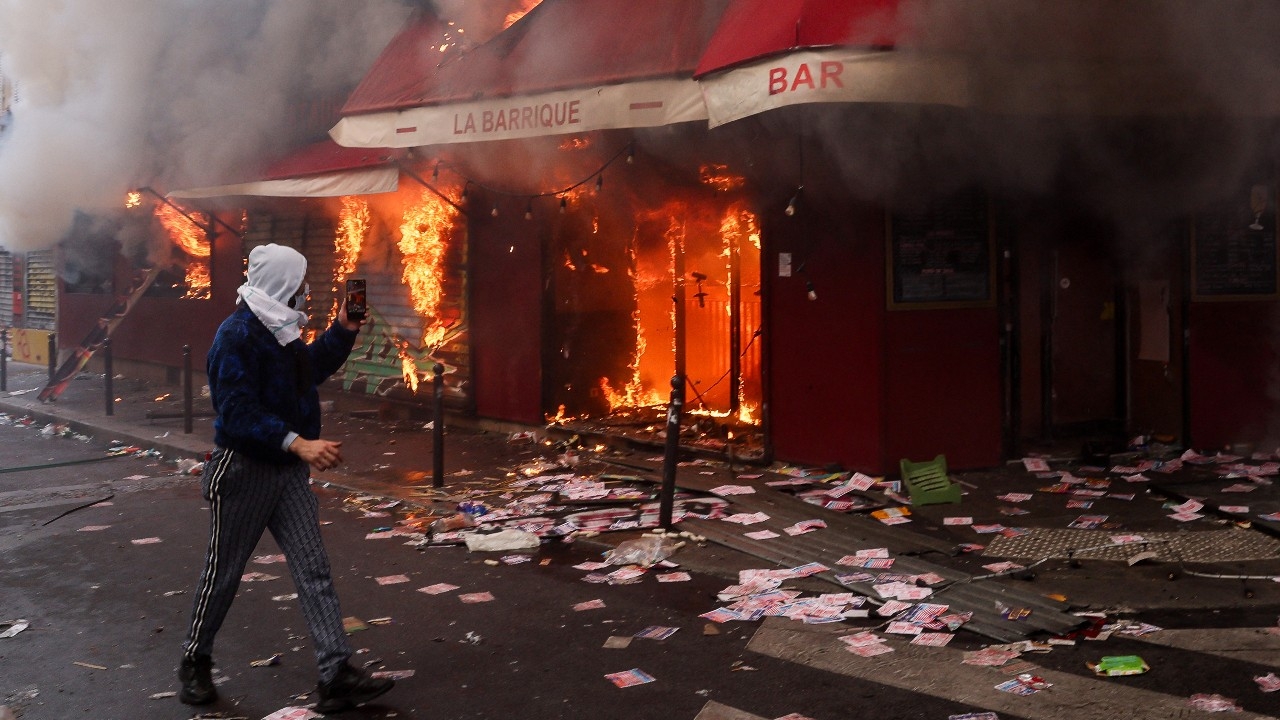
France faced widespread riots and damage on Sunday after protests against rising living costs escalated into violence across several cities nationwide. Demonstrators clashed with police, setting fire to cars and buildings, and looting numerous stores, causing severe damage to many streets in Paris.
French Prime Minister Sébastien Lecornu condemned the extreme violence, revealing that authorities had arrested 1,200 suspects and that 150 police officers were injured. He noted it was remarkable that the number of deaths and injuries was not higher.
The French Interior Ministry estimated around 550,000 people participated in protests nationwide, while the CGT labor union, one of the organizers, claimed up to 800,000 attendees. Police used tear gas and high-pressure water cannons to disperse protesters who threw objects and fired fireworks at officers. Meanwhile, a 17-year-old boy in Saint-Étienne in southern France lost his right hand due to a crowd control explosive device.
During and after the protests, groups of masked youths and men vandalized and looted shops in multiple cities including Paris, Marseille, Nice, Nantes, Bordeaux, Le Mans, Lille, Toulouse, and Strasbourg. Targeted stores ranged from supermarkets and pharmacies to clothing, cosmetics, eyewear shops, electronics retailers, and luxury goods outlets.
AFP reporters noted that in Paris, masked young men systematically disabled CCTV cameras before smashing store windows and entering shops. At Place de la République, rioters broke windows of a skincare product store and threw beauty items to crowds outside. A telecommunications store was looted, with mobile phones thrown out to people.
A prominent monument in the square was spray-painted with graffiti, and surrounding paving stones were removed. Additionally, a fire broke out at the bar "La Barrique," and youths raided a nearby supermarket, stealing bottles of alcohol and cans to throw at police officers.
In Marseille, France’s second-largest city, dozens of shops were damaged and looted, including the luxury Hermès brand, jewelry stores, clothing, cosmetics, household goods, and bakeries. Firefighters had to extinguish a fire at a shoe store.
In Lille, northern France, several stores were damaged, including an Apple store in the city center. In Nice, southern France, multiple shops were looted, including sportswear retailers and motorcycle dealerships.
The violence extended to government buildings. The more than 140-year-old city hall in Le Mans suffered heavy fire damage after masked protesters broke in and set it ablaze. City halls in Marseille and Lille were also occupied and vandalized. Reports also indicate police buildings were damaged in Bordeaux, and the tourism office in Lyon was set on fire.
These protests followed weeks of student demonstrations, primarily driven by rising living costs. Part of the inflation surge stems from the Middle East conflict pushing up prices across Europe and other regions. Since 2024, French citizens’ purchasing power has declined, and fuel prices have risen following the early-year war between the United States and Iran.
Rejine Monfroi, a teacher in Strasbourg, told AFP that people are frustrated with working hard but earning low wages while rent prices continuously increase.
Beyond economic issues, protesters expressed discontent with police force used against high school student protests and economic inequality, all occurring ahead of France’s presidential elections scheduled for April and May next year.
In a major Paris demonstration, tens of thousands marched through the city’s eastern and northern districts, shouting slogans against the police and calling for President Emmanuel Macron’s resignation.
Camille Alahyane, an 18-year-old high school student, said he participated in the protests for various reasons including the upcoming 2027 election, politicians’ falsehoods, and the increasing wealth concentration among billionaires over the past decade.
Some protesters compared the situation to the French Revolution of 1789. In Marseille, demonstrators shouted about revolution and called to seize the Bastille prison before storming the mayor’s office. In La Rochelle, protesters marched with signs reading “Revolution or Death,” while in Montpellier large banners over the central square proclaimed “The People Will Win.”
The Yellow Vests movement, which protested against President Macron’s fuel tax plans eight years ago, was among the groups calling for these demonstrations under the concept of “Yellow Vests and Youth.”
Riyad Rani, leader of the high school student organization LSU, told reporters in Paris that the government is shaken by public dissatisfaction, and when the French people are angry, they will not easily stop demanding change.
President Macron declared that those responsible for property destruction, attacks on government institutions or businesses, and looting—including those involved in city hall attacks—will be prosecuted and punished according to the law.
Marine Le Pen, a far-right politician preparing for the presidential race, condemned the rioters and accused Jean-Luc Mélenchon’s far-left party of normalizing violence. She vowed to protect the French people from far-left aggression.
Mélenchon, who supports student protests, urged demonstrators to avoid looting, stating such acts contradict the movement’s principles.
The unrest attracted international attention. U.S. Vice President JD Vance commented on the platform X that Western liberalism has brought populations from developing countries into France and other nations under the banners of diversity and compassion, criticizing neglect of fundamental issues like social integration and cultural compatibility.
These riots come as France faces economic pressures and political conflicts. Dissatisfaction with living costs, inequality, and police conduct are key factors driving the expanded protests, while the government rushes to control the situation and prosecute those involved ahead of the 2027 presidential election.
Source: AFP