

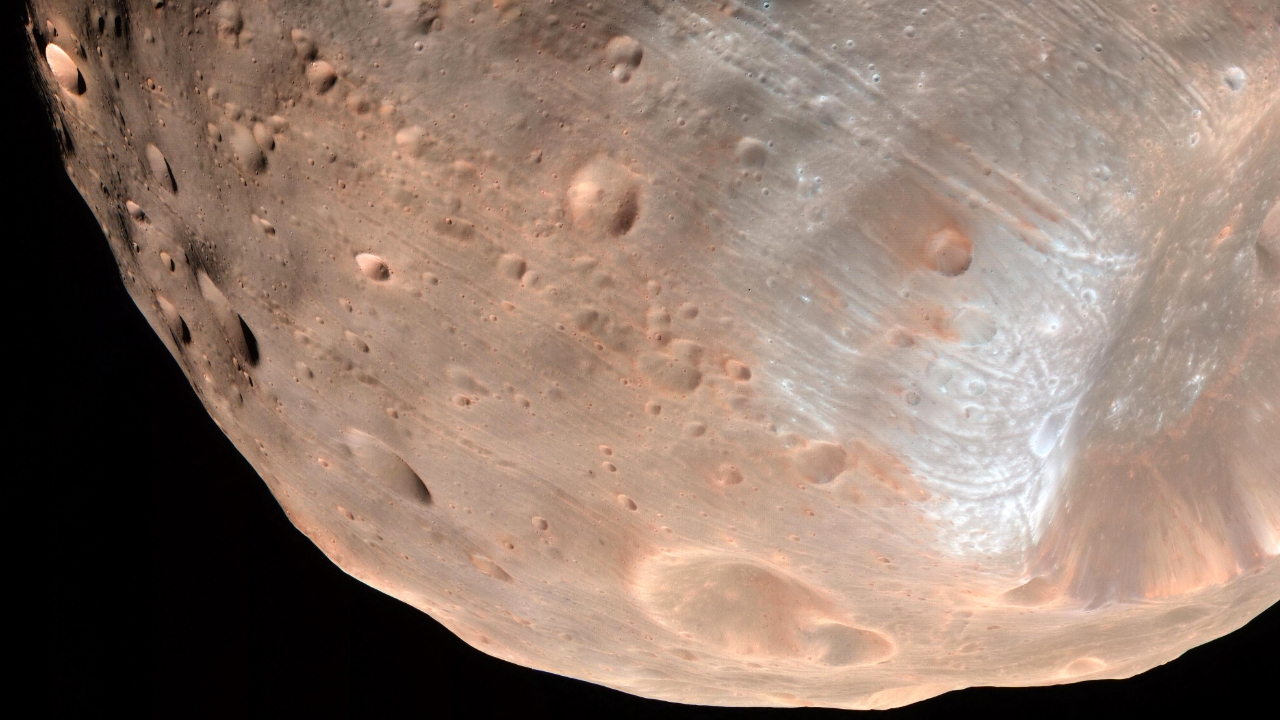
(Image courtesy AFP PHOTO / NASA / JPL-CALTECH / UNIVERSITY OF ARIZONA)
Japan is preparing to send an unmanned spacecraft this week to explore one of Mars’ moons, aiming to collect samples for return to Earth to help solve various space mysteries, including the formation of this red planet’s satellite.
The Japan Aerospace Exploration Agency (JAXA) is ready to launch the unmanned MMX (Martian Moons eXploration) spacecraft to explore Mars’ moons and return surface samples to Earth. This mission will mark the world’s first "round-trip" journey from the Martian system.
The MMX spacecraft will be launched aboard Japan’s flagship H3 rocket from the Tanegashima Space Center at 04:41 local time on Tuesday, 20 Oct 2026 GMT+7.
According to the plan, the spacecraft will arrive near Mars in August next year and enter orbit around Phobos, one of Mars’ moons. It will then land to collect at least 10 grams of surface material during the three-year mission.
Before landing, a ground exploration rover named IDEFIX—named after the dog from the classic French comic Asterix—will be deployed to survey the surface for safety.
Additionally, the MMX spacecraft will survey Mars’ other moon, Deimos, but will not land there before returning to Earth.
JAXA hopes the samples from Phobos will help determine whether Mars’ moons formed from a "giant impact" between Mars and another celestial body or were "captured" by Mars’ gravity.
Scientists say these samples could reveal how water, volatiles, and organic compounds are transported from beyond the solar system to inner rocky planets, which is key to understanding how Earth and other planets developed environments capable of supporting life.
The mission also examines the possibility of using Phobos as a "natural space station," which is crucial for future human exploration of Mars.
The MMX mission is a collaboration between JAXA and space agencies from France (CNES), Germany (DLR), the United States (NASA), the European Space Agency (ESA), as well as around 20 universities and technology companies. Japan previously returned samples of dust and rock from an asteroid to Earth via the Hayabusa-2 mission in 2020.
Follow international news at:https://www.thairath.co.th/news/foreign
Source:cna