

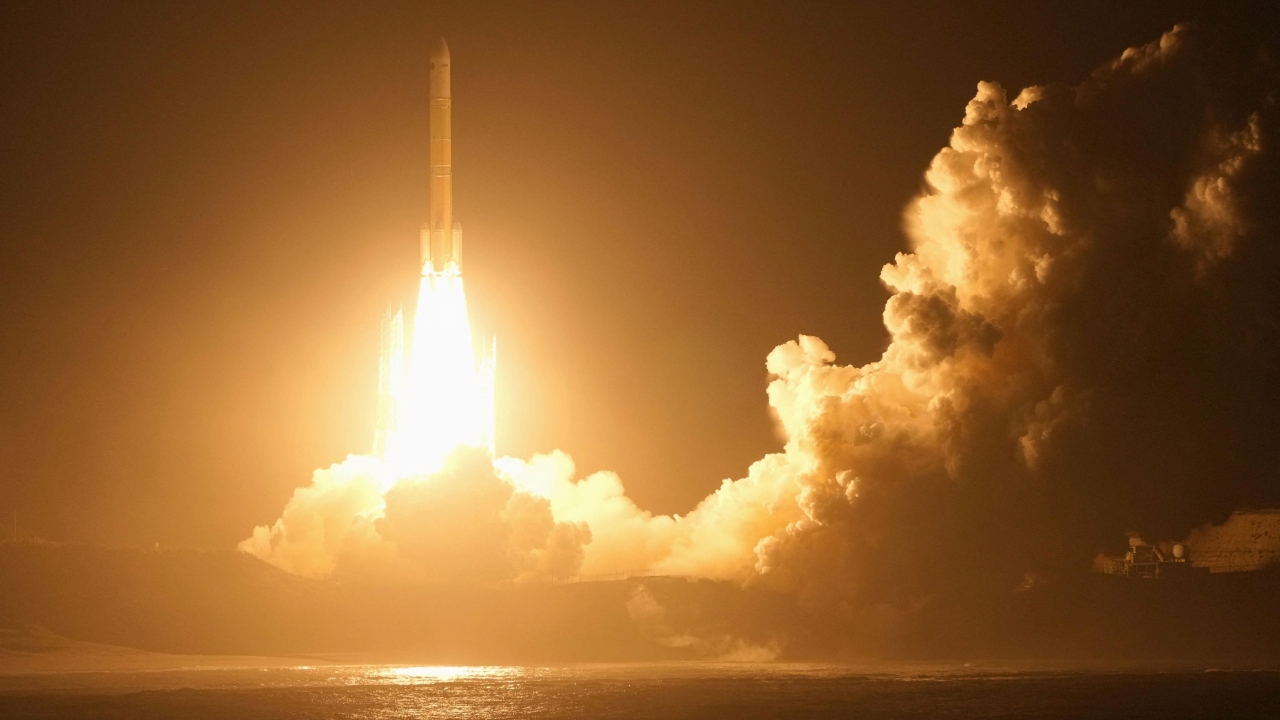
Japan has launched the MMX spacecraft toward Phobos, Mars' moon, with the goal of collecting dust samples from this satellite and returning them to Earth to solve the mystery of its origin.
In the early hours of Tuesday, 20 Oct 2026 GMT+7, the Mars Moons Exploration (MMX) spacecraft, led by the Japan Aerospace Exploration Agency (JAXA), was launched into space bound for Phobos, a moon orbiting Mars, to collect dust and debris samples for analysis back on Earth.
According to the plan, MMX will reach Phobos in August 2027 GMT+7 and return a capsule containing about 10 grams of samples to Earth, landing in the Woomera desert in Australia by 2031 GMT+7.
If successful, this will be the first time in history that samples from Mars or its moons have been directly studied in Earth laboratories.
Phobos is very small, with a diameter of about 20 kilometers and an irregular, potato-like shape. It has very low gravity yet orbits close to Mars, a large planet with strong gravity, making landing the spacecraft extremely challenging.
For sample collection, MMX will deploy a rover to explore and find a suitable landing site. Once landed, robotic arms and two sample collection devices will scoop moon dust into capsules for return to Earth.
JAXA hopes the Phobos samples will clarify whether Mars' moon formed from a giant impact with another space object or was gravitationally captured by Mars.
Since Phobos is close to Mars, meteor impacts on Mars may have caused debris to embed in Phobos, so the 10-gram sample might contain Mars fragments, providing highly valuable information.
The MMX mission is a collaboration between JAXA and space agencies from France (CNES), Germany (DLR), the USA (NASA), the European Space Agency (ESA), as well as about 20 universities and tech companies. Japan previously returned asteroid dust and rocks through the Hayabusa-2 mission in 2020.
Source:bbc