

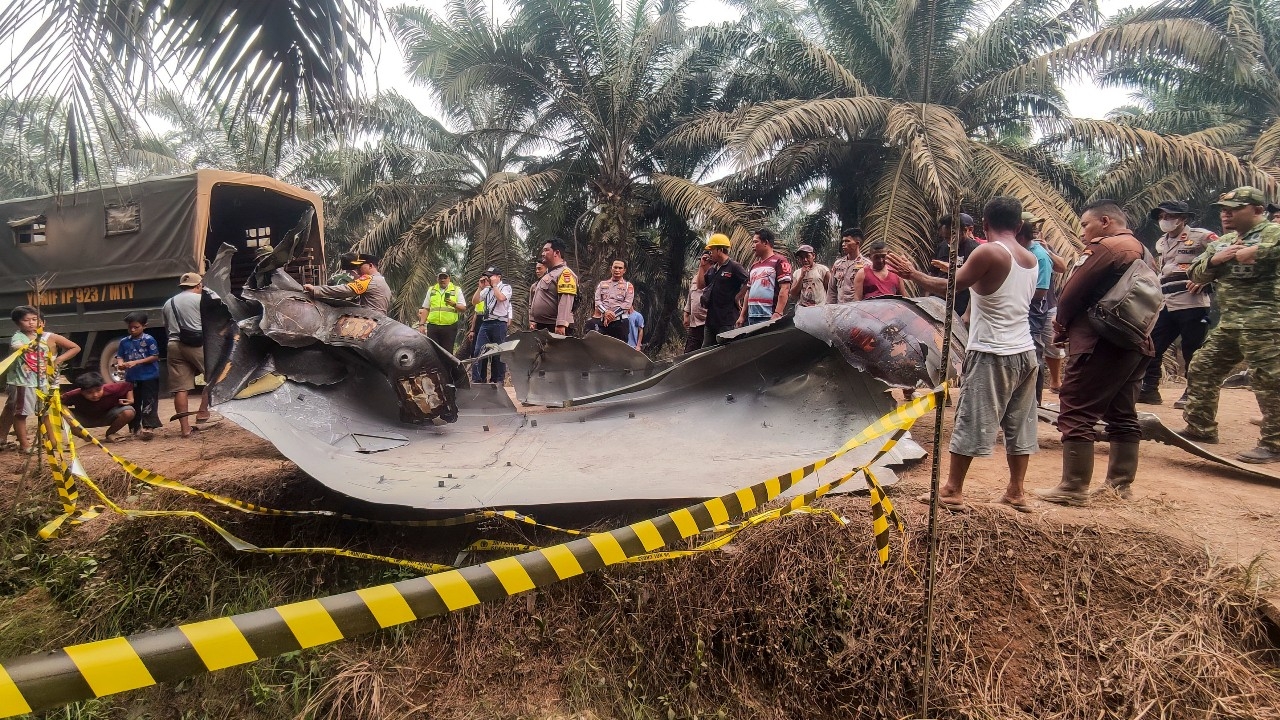
Indonesian authorities are urgently investigating two large metal fragments that fell into an oil palm plantation in Central Kalimantan province on Borneo Island. Indonesia's research agencies initially believe the debris is from China's Zhuque-2E rocket used to launch satellites into space. There were no reports of casualties or property damage, and officials have warned the public not to approach or move the suspicious objects.
Indonesian authorities are swiftly examining large metal debris that fell into an oil palm plantation near residential and worker areas in Central Kalimantan province on Borneo Island. Preliminary assessments suggest the fragments may be parts of a Chinese rocket reentering Earth's atmosphere before falling to the ground.
The incident began on the evening of 18 October when local residents reported hearing an explosion or loud noise from the sky in a remote area. The following morning, on 19 October, workers at the PT Agro Bukit oil palm plantation found large metal debris within the plantation near Sampit city, Central Kalimantan province.
Vardi Tamroni, a 51-year-old worker who first found the debris, told AFP news agency that at first he thought it might be airplane wreckage. The debris was located about 3 kilometers from the company's worker housing and within the normal working area. Fortunately, all workers had left for the day, so no one was in the plantation when the incident occurred.
E Kadek Dwi Yoga Sidimantra, the local police chief, said the first object was a large, irregularly shaped aluminum sheet about 9 meters long with clear burn marks.
Zakrudin, spokesperson for Indonesia's Civil Aviation Authority, stated that there were no casualties or property damage and no radioactive or toxic risks detected from the debris.
Indonesia's National Research and Innovation Agency (BRIN) assessed that the debris is likely part of China's Zhuque-2E rocket. The Chinese government had recently announced that this rocket launched 10 satellites into orbit from a commercial launch site in northwest China. However, China's National Space Administration has not immediately commented on the incident.
Thomas Jamaluddin, a BRIN researcher, explained that spacecraft parts do not fully burn up upon reentering the atmosphere. Components resistant to high heat can survive and fall to the ground, which may explain the large metal fragments found in the oil palm plantation near Sampit.
On the morning of 20 October, authorities found another suspicious object about 1 kilometer from the first site. Zakrudin said preliminary photos show the second object is dome-shaped or semicircular, possibly related to the first piece, and appears to be made of aluminum alloy. Further analysis is needed to confirm the material composition.
Photos and videos on social media show a dull yellow, curved object with rivets along its surface. Some parts still have wires and attached components. The debris fell amid scattered palm leaves, attracting workers and locals who came to observe and record the scene.
Officials cordoned off the area around the second object with police barriers to preserve the scene. The previously found fragment was moved to Iskandar Air Base in Pangkalan Bun city for expert examination and identification, with military and police personnel involved.
Preliminary checks found a code on the metal piece reading "2ZQE31-20-15 240256KY." Indonesia's National Transportation Safety Committee (KNKT) noted part of the code resembles the name of China's Zhuque-2E rocket and coordinated with BRIN's aerospace research agency. They confirmed the debris is part of China's satellite launch rocket.
The regional military command confirmed they received reports about the second object and dispatched personnel to investigate. Authorities warned that other debris might still be scattered in the area, urging the public to report any strange objects and not to approach, touch, or move them due to unknown risks and uncertain object types.
KNKT also coordinated with AirNav Indonesia, the air navigation service provider, and airlines to check for possible aircraft involvement but found no reports of lost contact linked to this incident.
Trajectory analysis of the debris reentry path showed it passed over the area where the objects were found. Authorities continue to examine the recovered fragments to officially confirm details and origin.
The European Space Agency (ESA) stated that the risk of space debris causing human fatalities on Earth remains relatively low compared to rare accidents like lightning strikes or shark attacks. However, this risk has increased in recent years due to heightened space activity from 2019 to 2024, according to ESA's space debris report last year.
For the palm plantation workers, the incident is an unusual and unpredictable event. Vardi said that if they had to worry about such incidents daily, they would not be able to work normally. He added that since these events cannot be predicted, they must accept whatever fate brings.
This event highlights the risks posed by space debris surviving reentry into Earth's atmosphere. Although most debris falls into oceans covering about 70% of the planet's surface, this case in Indonesia shows debris can land in agricultural areas or near communities.