

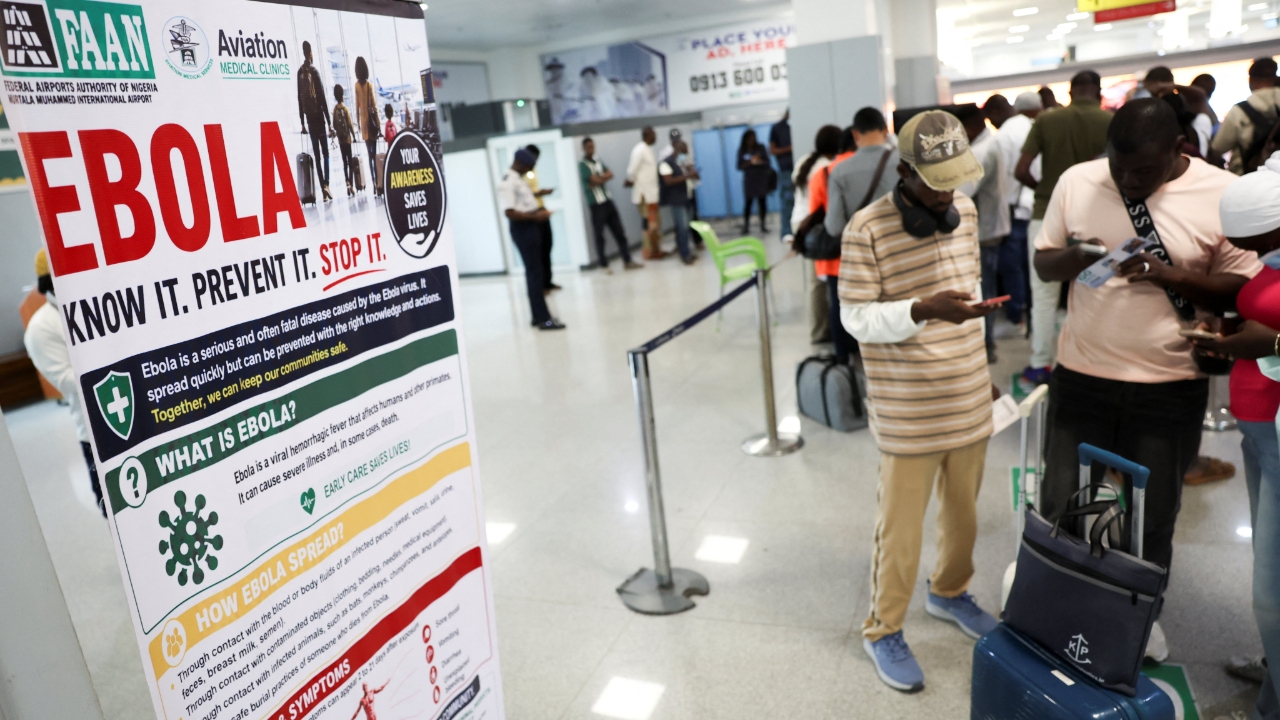
Nigeria has detected its first Ebola case in over a decade, with officials confirming the diagnosis came nearly two weeks after the patient began showing symptoms, making it unclear how extensively the virus has spread.
Foreign news agencies reported on 22 Oct 2026 that Nigeria has recorded its first Ebola infection in more than ten years. Authorities confirmed that the patient was not tested until 13 days after symptoms appeared, raising concerns about Nigeria's ability to control the Ebola outbreak, which has now spread to four African countries.
The Democratic Republic of Congo (DR Congo) is currently facing a major Ebola outbreak, which has spread to neighboring Uganda, where no new cases have recently been reported. In early October, cases were identified in Kenya, now totaling seven. On Tuesday, 20 Oct, Nigeria confirmed its first case, marking the widest spread of Ebola ever recorded in Africa.
Dr. Jean Kaseya, Director General of the Africa Centres for Disease Control and Prevention (Africa CDC), told Reuters that the patient in Nigeria is the wife of a Ugandan woman married to a Swiss diplomat. She arrived in Abuja, a key travel hub, on 3 Oct after a two-week vacation in Uganda.
Dr. Kaseya added that according to Nigerian authorities, the woman fell ill three days after arriving in Abuja. Initially suspected to have malaria, she sought treatment at several healthcare facilities before undergoing Ebola testing on 19 Oct.
"When we set the list of high-risk countries, Nigeria was not included, but now it is," Dr. Kaseya said. He added that this list will need updating, and regions in North and South Africa may also become at risk, emphasizing, "We must recognize that no one is safe today."
"We need to identify all close contacts... which is quite challenging because the patient went nearly two weeks without testing and had contact with healthcare workers, family members, and many friends."
So far, Nigeria has identified 44 close contacts, but Dr. Kaseya and other Ebola experts believe this number will increase.
It remains unclear whether the infected Nigerian woman contracted the virus in Uganda. Uganda reported 20 Ebola cases in May and June, mostly imported from DR Congo, but the World Health Organization declared Uganda Ebola-free in August.
Ugandan authorities say the Nigerian patient traveled through eastern DR Congo before passing through Uganda, but Nigerian officials say they have yet to confirm these details.
"Our patient has not confirmed traveling to DR Congo, so we assume she likely contracted the virus in Uganda," Dr. Muhammad Ali Pate, Nigeria's Health Minister, told state television on Tuesday.
Dr. Kaseya said Africa CDC is seeking clarity from both countries and from the patient herself.
Meanwhile, Marion Koopmans, a Dutch virologist serving on the WHO's Ebola emergency committee, stated that whether the woman had been in DR Congo is a critical question. If she had, it would heighten concerns about the effectiveness of border and airport screening.
If she had not been to DR Congo, it increases the likelihood she contracted Ebola in Uganda by some means. "Either way, it confirms that this outbreak is far from over," Koopmans said.
Follow international news:https://www.thairath.co.th/news/foreign
Source:reuters