

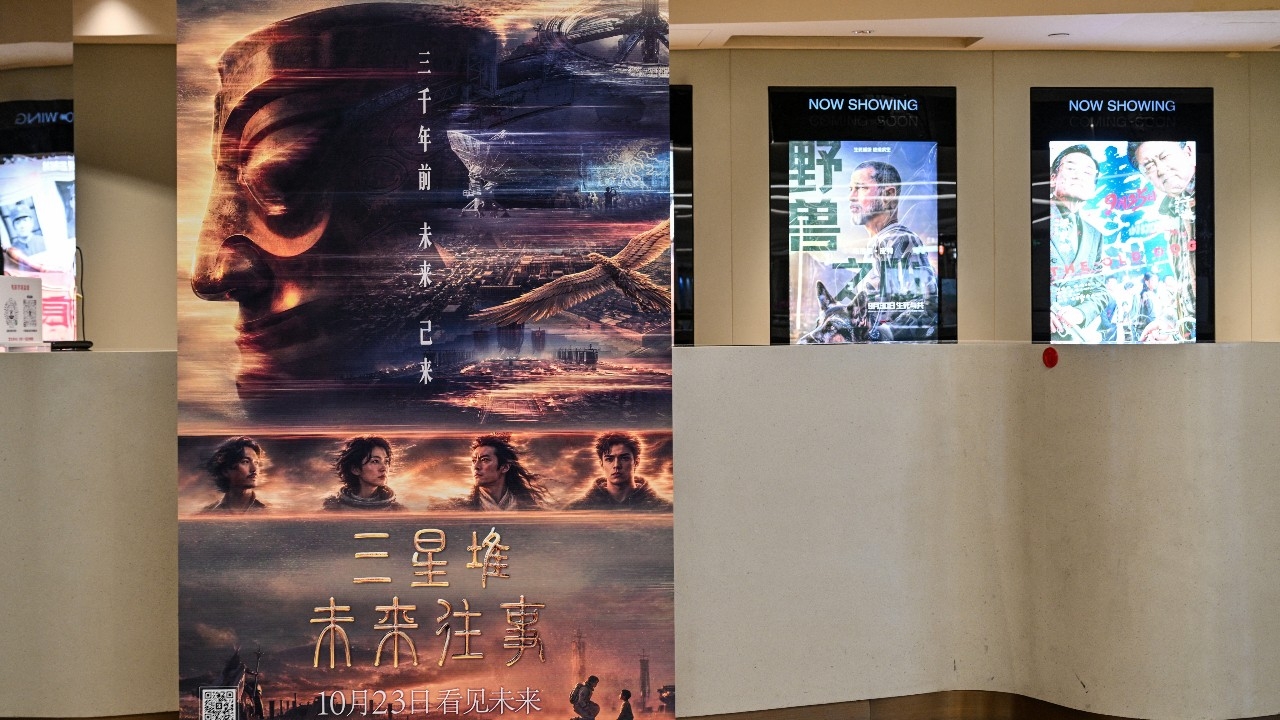
The sci-fi thriller "Sanxingdui: Future Past," a 100-minute film entirely created with artificial intelligence (AI) and the first of its kind in China, received official theatrical release approval and premiered today. However, it faced poor audience reception, resulting in sluggish advance ticket sales, despite over two years of development and a production budget of 10 million yuan.
The sci-fi thriller "Sanxingdui: Future Past," made 100% with AI, is set to premiere in Chinese cinemas today (23 Oct) amid challenges in China's tech and film industries to prove whether AI-created works can attract paying viewers.
Data from the ticketing platform Maoyan shows the film was scheduled for more than 10,000 screenings on its first day. However, advance ticket sales by Thursday evening totaled only 65,000 yuan (about 9,700 USD), with total expected ticket revenue under 100,000 yuan, a small fraction compared to the production cost exceeding 10 million yuan (about 1.5 million USD).
Jiang Defu, an executive at Bona Film Group, the film's producer, acknowledged the initial lukewarm response but said the project is pioneering new boundaries in cinema. In an interview with Chinese film industry media Yuli, he said the team was the first to attempt such a film, the first to receive a theatrical release license for this type of work, and the first to face evaluation from real audiences.
The production team revealed the film took over two years to make, involving nearly 100 collaborators and creating more than 1.2 million preliminary images. They revised and rebuilt the full film version over 100 times before finalizing it. The process was not simply AI-generated automatically but involved systematic film production steps, including scriptwriting, directing, art design, cinematography, lighting, sound, and editing, divided into 17 specialized workflows.
Jiang explained that images appearing good on mobile phones might not pass scrutiny on large cinema screens. The team thus inspected every frame, conducted test screenings, made corrections, and selected footage through multiple rounds. They also performed at least five major revisions to enhance the realism of visuals and scenes.
However, some viewers questioned the film's quality and value. Iris Yang, who attended a free special screening on Thursday, said she would not have chosen to pay for the film due to dissatisfaction with its quality. She added that if AI technology could deliver a viewing experience comparable to "Avatar," she would be willing to pay.
Independent director Zhang Jun, who uses AI in filmmaking, told AFP that audiences will not automatically pay for tickets just because a film is AI-made. Similarly, some Chinese social media users commented that while the film might gain popularity if available for free online, audiences are unlikely to pay for theatrical viewing at this stage.
This reception highlights a key issue facing the entertainment industry: as AI makes image and video creation easier, creators must find ways to convince audiences of the value and justify paying for complete works. There is also concern that rapidly advancing AI technology may render film-making techniques obsolete by the time production, which can take months or years, concludes.
Regarding the story, the film draws inspiration from the Sanxingdui archaeological site in Sichuan province, southwestern China, famous for bronze masks, sculptures, and artifacts related to an ancient civilization, much of which is still under academic study.
Producer Xu Jixiaojiang said the story uses mysterious symbols engraved on Sanxingdui bronze artifacts to connect ancient civilizations with a future where humans confront AI surpassing human intelligence. The digital characters are newly created, not replicas of real actors, and the team used archaeological research data to depict the ancient world alongside imagined futures.
Xu stated the team consulted Sanxingdui experts during development to distinguish confirmed archaeological facts from unresolved academic issues and imaginative elements for entertainment. He compared this to earlier resistance faced by the film industry when moving from stage plays to motion pictures and from film to digital cameras, times when concerns arose that new technology might erode the art's spirit.
The film has received official theatrical release authorization from Chinese authorities, setting it apart from AI videos and short works distributed online. It was also featured at the Cannes Film Festival and released trailers for international markets. The team is seeking overseas distribution channels, including Malaysia, where it will premiere simultaneously, and is negotiating with other markets like Russia and France.
The creators believe the film could attract foreign audiences both for its distinctive depiction of an ancient civilization and as an ambitious example of AI-driven feature filmmaking. However, they emphasize that technological novelty alone does not guarantee success; the goal is to engage viewers with characters and storyline rather than having them focus solely on AI-generated visuals.
Xu said that while AI gives creators easier access to tools, it also sharpens distinctions among creators. Ultimately, regardless of production technology changes, audiences still want compelling stories that are worth their time and money.