

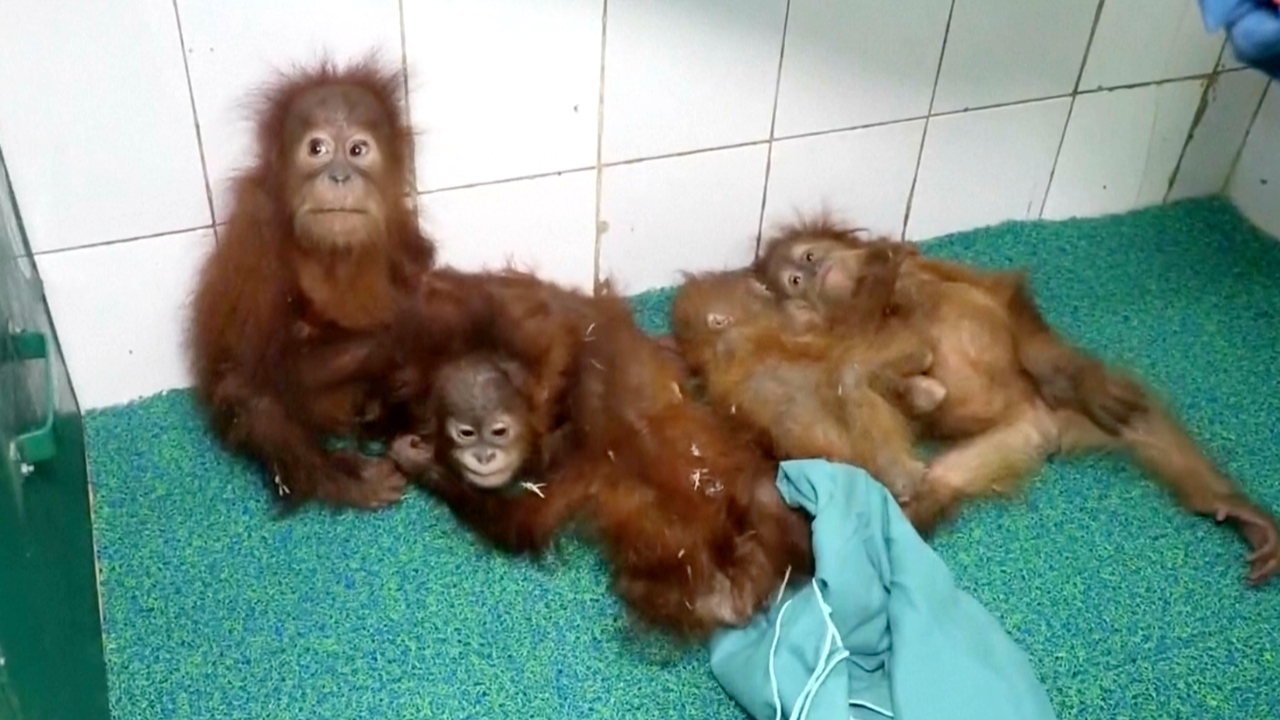
India has become a major endpoint for the illegal trade in orangutans and endangered primates. Recently, five infant orangutans were found abandoned, with experts pointing to wealthy collectors as driving the growth of this illegal market.
India is becoming one of the key destination markets for the illegal trade of rare wildlife, especially orangutans and endangered primates, after five infant orangutans were found abandoned in the Kasuarina forest park in Odisha state, eastern India, in early September 2026. This location is over 2,700 kilometers from their natural habitats on Borneo and Sumatra islands.
The five infant orangutans, comprising three males and two females aged about 6 to 8 months, surprised local villagers who first spotted them due to their red fur and unfamiliar appearance. All the animals were rescued and taken to Nandankanan Zoo in India, where caretakers played classical music to help calm the infants.
This discovery highlights the growing problem of cross-border illegal trade in rare wildlife. Experts note India is becoming a key destination market for trading primates, including orangutans and gibbons.
Sinan Serhadli, an expert on illegal wildlife trade from the Orangutan Information Center in North Sumatra, Indonesia, stated that in recent years, cross-border trade in gibbons has risen sharply, with India emerging as a main destination after efforts to crack down on domestic trafficking in Indonesia significantly reduced internal smuggling.
Uttara Mendiratta, a researcher on illegal wildlife trade in India, views demand from wealthy collectors as a key factor driving this market. These rare animals are not just kept as pets but are seen as social status symbols, fueling demand for expensive and hard-to-obtain animals, most of which cannot be legally acquired.
Orangutans Are Endangered; Separating Infants from Mothers Has Severe Impact
Orangutans are wild animals native to Borneo and Sumatra, playing a vital role in rainforest ecosystems by dispersing seeds over wide areas, promoting forest regeneration, and aiding trees in absorbing carbon, which helps mitigate climate change.
However, orangutans face severe risk of extinction due to habitat loss. According to the World Wildlife Fund (WWF), approximately 119,500 orangutans remain in the wild today.
Mendiratta explained that orangutans are evolutionarily close to humans and have low reproductive rates, with mothers caring for offspring for 8 to 9 years. Separating infants from mothers causes extreme stress and trauma and negatively affects long-term survival of wild populations.
Ongoing Illegal Smuggling of Rare Wildlife into India Detected
Indian authorities have repeatedly found illegal imports of primates. In 2022, two Sumatran infant orangutans were discovered hidden in a box at a checkpoint between Assam and Mizoram states. In 2023, another orangutan was found in Mizoram, and in November 2024, a juvenile orangutan was discovered in an apartment near Mumbai.
Additionally, analysis by the Wildlife Trust of India nonprofit found that in 2025 officials seized at least 23 gibbons at Indian airports, while in May 2026 Egyptian authorities confiscated three sedated infant chimpanzees being trafficked to India.
Experts also noted that expanding tourism and direct flights among regional cities like Bangkok and Kuala Lumpur have enabled wildlife trafficking networks to transport animals to India more quickly by air, despite risks of detection.
Legal Loopholes Enable Illegal Wildlife Trade
Although India has wildlife protection laws, these were originally focused on native animals such as elephants, rhinos, and tigers to prevent illegal export, while controls over exotic species imports, especially source verification, remain limited.
According to data from CITES (Convention on International Trade in Endangered Species), India imported 41 orangutans between 2021 and 2024. Though international commercial trade in orangutans is mostly banned, exceptions exist for captive-bred animals under specified conditions.
In 2020, India launched an online registration system allowing citizens to register exotic animals without providing proof of origin, aiming to track animals potentially posing zoonotic risks during the COVID-19 pandemic. This system allowed reporting of births, deaths, and breeding of exotic species but experts warn that limited government resources hinder thorough verification, enabling trafficked animals to be falsely claimed as legally registered.
India updated its wildlife laws in 2022 to give authorities more power to seize illegally traded exotic animals and prosecute offenders, but experts say these measures came after the exotic pet market had already grown substantially.
A 2026 report by Humane World for Animals India states that the exotic pet trade in India is linked to biodiversity loss, rising consumer demand, and organized criminal networks operating as syndicates.
Source:AP
Click to read news aboutInternational News