

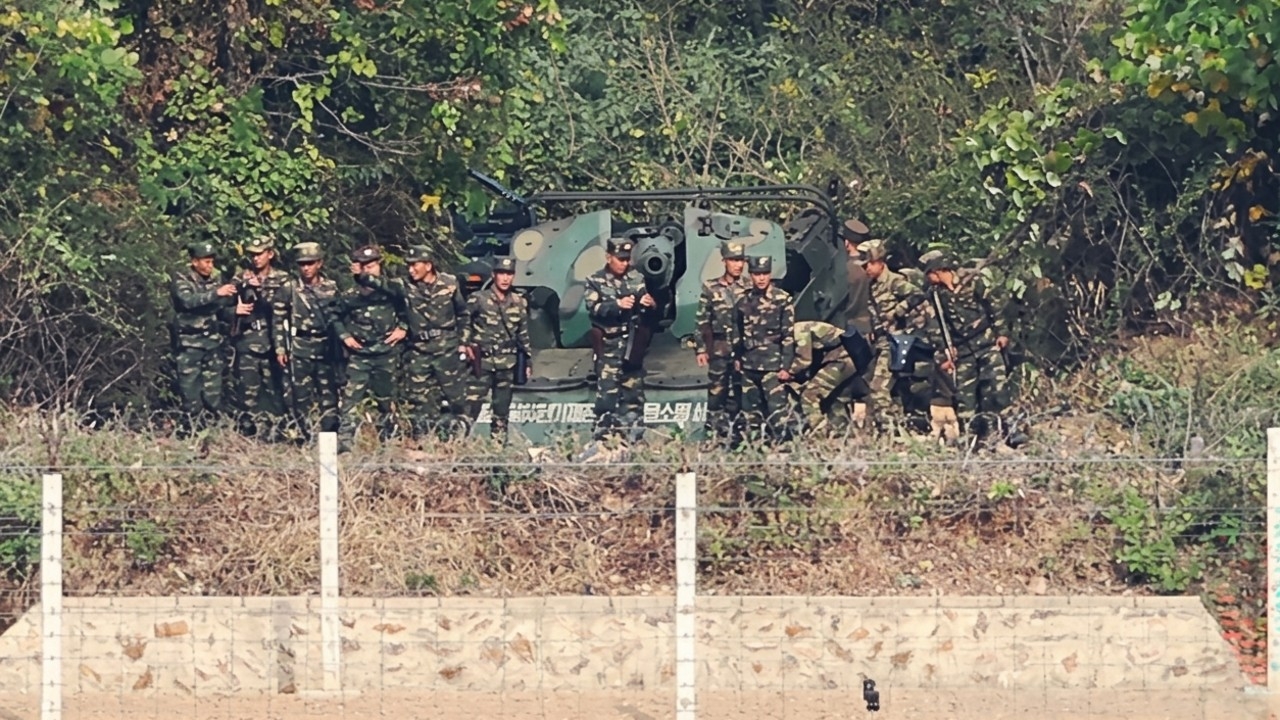
North Korea has moved artillery guns to point directly at South Korea across the Demilitarized Zone (DMZ), causing alarm among visitors at the Aegibong observation point. The South Korean military quickly sought to calm fears, stating these are merely "old-model self-propelled artillery" placed visibly as a symbolic display of strength amid verbal clashes and intensified military buildup between the two sides.
Tourists visiting the Aegibong observation point in Gimpo city, west of Seoul, South Korea, expressed concern on Tuesday after spotting North Korean armored vehicles equipped with artillery along the border, with barrels aimed south toward South Korea.
Reuters reporters noted that on Friday, 23 Oct, South Korean media photographed one such armored vehicle near the border in a clearly visible area, and by Monday, three similar armored vehicles were observed, all pointing their gun barrels toward the south.
Photographs from South Korea’s Yonhap News Agency taken from the observation point in Gimpo show what experts identify as 122-millimeter self-propelled artillery positioned along the coastal area of Kaepung in Hwanghae Province, North Korea. The Aegibong observation point is approximately 1.4 kilometers from this site.
Jang Gilsong, an 83-year-old war veteran who fought in the Vietnam War, said he had previously only seen news about North Korea moving 122-millimeter artillery on television. Seeing the actual location made him realize how close the threat is, and he expressed concern about how well South Korea is prepared to handle this situation in the future.
Hannah Robbins, a 28-year-old Canadian tourist, said her tour group was only informed about the artillery at the observation point by their guide. Although the guide reassured them that North Korea would not fire the guns, she admitted feeling uneasy about the situation.
Experts believe the weapons are likely M-1981 122-millimeter self-propelled artillery, an older North Korean system thought to have been introduced in the late 1970s, with a maximum range of about 24 kilometers, placing parts of South Korea, including Gimpo city, within firing distance.
Yang Uk, a military expert from the Asan Institute for Policy Studies in Seoul, assessed that this artillery movement is more a symbolic demonstration of power than a significant enhancement of combat capability. Positioning the weapons in visible locations indicates that North Korea wants its adversaries to notice this activity.
South Korea’s military echoed this view. Jang Do-Young, spokesperson for South Korea’s Joint Chiefs of Staff, stated in a briefing that North Korea has positioned old-model artillery openly along the coast. Although North Korea has mentioned new weapons systems in recent statements, South Korea’s military does not consider the detected artillery to be new weaponry.
Photos also show propaganda slogans painted on the armored vehicles, reading: “Destroy the imperialist American aggressors, the sworn enemies of the Korean people.” Several North Korean soldiers holding red flags were seen near the vehicles, likely part of military drills.
This development comes amid heightened tensions along the DMZ, which separates North and South Korea. Both sides have increased military measures and responded with sharp statements following a landmine explosion in the border area in September that injured three South Korean soldiers. South Korea demanded an apology from North Korea, while Pyongyang accused Seoul of fabricating the incident.
Last week, Kim Yo-jong, sister of North Korean leader Kim Jong-un, warned that North Korea would soon install loudspeakers along the border to broadcast anti-South Korean propaganda and announced undisclosed additional countermeasures after South Korea began broadcasting warnings and firing warning shots near the border.
In recent months, North Korean forces have also been constructing tactical roads and fences along the border as part of efforts to strengthen defenses, aligning with Kim Jong-un’s policy to define inter-Korean relations as those between “two hostile states.”
Although North Korea has steadily reinforced the border, placing heavy weapons in visible positions near the border line, directly observable from South Korea, is unusual and has raised concerns among observers.
The DMZ remains a tourist destination for South Korean and international visitors, despite periodic tensions. Technically, the two Koreas remain at war, as the Korean War ended in 1953 with an armistice agreement but no formal peace treaty has been signed.