

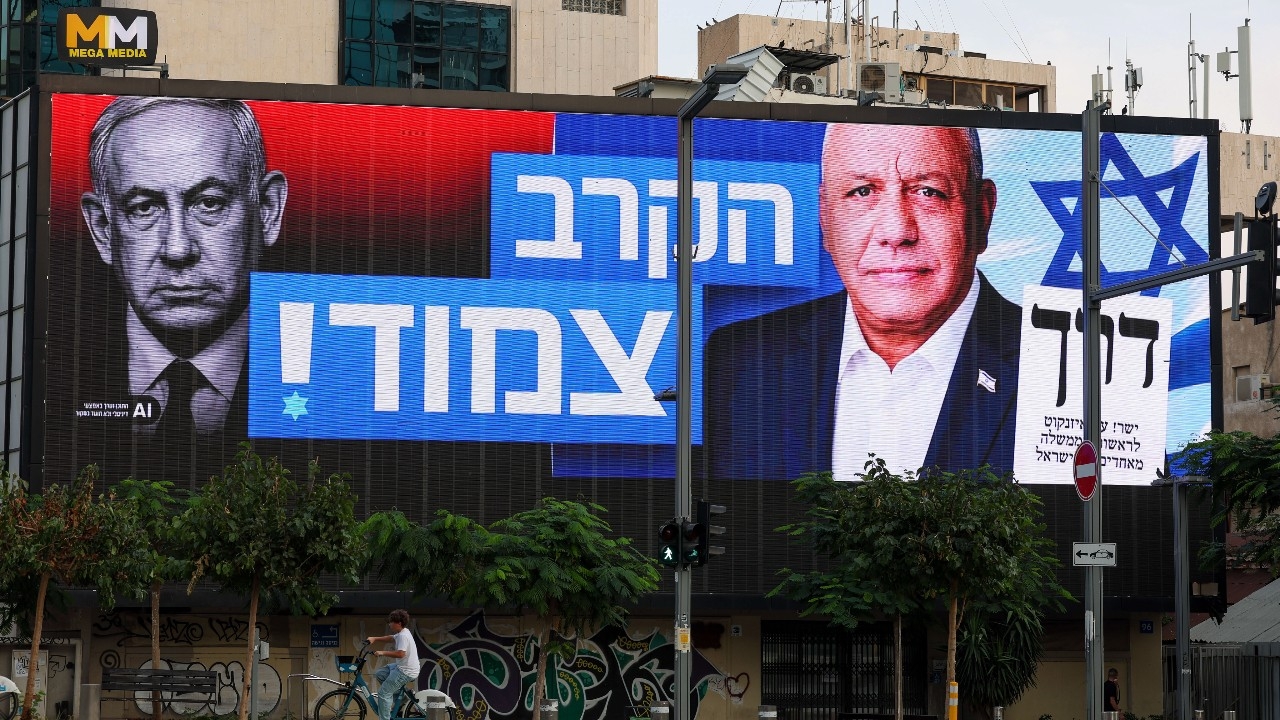
Israelis went to the polls amid deep political divisions following multiple wars sparked by Hamas' attack on 7 Oct 2023. Recent polls show current Prime Minister Benjamin Netanyahu and former military chief and Yesh Atid leader Gadi Eisenkot have nearly equal popularity, but no political bloc is expected to secure a majority alone, making government formation likely to take weeks or months.
Israelis voted today (27 Oct) in an election closely watched as potentially one of the most important in the country's history. It was the first election since Hamas launched attacks on 7 Oct 2023, which killed nearly 1,200 people and took 251 hostages to the Gaza Strip.
The election occurs amid intense societal divisions in Israel after nearly three years of ongoing multi-front wars in the Middle East. Security concerns, accountability for failure to prevent the attacks, democratic direction, and the role of religion in the state have become key campaign issues.
The final pre-election polls showed Prime Minister Benjamin Netanyahu, who has served a combined total of over 19 years, closely matched in popularity by former military chief Gadi Eisenkot, a newcomer to politics and leader of the Yesh Atid party founded last year.
However, polls predict that both Netanyahu's supporters and opposition groups are unlikely to secure at least 61 of the 120 parliamentary seats, meaning coalition talks could take weeks or months. Failure to form a government could lead to new elections.
The opposition attacks Netanyahu mainly over the massive security failure that allowed Hamas' 7 Oct 2023 attack, the deadliest day in Israel’s history.
The opposition calls for a state-level independent inquiry into the failures, but Netanyahu's government has consistently opposed this, with the prime minister arguing the process could be biased against him.
Despite criticism over security failures, Netanyahu emphasizes his security experience during the campaign, citing what he calls Israel’s strategic military successes across the Middle East and close ties with U.S. President Donald Trump, asserting he is the leader capable of protecting Israelis.
Since the October 2023 attacks, the Israeli military has waged war across multiple fronts, including operations in the Gaza Strip, control of southern Lebanon, and attacks on Iran with U.S. support. Israelis have faced attacks from Iran, Hamas, Lebanon's Hezbollah, and Yemen's Houthi rebels.
Israel’s military operations in Gaza have drawn increasing international condemnation and strained relations with many allies. Gaza’s Hamas-run health ministry reports over 74,000 deaths from the war, a figure the United Nations considers credible.
Israel continues near-daily strikes on Gaza despite a ceasefire agreement last year, with the Israeli military stating its operations target Hamas members.
Eisenkot is a key figure in the 'Change Bloc,' a political coalition including parties from right to center-left, united by the goal of ending Netanyahu’s rule.
Other notable figures in this bloc include former Prime Minister Naftali Bennett, right-wing security hardliner Avigdor Lieberman, and left-leaning former general Yair Golan.
Eisenkot shares many positions with Netanyahu, especially regarding Gaza. He pledges to end Hamas’ rule within 18 months through a U.S.-led peace plan or military force if necessary. He opposes establishing a Palestinian state and supports Israeli settlements in the occupied West Bank, which are considered illegal under international law.
However, Eisenkot promises to crack down on extremist Jewish settlers who commit violence against Palestinians, incidents that the UN reports have reached record levels. He also mentions creating conditions for limited Palestinian self-governance under Israel’s final security control.
The idea of an independent Palestinian state coexisting peacefully with Israel, or the two-state solution, has nearly vanished from Israel’s mainstream political discourse today.
The opposition also accuses Netanyahu of policies undermining democracy. He faces ongoing corruption trials, which he denies, and has pushed controversial judicial reforms that sparked major protests before the October 2023 attacks.
Another key issue is military conscription. Netanyahu’s government faces criticism for not enforcing a Supreme Court ruling requiring ultra-Orthodox Jewish men studying full-time in religious institutions to serve in the military like other citizens.
This issue causes significant division as the military seeks more personnel amid ongoing war, while ultra-Orthodox religious parties in government try to preserve conscription exemptions for religious students.
Netanyahu’s return to power depends on maintaining alliances with far-right and ultra-Orthodox Jewish parties, key components of the current government, regarded as Israel’s most right-wing administration historically.
National Security Minister Itamar Ben-Gvir and far-right Minister Bezalel Smotrich play major roles in government and lead their own parties. Both support religious nationalist policies and Israeli settlements.
Arabs make up about one-fifth of Israel’s population, many identifying as Palestinian citizens of Israel. Two Arab political blocs are contesting the election and could theoretically play a kingmaker role if results are close.
However, almost all major Jewish parties reject coalition with Arab parties. Neither Eisenkot nor Netanyahu has declared willingness to cooperate with them, while Lieberman, a potential opposition ally, opposes minority governments relying on Arab party support.
Yousef Jabareen, leader of one Arab-based party, told AFP he hopes for high Arab voter turnout to help change the government, casting his vote in Umm al-Fahm in northern Israel.
About 7.3 million Israelis are eligible to vote, including hundreds of thousands of first-time young voters. Polls show this younger group mostly leans center-right to right-wing politically.
Meanwhile, some 70,000 Israelis reportedly returned from abroad to vote, reflecting the election’s perceived importance for the country’s future direction.
Most polling stations close at 22:00 local time, after which Israeli TV will release exit polls that may give early indications of results, though these could differ significantly from official counts.
Netanyahu’s party plans to watch results in Jerusalem, while Eisenkot’s Yesh Atid will do so in Tel Aviv. Final results may take days because hundreds of thousands of soldiers and reservists vote later, with their ballots starting to be counted Wednesday, potentially affecting right-wing party shares.
Although seen mainly as a contest between Netanyahu and Eisenkot, other politicians could become prime minister if they build coalition support, especially if parties refuse to back a coalition without their leader as PM.
A major risk is political deadlock, where no bloc gains a majority and no minority government forms. In that case, Israel might hold new elections, with Netanyahu remaining caretaker prime minister.
Israel has faced government formation difficulties several times; from 2019 to 2022, it held five elections due to parties’ inability to form stable coalitions.
This election will not only decide Netanyahu’s political future but also reflect Israeli divisions over security, accountability for the major attacks, democratic direction, and the country’s role in the Middle East.