

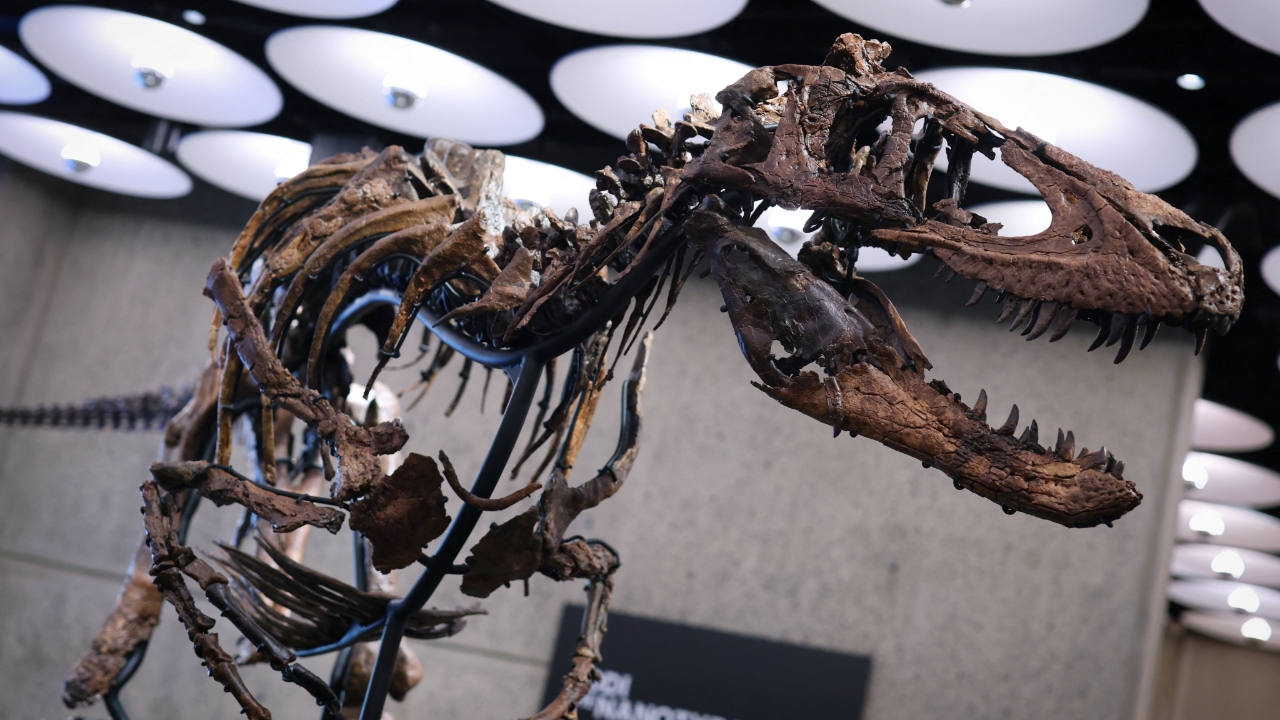
The fossilized skeleton of a "Nanotyrannus" dinosaur has been auctioned off for over 1.6 billion baht amid debates on whether such a rare fossil will disappear from public view.
Foreign news agencies reported on 27 Oct 2026 that the "Nanotyrannus" dinosaur skeleton, recently officially recognized as a new species, was auctioned for 47.3 million U.S. dollars (around 1.6 billion baht) after six bidders competed for 12 minutes. The identity of the winning bidder has not yet been disclosed.
Sotheby's auction house in New York described 'Jodi' as an "extremely valuable and exhibition-ready" skeleton and the first example to enter the market since the species confirmation.
This skeleton, nicknamed "Jodi," stands about 3 meters tall, comprises approximately 191 well-preserved bone pieces, and has a nearly complete skull. It is one of only three Nanotyrannus skeletons found worldwide and the first to be auctioned.
The skeleton was first discovered by a ranch owner named Jodi Pearson in the Hell Creek Formation in Montana, USA, and excavated by private paleontologist Clayton Phipps.
Initially, the bones were mistaken for a juvenile Tyrannosaurus rex until 2025 research confirmed they belonged to a separate species, ending decades of debate.
Megan Jenkins, a paleontologist from the University of Portsmouth, said, "For a long time, Nanotyrannus was thought to be a juvenile T. rex, but actually it is smaller, more slender, with blade-like teeth for slicing meat."
The auction of dinosaur fossils to billionaires for private collections is raising concerns that valuable fossils may be stored away in private safes rather than displayed in museums for public and scientific benefit.
Professor Steve Brusatte, a paleontologist from the University of Edinburgh and consultant for the Jurassic Park films, said he feels "deeply saddened" that Jodi might disappear from public view.
"We just learned that Nanotyrannus truly exists, but now one of the best skeletons is being sold to the highest bidder. It is sad to think it might vanish into a collector’s safe instead of being exhibited in museums to inspire children, families, and the public," Professor Brusatte said.
However, some experts see it as normal for fossil excavators to seek high prices due to the enormous time, effort, and funding required. Many auctioned fossils eventually end up donated or displayed in museums.
"Although it’s concerning that fossils are auctioned, many pieces ultimately become publicly accessible. These will definitely be exhibited in museums eventually," Jenkins said, adding she understands why excavators want to sell fossils at high prices given their investments.
Follow international news:https://www.thairath.co.th/news/foreign
Source:bbc