

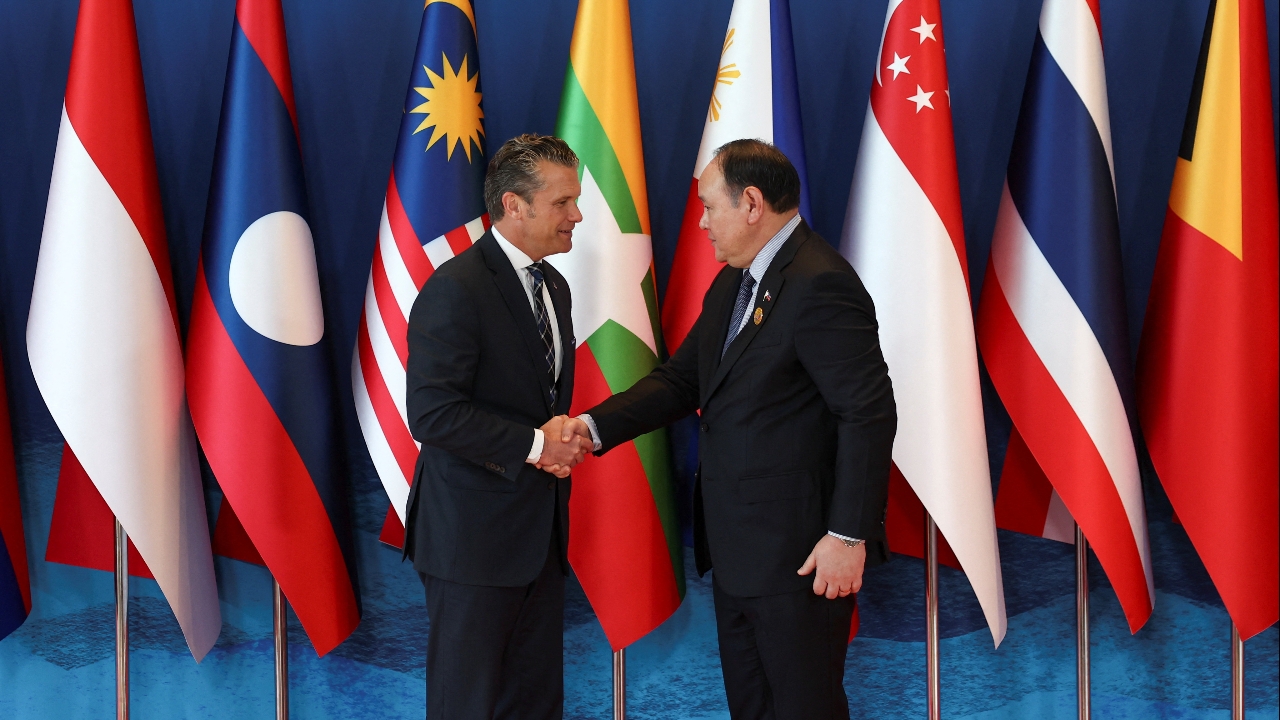
U.S. Defense Secretary Pete Hegseth reaffirmed the U.S. government's commitment to the Indo-Pacific region at the ASEAN Defense Ministers meeting held in Cebu, Philippines, from 28-29 October, amid the Iran war pressuring U.S. military readiness and escalating tensions with China.
The U.S. Department of Defense stated that Hegseth’s participation underscores America’s commitment to the Pacific region under the approach called "Peace Through Strength."
Hegseth said, "These are not just symbolic acts but tangible proof of what serious partners must do." He added, "Serious partners train together, learn together, plan together, and build the trust and capabilities necessary to deter conflict."
The Defense Secretary described the U.S. approach as "strong, measured, and clear," explaining it is "strong enough to deter coercion and aggression," measured enough to avoid "escalating conflict or unnecessary public displays," and clear enough that friends and potential adversaries understand U.S. positions. He stated, "We will protect our interests and those of our allies and partners, which by definition is peace through strength."
However, security analysts believe Southeast Asian nations may take the opportunity to meet with Hegseth on the sidelines to seek clarity on the U.S.'s ultimate goals in the Iran war, its expectations of allies and partners, and its capacity to uphold security commitments in the Indo-Pacific while addressing Middle East conflicts.
Collin Koh, a security scholar at the S. Rajaratnam School of International Studies in Singapore, said countries want clear answers from the U.S. about alliance certainty and cooperation, questioning how the Middle East conflict will affect U.S. commitment to the Indo-Pacific and Western Pacific regions.
The Iran war, initiated by U.S. and Israeli strikes on 28 February, has impacted international shipping and oil markets, exposing Southeast Asian countries reliant on fuel imports to risks from volatile energy prices and supply, making energy security a key ASEAN concern.
Meanwhile, the conflict between the Philippines and China complicates the meeting, which aims to promote dialogue and concrete security cooperation.
Greg Poling, director of the Asia Maritime Transparency Initiative, said the meeting offers Hegseth a chance to discuss China, South China Sea disputes, and U.S. treaty obligations. Many countries seek assurance that the U.S. will continue prioritizing the region despite political turmoil and that the Iran war may affect military capabilities and readiness.
This issue is particularly important for the Philippines, a U.S. treaty ally, whose relations with China have deteriorated due to multiple encounters in disputed South China Sea areas, Chinese sanctions on senior Philippine defense officials, and recent summons of the Philippine ambassador by China.
The Chinese Ministry of Defense stated that China’s military attaché to the Philippines will attend the meeting. Days before, the Philippine military reported tracking and monitoring China’s aircraft carrier Liaoning as it passed through southern Philippine waters en route to the Celebes Sea.
Poling added that cooperation with aligned positions is likely to be discussed more clearly in meetings among like-minded partners, such as the security cooperation group comprising the U.S., Japan, Australia, and the Philippines, which plans a defense chiefs meeting on 28 October.
Ahead of the ASEAN Defense Ministers meeting, Hegseth proposed establishing a new "U.S.-ASEAN Defense Cooperation Framework," describing it as an ambitious framework to guide collaboration in the critical coming years for the region.
Hegseth praised the practical approaches and national pride of countries in the region, noting that the U.S. does not need to agree with every country on all issues but should cooperate on shared interests.
He stated that the U.S. is ready to start this initiative as Singapore prepares to chair the ASEAN Defense Ministers Meeting-Plus (ADMM-Plus) next year, though he has not disclosed details of the proposed framework.
The ADMM-Plus includes 11 ASEAN member states and dialogue partners like the U.S., Japan, China, and Australia, serving as a platform to discuss and promote regional security cooperation.
Hegseth also called for enhancing Maritime Domain Awareness and upgrading cooperation among navies, saying joint exercises, learning, and planning demonstrate serious alliance collaboration and build trust and capabilities needed to deter conflict.
Previously, Hegseth met with Japanese Defense Minister Shinjiro Koizumi on the sidelines in Cebu, discussing the need for effective defensive measures to prevent attacks along the First Island Chain, the island arc between China and the Pacific Ocean.
Both countries pledged closer coordination in weapons and ammunition production, reflecting efforts by the U.S. and allies to strengthen defense capabilities amid regional security challenges.
While the sideline talks may allow countries to voice security concerns frankly, analysts expect the ASEAN chair’s post-meeting statement to use cautious language consistent with ASEAN's traditional diplomatic tone.
Koh noted that the Philippines chairing ASEAN amid disputes with China is a sensitive situation. Poling pointed out that the Philippines must balance advancing future cooperation—such as energy connectivity, digital economy, and coast guard collaboration—with rising tensions with China and stalled progress on South China Sea codes of conduct.
Poling expects ASEAN to continue practical cooperation under the ADMM framework but is unlikely to adopt a unified strategic stance on the South China Sea or other sensitive disputes.
This meeting is a crucial test of U.S.-ASEAN defense cooperation and the member states’ ability to maintain regional collaboration amid great power competition, Middle East conflicts, and uncertainties in energy and security.