

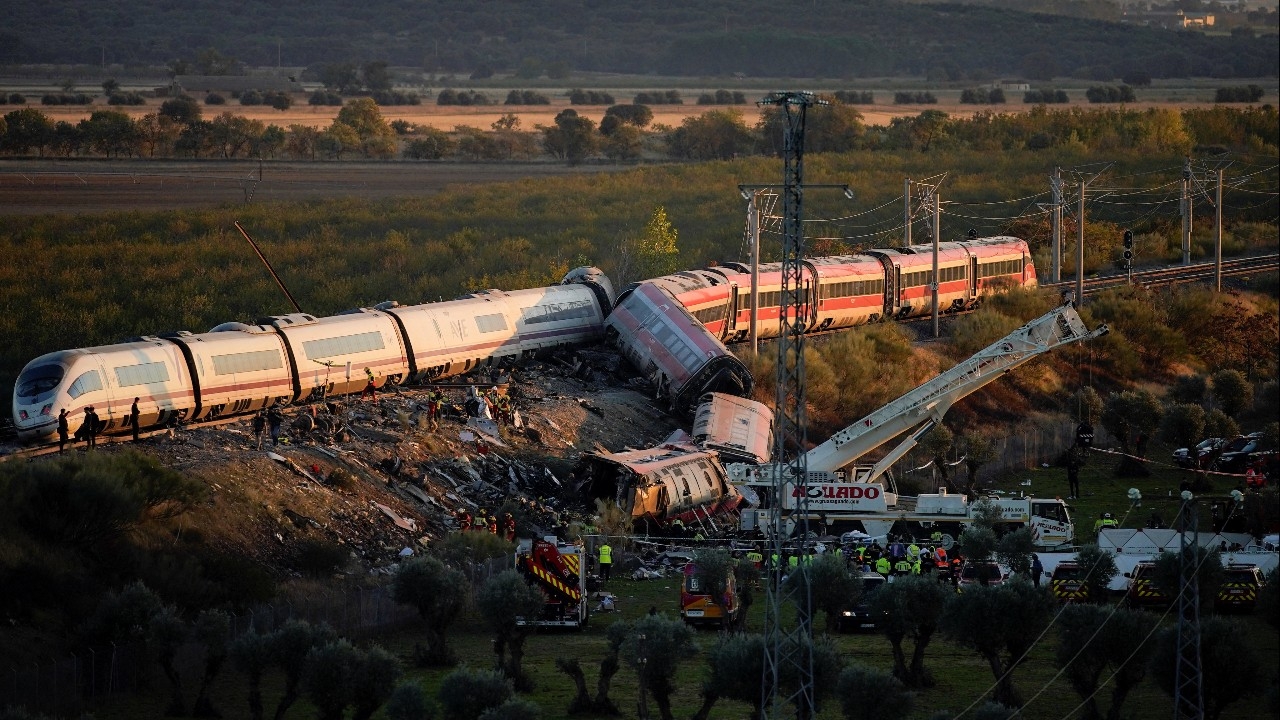
Spain's Prime Minister ordered nationwide mourning following one of the deadliest train accidents in European history. Authorities are urgently identifying the victims and investigating a failure in the train control system.
Spain began a three-day national mourning period after a severe train collision killed at least 68 people and injured dozens more. This is one of the worst train disasters in modern European history, as rescue teams worked through the night to find victims possibly trapped inside twisted train cars.
Emergency workers used specialized tools to cut through the metal structures of the train cars under large floodlights. Some victims remain unidentified, while hundreds of officials, aided by drones and helicopters, continue searching for survivors and clearing debris.
Prime Minister Pedro Sánchez expressed deep sorrow over the tragedy, stating that the entire country mourns the loss, acknowledging lives lost, broken families, and profound grief.
The accident happened Wednesday morning when a train traveling from Madrid to Seville rear-ended another train stopped on the tracks, causing several cars to derail and fall down an embankment.
Oscar Puente, Spain's Transport Minister, revealed that the stationary train was operated by the private company Iryo and carried 147 passengers. It had stopped due to a computer system failure. He explained that normally a 24-hour control center in Madrid would manage the situation, but a command was given to move the train without speed limits, calling it an inexplicable mistake.
Meanwhile, recordings of communications between train controllers and drivers appear to show permission was granted for a high-speed train to proceed despite another train being stopped ahead. The exact cause of the accident remains under investigation.
Iryo stated their train was rear-ended by a Renfe train, the state rail service operator, carrying 397 passengers. The impact caused multiple train cars to fall down the embankment beside the tracks.
Witnesses described seeing passengers crying and bleeding, many trapped in their seats, while smoke filled the passenger cars and one car caught fire.
Prime Minister Sánchez said it was unacceptable that Spain faced two major train accidents in one year. The earlier crash near Córdoba in January killed 46 people on the same route but further south.
The tragedy sparked calls for accountability, with most political parties suspending election campaigning except the far-right Vox party. Vox leader Santiago Abascal said his party would not participate in what he called efforts to silence critics of Spain’s rail infrastructure during mourning.
On Wednesday night, about 1,500 protesters gathered outside the Ministry of Transport in Madrid, mostly demanding the resignation of Sánchez and the transport minister. Police used tear gas to disperse the crowd after protesters threw bottles and fireworks. No injuries or arrests were reported.
The Spanish train drivers’ union confirmed a planned strike for Thursday will proceed to demand safer rail operations. Opposition leader Alberto Núñez Feijóo said Spaniards have the right to know what is happening with the country’s infrastructure.
Families of missing passengers continue seeking news as Spain’s Civil Protection set up centers in Madrid, Toledo, Seville, and Córdoba to register missing persons. DNA samples are being collected to help identify victims and coordinate with relatives.
Residents of Toledo near the crash site held a moment of silence for the victims, while the European Union flag in Brussels flew at half-mast to show solidarity with Spain in this time of mourning.
This accident is the deadliest train collision in Spain since 2013, when 80 people died in a derailment near Santiago de Compostela in the northwest.
. . .BBC
Click to read related newsInternational News