

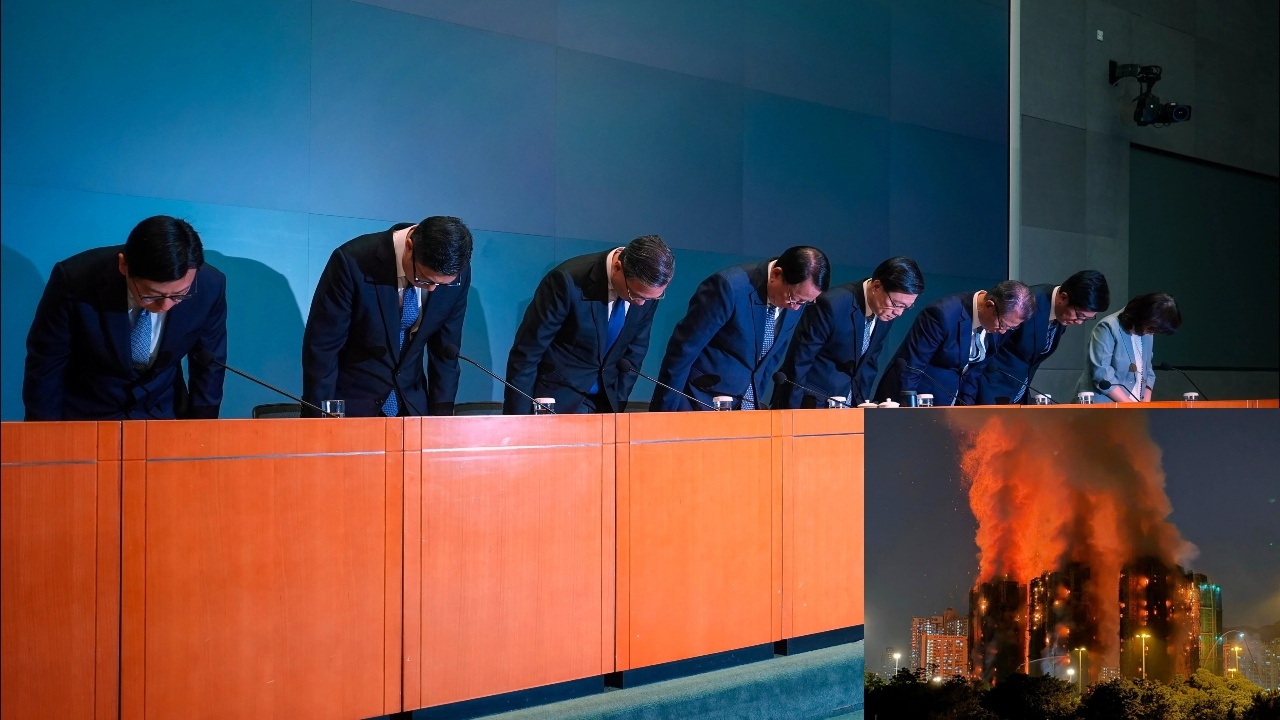
John Lee, Chief Executive of the Hong Kong Special Administrative Region, apologized to the public for the Wang Fu Court residential building fire on 26 November 2025, more than 11 months after the incident that caused 168 deaths. Meanwhile, the Secretary for Housing resigned after an investigation report identified responsibility among four government agencies for the losses. The government announced reforms to laws and building safety oversight systems, including measures to prevent bid-rigging.
John Lee, Chief Executive of the Hong Kong Special Administrative Region, issued a formal apology and bowed to the public and those affected after a judicial-led inquiry committee released its report on the cause of the major fire at the Wang Fu Court residential building on 26 November 2025. The fire claimed 168 lives and is the deadliest residential building fire disaster worldwide since 1980.
Responding to media criticism about the apology coming more than 11 months late, John Lee explained that immediately after the incident, the priorities were to assist victims, provide temporary housing, and investigate perpetrators. Once the complex fact-finding investigation concluded, this was the most appropriate time to formally apologize to the public and urgently push for systemic reforms to prevent such a tragedy from recurring.
The investigation report concluded that the tragedy resulted from systemic failures and neglect by both private sector and government agencies. Deficiencies included delays, carelessness, and a lack of "crisis awareness" in risk assessment. The fire likely started from a still-burning cigarette igniting paper materials at the external building joint. Almost all fire safety systems inside the building were nonfunctional due to human error. Of the total fatalities, 114—about 70%—were elderly aged 65 or older.
The investigation identified four government agencies jointly responsible: the Independent Checking Unit (ICU) under the Housing Bureau, the Buildings Department, the Fire Services Department, and the Labour Department. The ICU was singled out as bearing the greatest responsibility due to inadequate contractor oversight.
Consequently, Winnie Ho, Secretary for Housing, submitted her resignation to take political responsibility, which John Lee approved. Michael Wong, Chief Financial Officer, was appointed as acting Secretary for Housing temporarily. The government announced the dissolution of the ICU and the establishment of a new agency to oversee all public housing projects.
Additionally, John Lee stated that the government has initiated disciplinary investigations under accountability systems for second-tier civil service heads to examine whether officials in the four agencies violated regulations or ethics. Results are expected within three months to impose disciplinary actions. On the criminal side, authorities have prosecuted seven individuals and two companies for negligence causing death, with at least 35 related arrests made.
To address corruption and safety standard compromises in building renovations, Paul Lam Ting-kwok, Secretary for Justice, announced an overhaul of three laws. The Competition Ordinance will be amended to make bid-rigging a criminal offense covering all renovation project phases, including initial work and consultancy services, alongside existing offenses such as price-fixing. Maximum penalties could include 10 years imprisonment and fines of HKD 10 million or up to three times illicit gains or 50% of company profits, per legal provisions.
Furthermore, the government will add bid-rigging offenses to the schedule of crimes under the Organized and Serious Crimes Ordinance to enhance investigative powers and asset seizure. Amendments to the Independent Commission Against Corruption (ICAC) law will increase anti-corruption investigative authority.
The government also established a new agency to support building repair and renovation for homeowners, with an initial budget allocation of HKD 300 million. This agency will provide oversight and advice to the public undertaking renovations to prevent contractor collusion and corruption.
Chris Tang Ping-keung, Secretary for Security, announced that the Fire Services Department will establish a new Major Fire Prevention Operations Zone dedicated to emergency planning for high-risk scenarios. Authorities are also exploring developing a mobile app to alert the public promptly in case of fires.
Tang stated that the government has amended laws to require legal approval before suspending or shutting down fire protection systems, with each suspension limited to 60 days. Buildings undergoing major renovations will be inspected with a focus on risk; if fire alarm systems are found defective, work will be ordered to stop.
Proposals include changing fire protection system contractors' registration from permanent to mandatory renewal every five years and granting authorities the power to revoke licenses of contractors committing serious violations.
Chris Sun Yuk-han, Secretary for Labour and Welfare, said the Labour Department has deployed robots equipped with infrared cameras to enhance construction site inspections and detect smoking.
The Labour Department will study using artificial intelligence (AI) to assist field officers in identifying individuals smoking at construction sites and requests public cooperation in submitting photos of workers violating laws. Sun stated that if necessary, the government will amend laws further and increase penalties.
/sourceSouth China Morning Post