

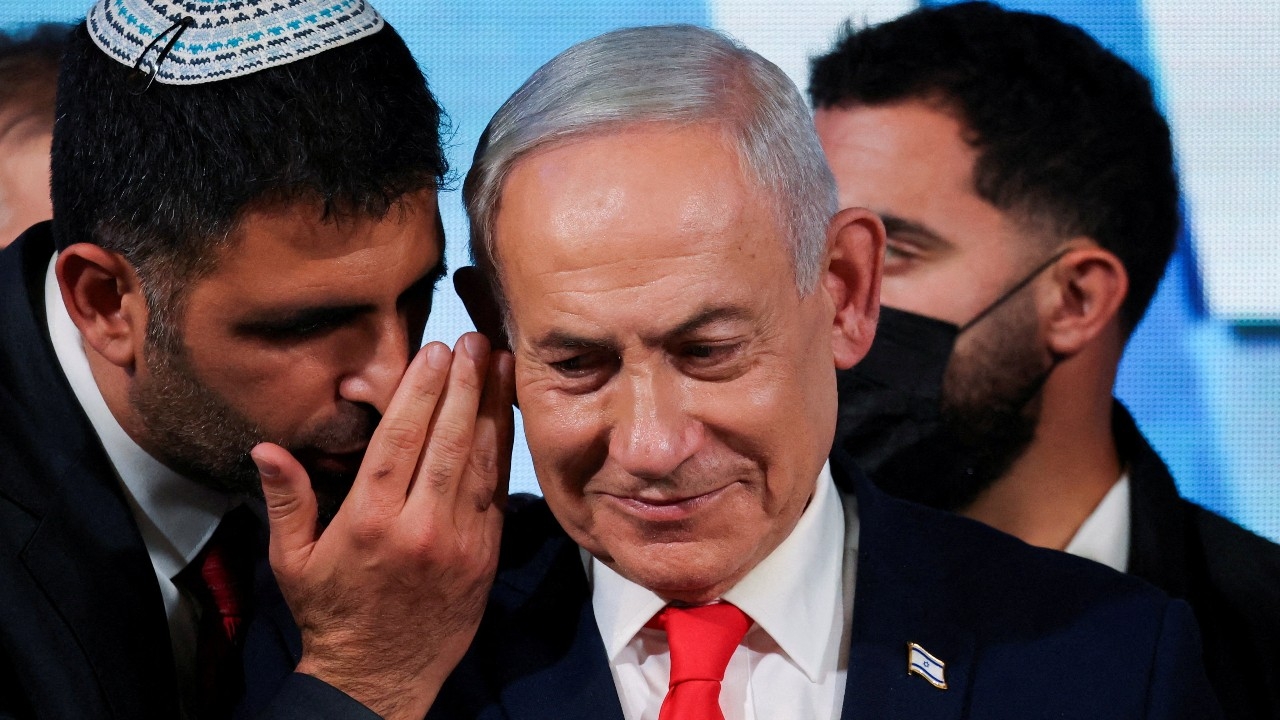
Gadi Eisenkot, Israel's main opposition leader, along with political leaders from the Arab Joint List party, condemned Prime Minister Benjamin Netanyahu for accusing foreign interference following the elections, which caused his coalition to lose its majority. Netanyahu's Likud party accused the Arab-led political parties of "stealing" the election. Meanwhile, internal security agencies are investigating allegations that they received illegal funding from Qatar and Turkey.
The official results of Israel's general election confirmed that Prime Minister Benjamin Netanyahu's right-wing and far-right coalition won 53 of the 120 seats in the Knesset. Netanyahu's Likud party remains the largest single party in the bloc, securing 27 seats.
The opposition group led by Gadi Eisenkot won 48 seats, while two Arab political parties—the Joint List and Ra’am—secured a combined total of 19 seats, the highest ever. This gives both groups potential key roles in forming the next government.
The fragmented election results mean no side has the minimum 61 seats needed for a majority to form a government. This could lead to prolonged coalition negotiations lasting several weeks, with the possibility of new elections if talks fail.
As election results became clearer, Likud and Netanyahu accused Arab political parties of possibly receiving foreign funding to sway or buy votes, particularly alleging Ra’am received money from Qatar to encourage voter turnout among Arab communities.
Likud described the scandal, dubbed "Raamgate," as a "political earthquake," accusing the election of being "stolen" and calling it an attack on democracy aimed at toppling the right-wing government.
These allegations arose after the head of Israel's Central Elections Committee requested that the Shin Bet, the country's internal security agency, investigate serious suspicions of foreign interference. Israeli media reported that the committee received claims that Qatar provided funding to increase voter turnout in Arab communities.
Shin Bet confirmed it is investigating suspicions of irregularities but clarified that the inquiry is not intended to accuse or blame the entire Arab community that legally and democratically participated in the vote.
Dean Livneh, acting director-general of the Central Elections Committee, stated there is no evidence to support claims of systematic electoral fraud, and broad allegations lack any substantiated proof.
Both Arab political groups firmly denied the accusations. Ra’am affirmed it committed no wrongdoing, while the Joint List called the claims baseless and accused Netanyahu and his allies of orchestrating a fear campaign against the growing political influence of Arab citizens.
Gadi Eisenkot, the opposition leader, who received reports regarding the Shin Bet and election committee investigations, said it is too early to conclude what actually happened. However, he accused Likud and Netanyahu of launching a coordinated campaign to delegitimize the election results.
Critics of Netanyahu view the foreign interference allegations as an attempt to undermine the credibility of the Arab Joint List and to pressure Eisenkot politically, preventing him from forming alliances with those parties, despite their support being crucial for his potential government formation.
Sami Abu Shehadeh, head of the Balad party within the Joint List, rejected the accusations, saying the defeated side is making racially biased allegations and urging security agencies not to use force to overturn the election outcome.
Mansour Abbas, leader of the Ra’am party, denied any wrongdoing and expressed willingness to cooperate with investigations. Israeli officials have yet to present any evidence to support the foreign funding claims.
Qatar's Ministry of Foreign Affairs strongly denied the allegations, calling them "absurd and harmful" and accusing Israeli politicians of conducting a disinformation campaign against Doha.
The Qatar allegations emerged amid longstanding scrutiny of Netanyahu's ties to the country. Last year, two of his aides were arrested on charges related to receiving funds from Qatar.
Netanyahu, Israel's longest-serving prime minister, had previously tacitly supported Qatar's financial aid to Hamas in Gaza, hoping to stabilize the region. However, this approach collapsed after the October 7, 2023, attacks on Israel.
In recent days, Netanyahu repeatedly attacked Arab voters and the Joint List. On election day, he posted multiple social media messages warning that high Arab turnout was an "emergency" and a "matter of life and death" for Israel's right wing. He also shared AI-generated images depicting Arab voters at polling stations to mobilize right-wing supporters.
Arab Israelis, many of whom identify as Palestinians with Israeli citizenship, make up about one-fifth of the country's population. Historically, many Arab citizens boycotted Israeli elections, viewing voting as legitimizing a system that treats them as second-class citizens.
However, this election saw increased Arab voter participation, motivated by a desire to unseat Netanyahu's coalition, regarded as the most right-wing government in Israel's history.
The election results present three possible government formations: a national unity government including both Netanyahu and Eisenkot; a right-wing coalition led by Netanyahu incorporating some opposition members; or a government led by Eisenkot with support from Arab parties.
Previously, Eisenkot and most opposition members rejected forming a government with Arab parties. Yet, in recent days, speculation has grown about a possible political agreement between them.
A snap poll conducted by the Hebrew University found that the most popular option among opposition supporters is for Eisenkot to form a minority government with Ra’am's participation, supported externally by the Joint List.
Meanwhile, Yousef Jabareen, head of the Joint List, told AFP he is willing to cooperate with the opposition to unseat Netanyahu but does not want to be part of the government.
Regarding fraud allegations during voting, Netanyahu previously claimed that Arab parties were caught handing out cash envelopes. Likud continued to spread these claims throughout Thursday. Police arrested three suspects, but the Central Elections Committee clarified that these were isolated incidents, not widespread problems.
These developments pose significant challenges for Israel's coalition negotiations, both due to the lack of a clear majority and political disputes over the role of Arab parties, which could be crucial in determining the next government's direction.