

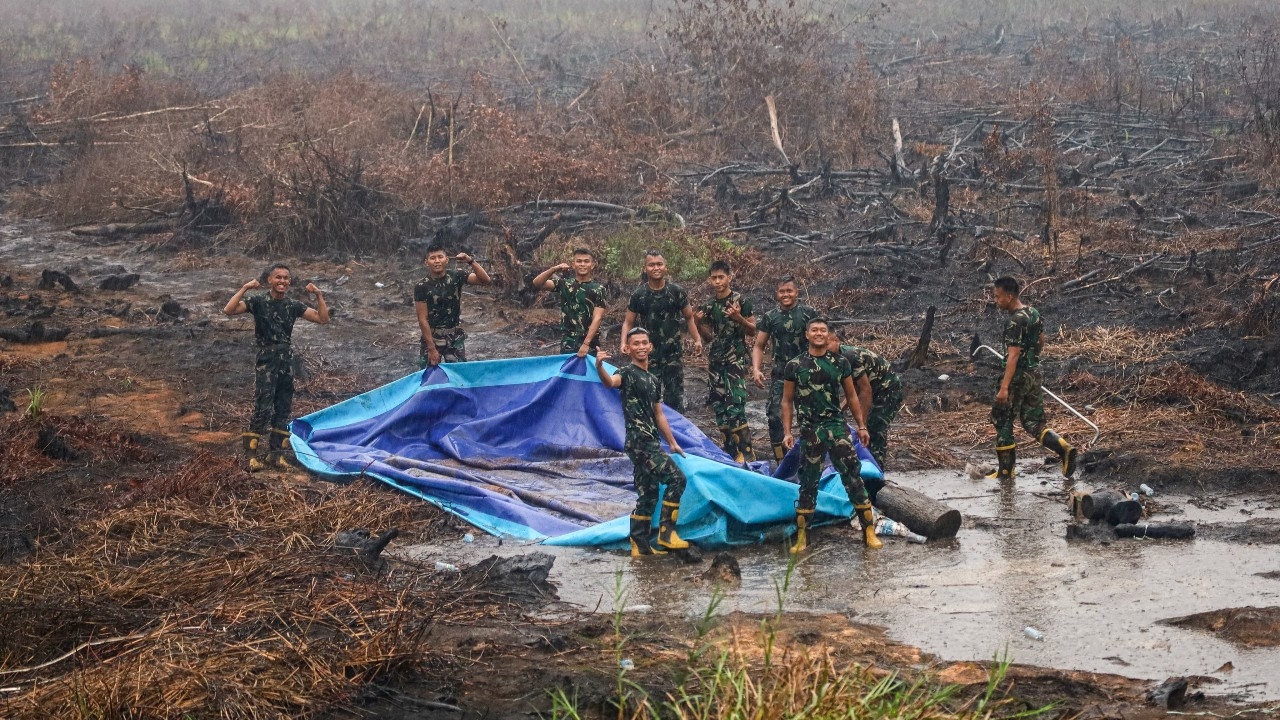
Residents and firefighters in Palangka Raya on Indonesia's Borneo island danced and celebrated after rain eased the toxic haze that had blanketed the area for months. Research reports estimate that forest fire smoke pollution caused about 3,560 deaths nationwide in September, while nearly 58 million people were exposed to air quality ranging from hazardous to extremely hazardous levels.
Residents and firefighters in Palangka Raya, the capital of Central Kalimantan province on Indonesia's Borneo island, gathered outdoors to dance and cheer after rainfall this week helped alleviate the toxic haze that had covered the city for months due to forest fires since August.
Tired volunteer firefighters joyfully jumped in puddles and bowed to kiss the ground in gratitude as another wave of rain fell. Firefighter Lukman El Hakim told AFP, "Everyone is very happy; they bowed to show thanks and praised God that the rain finally came."
In recent days, intermittent rain has fallen in Palangka Raya, which has suffered intense forest fires since August. The city's air quality index reached 4,000 points this month—the highest ever recorded—exceeding the Ministry of Environment's hazardous health threshold by more than 13 times.
During the forest fire crisis, over 11,000 people in Palangka Raya sought treatment for respiratory infections, while the haze spread and affected neighboring countries of Indonesia as well.
The World Health Organization (WHO) states that exposure to high levels of air pollution, especially fine particulate matter PM2.5, is linked to increased risks of illness and premature death.
Additionally, at least 11 people have died fighting forest fires in Indonesia. The most recent fatality was a 45-year-old forest ranger crushed by a falling tree while combating fires in Tana Toraja district, South Sulawesi province, on Wednesday (28 Oct).
Indonesia's National Disaster Management Agency (BNPB) reported deploying 61 aircraft, including planes and helicopters, for cloud seeding and water drops to fight fires in six provinces. However, Indonesia's Meteorology, Climatology, and Geophysics Agency (BMKG) warned that dry weather will persist, maintaining the risk of further forest fires.
BMKG stated that recently light to heavy rain fell in Central Kalimantan, South Kalimantan, and South Sumatra provinces, partly due to cloud seeding operations. BMKG officials noted that as rain began, PM2.5 levels in Palangka Raya started to decrease. Although air quality remains unhealthy, the trend has improved compared to a week ago when it was mostly very unhealthy and sometimes hazardous.
They said that in the short term, rain clouds are expected to cover affected provinces, with ongoing cloud seeding operations aiming to deliver rain deep into the peatlands damaged by fire. However, they warned vigilance is needed due to possible future dry spells before the full onset of the rainy season.
Data from Nusantara Atlas, a deforestation monitoring agency, shows that over 1.9 million hectares burned in the nine months through September. However, the Indonesian government has neither confirmed nor denied this figure.
Smoke from forest fires increased air pollution levels as far as Malaysia, Singapore, the Philippines, and Timor-Leste, straining Indonesia's relations with neighbors. Experts say a major cause is slash-and-burn land clearing, often linked to timber, palm oil, and mining companies.
Asep Safrudin, head of the Indonesian National Police's special investigation unit, revealed that 245 individuals and 20 companies are suspects in forest fire cases and may face imprisonment and heavy fines. Police confirmed on Thursday they will continue cracking down on those responsible.
Meanwhile, a new report from the Center for Research on Energy and Clean Air (CREA), an independent institute in Helsinki, Finland, estimated that smoke pollution from months of forest fires across Indonesia caused approximately 3,560 deaths nationwide in September 2026.
The report stated that in the same month, about 57.8 million Indonesians were exposed to air quality ranging from unhealthy to hazardous levels.
CREA said in a statement that worsening air quality from forest fires and other fires in Indonesia doubled the estimated deaths in September to 3,560, compared to August's figures.
CREA's study estimates deaths from short-term exposure to PM2.5 pollution, meaning effects occurring within days, as these fine particles can penetrate lungs and bloodstream. The WHO associates such exposure with increased risks of illness and premature death.
The report noted that most deaths concentrated on Indonesia's Borneo island, including parts of Java, Sumatra, and eastern regions.
Besides forest fire pollution, researchers assessed pollution from urban power generation, industry, and transportation, estimating about 1,750 additional deaths in September from these sources, raising total air pollution deaths to approximately 5,310 in a population of about 290 million.
The report highlighted that in September alone, nationwide PM2.5 exposure exceeded the WHO annual average guideline by more than seven times, with Sumatra exceeding it tenfold and Kalimantan on Borneo 24 times. Over 330,000 acute respiratory infection cases were recorded nationwide during this period.
Indonesia has faced prolonged drought worsened by El Niño, fueling widespread forest fires. Nusantara Atlas estimates over 1.9 million hectares burned in nine months through September, though the government has not verified this data.
On Java, Indonesia's most populous island and home to Jakarta, CREA's report states 1,530 deaths from air pollution in September, with 73-80% caused by non-forest fire pollution such as industrial emissions, vehicle exhaust, and waste burning.
The report emphasizes that pollution from other sources poses health risks comparable to smoke from forest and peatland fires.
CREA recommends the government shift focus from responding to fires toward restoring peatlands vulnerable to fires, as these areas have been extensively drained, increasing fire risk.
It also urges stricter law enforcement against illegal land clearing by burning and greater legal accountability for concession holders to protect forests and the environment. For areas affected by other pollution sources, such as Java, the report suggests the government enforce tougher emission standards.
However, the Indonesian government defended its forest fire response on Wednesday, saying it has mobilized over 72,000 people for cloud seeding and firefighting operations, deployed more than 2,100 medical and health workers to heavily affected areas, and distributed 5.3 million face masks.
. . .AFP