

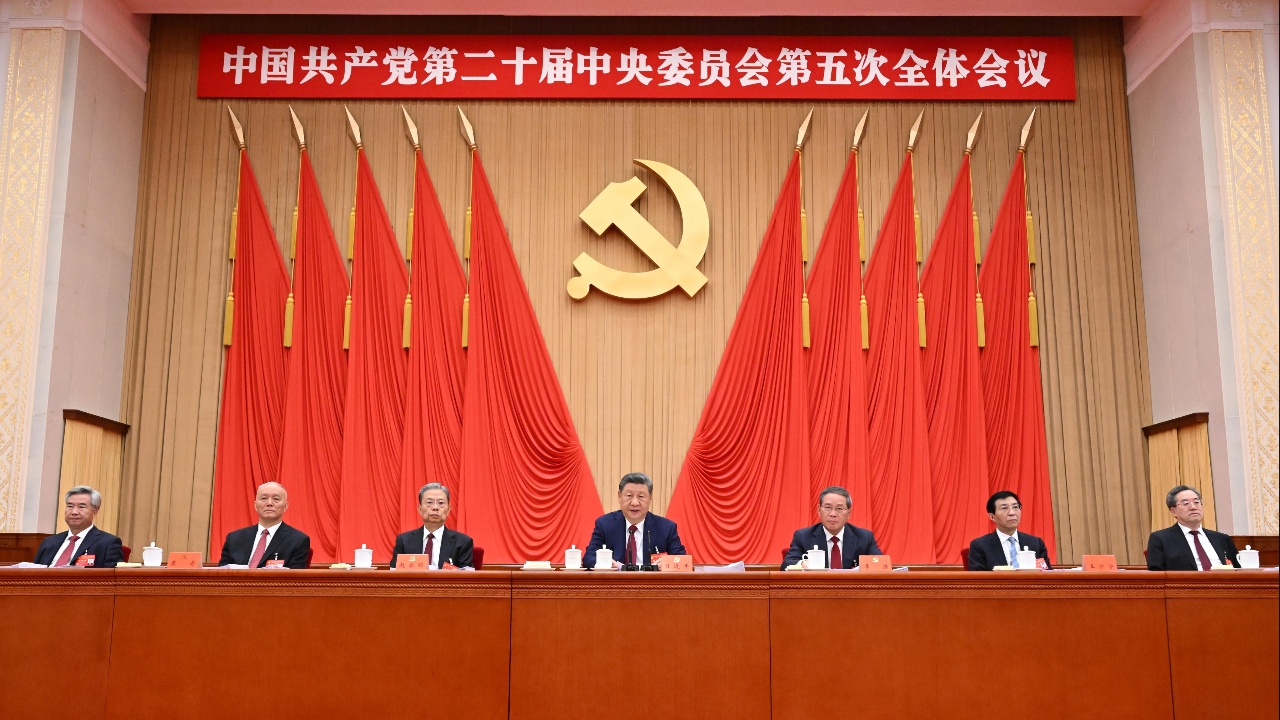
The Chinese Communist Party announced success in purging "serious hidden threats" within the party and military after concluding the 5th Central Committee meeting. It confirmed expelling 33 senior party members, including former top generals and ex-Politburo members. Analysts see this major purge as a move to consolidate absolute power and clear the path for Xi Jinping to serve a fourth term as China's leader at the 2027 Party Congress.
Chinese authorities stated that under President Xi Jinping's leadership, the Communist Party and military have eliminated serious hidden threats, confirming the expulsion of 33 key figures—the highest number ever recorded. Analysts view the intensified anti-corruption crackdown as part of efforts to consolidate power ahead of the 2027 Party Congress.
Zhang Fuhai, Deputy Secretary of the Chinese Communist Party's Central Commission for Discipline Inspection (CCDI), said the Central Committee, led by Xi Jinping, removed "serious hidden threats" within the party, state, and military. He affirmed the party's commitment to its mission to "displease thousands rather than disappoint 1.4 billion people."
These remarks came a day after Chinese state media confirmed that 33 party members and key figures were expelled following the 5th plenary session of the Central Committee of the Chinese Communist Party, held over four days and ending last Thursday (29 Oct). Among them were 16 military personnel, including Zhang Youxia, former Vice Chairman of the Central Military Commission and China's highest-ranking ex-general; Liu Jinli, a former senior military officer; and Ma Xingrui, ex-party secretary of the Xinjiang Autonomous Region.
Expelling these 33 members is the highest number since Xi Jinping took power, bringing the total expulsions during his third leadership term to 51, compared to 35 in his first term and 5 in his second.
This meeting emphasized maintaining party discipline, adopting resolutions to "promote comprehensive and strict party governance," including measures to reduce corruption among officials at various levels.
Zhang Fuhai also revealed that since 2012, disciplinary and supervisory agencies nationwide have punished 7.9 million people, with over 2 million sanctioned for issues related to unnecessary formalities, inefficient bureaucracy, lavish lifestyles, and excessive personal indulgence.
He stated that the party will intensify anti-corruption efforts, especially in sectors where power is concentrated, large funds exist, and valuable resources are present. Focus will be on investigating cases involving political and economic issues, collusion between state officials and businesses, infiltration of capital into politics, as well as new and hidden forms of corruption.
Additionally, the party will address misconduct and corruption affecting local populations, pushing officials to "not dare, cannot, and do not want to be corrupt."
The military personnel purge is a key aspect of recent anti-corruption efforts. Zhang Youxia, formerly Vice Chairman of the Central Military Commission (CMC), was removed following a months-long corruption investigation before the party confirmed his expulsion last Thursday.
Ma Xingrui, who held senior positions in Xinjiang, was previously removed from all posts after facing allegations including corruption, factionalism, bribery, and paying for sexual services.
However, official statements did not disclose specific charges against those expelled beyond stating "serious violations of discipline and law," a phrase commonly used in announcements under Xi's anti-corruption campaign.
The 5th plenary session had only 279 Central Committee members attending, down from 315 at the 4th meeting in October 2025 and 364 at the 3rd meeting in July 2024. This marks the first time in 14 years under Xi's leadership that attendance fell below 300, despite the current Central Committee starting its term in 2022 with over 370 members.
Meanwhile, the Central Military Commission, responsible for controlling China's military, now has only two members: Xi as chairman and Zhang Shengmin as vice chairman, down from seven previously.
The meeting also approved the promotion of Zhang Shengmin, a key figure in the military anti-corruption campaign and the second-ranking member of the Central Military Commission, to the Politburo, the party's top policymaking body, raising its membership to 22.
Additionally, Liu Jianchao, a former senior diplomat who has been absent from public view since July last year, was among those purged.
Since becoming leader in 2012, Xi Jinping has made anti-corruption a cornerstone of governance, once calling corruption the "greatest threat" to the Chinese Communist Party.
Supporters say the anti-corruption drive promotes transparent and disciplined governance. However, some analysts argue the campaign has become a tool for consolidating and maintaining power rather than solely addressing corruption issues.
In a post-meeting statement, the party acknowledged confronting the worrying reality that its leadership had weakened or been undermined at times, affirming it will continue strict self-governance and seriously address internal party problems.
Analysts believe the increased emphasis on party discipline, linked to political loyalty, relates to the 21st National Congress of the Chinese Communist Party in the latter half of 2027, which will feature leadership reshuffles.
Many analysts expect Xi to secure a fourth term and possibly longer, which would make him the longest-serving Chinese leader since Mao Zedong, founder of the People's Republic of China.
O'Neil Thomas from the Asia Society Policy Institute said the dismissal of many current Central Committee officials gives Xi reason to scrutinize potential next-generation leaders more closely. Rising stars tend to be younger, with expertise in technology and administration, and connected to Xi's political network, while provincial executives are also closely watched.
Analysts see Xi likely playing a decisive role in selecting personnel for the 21st Party Congress, further reinforcing his influence over the party and China.