

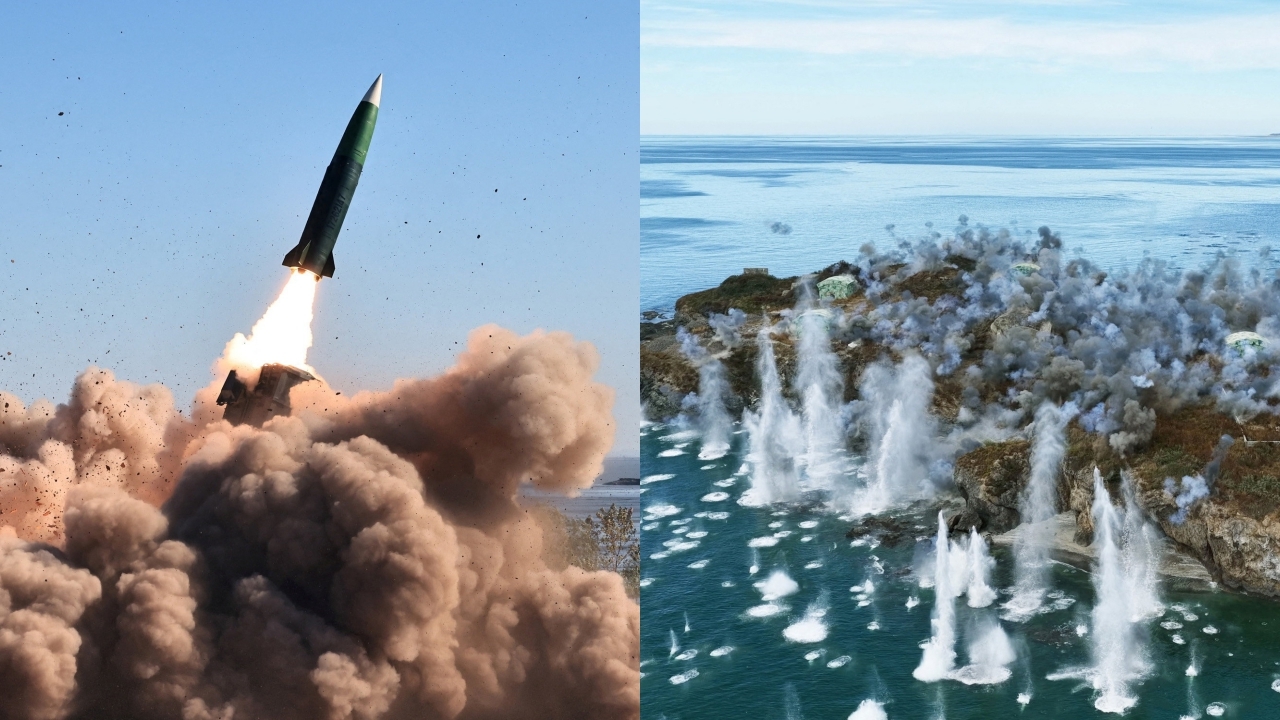
North Korea has tested cluster bombs that can be mounted on guided tactical missiles, claiming they can destroy target areas of 12-13 hectares, or nearly 130,000 square meters. It announced plans to deliver four types of warheads for military units to select according to mission requirements by the end of this year.
North Korea's Korean Central News Agency (KCNA) reported that the country's Missile Administration conducted a test of a cluster bomb warhead on 31 October to assess its combat effectiveness and destructive power. The warhead is designed to be mounted on tactical ballistic missiles.
A research institute under the Missile Administration stated that the test confirmed the standard type 2 cluster bomb warhead can destroy a target area of 12-13 hectares, or approximately 119,000 to 129,000 square meters, with a very high density of attack power.
The director of the Missile Administration said North Korea categorizes cluster bomb warheads into four types, including standard and special mission variants. The goal is to enable military units to select and deploy all types of warheads within this year, based on operational objectives and the characteristics of the targets.
Cluster bombs are weapons containing dozens to hundreds of small submunitions inside a warhead, which disperse in the air to strike multiple targets over a wide area. North Korean media footage showed the dispersal and explosion of small explosive devices, including attacks on island targets featuring structures believed to simulate aircraft hangars and ammunition depots of the South Korean military.
South Korea's military said it has been tracking the missile launch, which was fired from near Cheongju in northwest North Korea, heading toward the Yellow Sea. The South Korean Joint Chiefs of Staff stated that South Korea and the United States have been closely exchanging information, monitoring related activities before the launch, and remain prepared to respond continuously.
Shin Jong-woo, Secretary of the South Korean Forum for Security and Defense in Seoul, assessed that the missile used in this test is likely the Hwasong-11RA model.
Previously, North Korea tested the Hwasong-11RA missile equipped with a cluster bomb warhead in April, with leader Kim Jong-un attending alongside his daughter, Kim Ju-ae. However, the recent test on Saturday reportedly did not include Kim Jong-un's presence.
This latest test comes amid North Korea's ongoing weapons trials, including armed drones, new guided torpedo systems, and medium-range hypersonic missiles. At the same time, tensions along the inter-Korean border have risen after a landmine explosion injured three South Korean soldiers. North Korea denied responsibility, announced reinforcement of border defenses, and plans to resume broadcasting propaganda via loudspeakers.
Meanwhile, the foreign ministers of South Korea, the United States, and Japan recently reiterated their joint stance during a trilateral meeting in Atlanta, calling on North Korea for complete nuclear disarmament. U.S. Secretary of State Mark Rubio stated on Saturday that President Donald Trump remains open to talks with Kim Jong-un if North Korea is willing to discuss concerns raised by the U.S. and its allies. However, no date has been set for a meeting between the two leaders.