

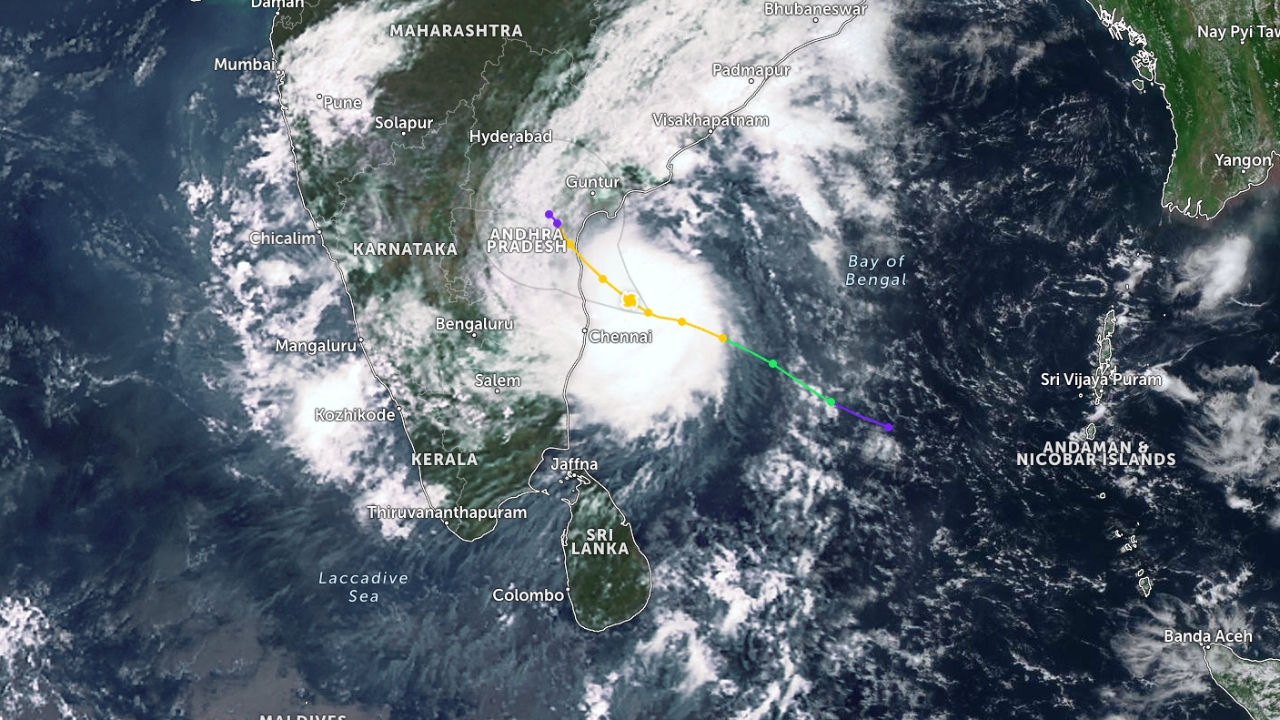
Indian authorities began evacuating residents along the eastern coast from 2 November to prepare for Cyclone Moorsuu, expected to make landfall in the early hours of 3 November. The area is still recovering from Cyclone Aranib, which struck last week and caused at least six fatalities.
The India Meteorological Department stated that Cyclone Moorsuu formed from a strong low-pressure area in the southern to central western Bay of Bengal and is expected to strengthen into a cyclone before making landfall in Andhra Pradesh in the early hours of 3 November.
The cyclone may intensify into a severe cyclone with wind speeds of 100-110 kilometers per hour and gusts up to 120 kilometers per hour, with the coastal areas of Andhra Pradesh and Tamil Nadu in southeastern India likely to be the most severely affected.
Prakhar Chen, Managing Director of the Andhra Pradesh State Disaster Management Authority, told Reuters that about 2,000 people have already been evacuated and efforts are ongoing, targeting the evacuation of approximately 30,000 residents to safer areas.
Information from Andhra Pradesh's Disaster Management Authority indicates that the expected landfall point is near Ongole city. Six teams from the National Disaster Response Force (NDRF) and seven teams from the State Disaster Response Force (SDRF) have been deployed across vulnerable areas, including Krishna, Bapatla, Guntur, Nellore, Prakasam, Markapuram, Palnadu, and Tirupati districts, with additional forces on standby if needed.
Meanwhile, the neighboring state of Odisha continues rescue and recovery efforts from Cyclone Aranib, with the death toll rising to six after officials found two more bodies in villages affected by landslides, while ten people remain missing.
Officials reported that the village of Kidipabali, located on a hill near the border of Ganjam and Kandhamal districts, with about 26 residents, was hit by landslides and debris that destroyed all homes. At least 13 survivors have been evacuated to relief centers.
The Odisha Special Relief Commissioner said Cyclone Aranib and subsequent flooding have affected approximately 118,000 people, damaged 75,388 hectares of crops, and destroyed 1,672 houses, with Ganjam and Kandhamal districts being the hardest hit.
Odisha is simultaneously accelerating restoration of electricity in affected areas by deploying over 6,400 workers, providing assistance to residents, and preparing for the incoming Cyclone Moorsuu.
The Odisha government has announced aid measures for families affected by flooding, providing each family in the southern region with 50 kilograms of rice and financial assistance of 2,500 Indian rupees (approximately 900 baht), along with compensation for damages to crops, homes, and livelihoods.
Mohan Jharna Majhi, Chief Minister of Odisha, stated that the government has upgraded preparedness measures for the new cyclone, ordered evacuations from low-lying and hill areas at risk, and closed some schools and colleges in the southern region until 3 November.
Additionally, a high-level warning has been issued for southern Odisha, particularly Ganjam district, which suffered severe damage from Cyclone Aranib. Fishermen have been ordered to avoid going out to sea, and disaster response units remain on constant alert.
The India Meteorological Department forecasts that Odisha will begin receiving rain from 2 November, with heavier rainfall expected on 3 November continuing through 4 November due to Cyclone Moorsuu.
Cyclone Moorsuu, meaning 'war drum' in Tamil, is the name India has proposed for this storm. The Indian government and local agencies continue to closely monitor the situation to prevent loss of life and reduce impacts on vulnerable populations.
SourceThe Hindu/NDTV/Hindustan Times