

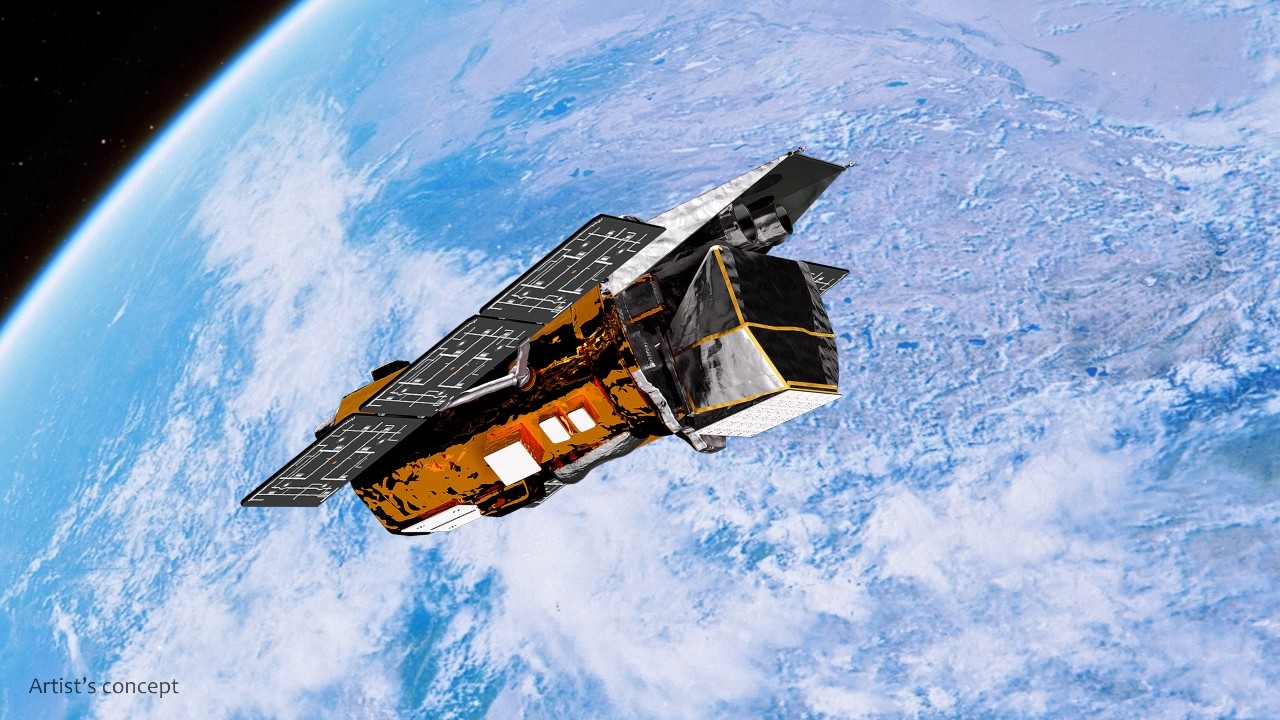
NASA's Swift space telescope, which has been in service for more than 22 years, is set to fall back to Earth around 6 Nov. after an unsuccessful attempt to boost its orbit. Most parts are expected to burn up in the atmosphere, though some fragments might reach the ground. The risk to the public is considered very low.
The Swift space telescope, operated by the U.S. National Aeronautics and Space Administration (NASA), is entering the final phase of its mission after its orbit steadily decayed and efforts to raise it failed. The U.S. Space Force predicts the telescope will reenter Earth's atmosphere on or near 6 Nov.
Weighing about 1,500 kilograms, most parts of the Swift telescope are expected to burn up in Earth's atmosphere. However, some dense and heat-resistant components, such as tungsten and some glass parts, may survive reentry and reach the Earth's surface.
Brad Cenko, a scientist on NASA's Swift mission, said that if any debris survives reentry, it will likely fall mostly into the ocean. However, parts of Africa, Australia, India, Southeast Asia, Central America, and South America lie within the potential impact corridor. The U.S. Space Force is closely monitoring the telescope's decaying orbit.
This development has saddened the mission team but also filled them with pride over Swift's achievements during its 22-year lifespan. Swift was launched into space on 20 Nov 2004 to study some of the universe's most powerful explosions, including gamma-ray bursts and supernovae.
John Nousek, an astronomer from Pennsylvania State University and former mission control lead, said the team always knew this day would come because objects in low Earth orbit eventually fall back down. He noted that mission endings like this tend to be dramatic.
In recent years, increased solar activity accelerated Swift's orbital decay. Last year, NASA hired Katalyst Space to conduct an urgent recovery mission using a three-armed robot named Link.
However, the robot encountered problems after launching in July and could not approach the telescope closer than about 12-15 kilometers before falling back to Earth in September, causing the recovery mission to fail.
After ending the recovery attempts, Swift resumed observations and discovered more gamma-ray bursts and other high-energy phenomena. But by late October, its orbit had decayed too much to maintain stable observations, prompting the team to shut down all systems.
Throughout its mission, Swift detected over 2,000 gamma-ray bursts and about 1,400 exploding stars, while also tracking comets, asteroids, and black holes that tear apart stars with intense gravity.
A key feature of Swift was its ability to quickly reorient its instruments toward sudden astronomical events, which inspired its name, meaning "swift" or rapid.
NASA regarded Swift as a frontline alert system for astronomical events, enabling other telescopes such as Hubble and James Webb to study these phenomena in greater detail. Scientists are now considering how to replace Swift's important role.
Experts in space debris and aerospace engineering say Swift will mostly break apart and burn during reentry, making it unlikely to pose significant danger to people on the ground.
Darren McKnight, a senior technical expert at LeoLabs who tracks objects in Earth's orbit, said that compared to the risk posed by other debris reentering the atmosphere, Swift is only a small part of the many objects returning to Earth.
McKnight also pointed out that the number of objects reentering Earth's atmosphere annually is about ten times higher than five years ago, due to the rapid increase of satellites in low Earth orbit and ongoing replacement with newer equipment.
Dean Sladen, a quality manager and aerospace engineer from Accu Components in the UK, explained that once the telescope descends to about 120 kilometers altitude, reentry happens within minutes. The air in front heats up intensely, causing the satellite to glow. Solar panels and antennas typically detach first, followed by the main structure breaking apart around 78 kilometers.
Most of Swift's components are aluminum, wiring, and electronics, which melt or vaporize early during reentry. Parts likely to survive are dense, heat-resistant materials such as titanium, steel, and glass.
Sladen expects the most likely survivors to be six reaction wheels used to control the telescope's orientation, along with some sturdy parts of the optics like lenses and glass. The approximately 52,000 small lead sheets used as shielding will probably melt entirely. Any debris reaching the ground is expected to be small, charred fragments unlikely to be identifiable as parts of the telescope.
Currently, space agencies emphasize designing satellites to end missions more safely, with some models equipped with propulsion systems to steer them into remote ocean areas or built from materials that fully burn up upon reentry.
NASA and the European Space Agency require that the risk of satellite debris harming people must not exceed 1 in 10,000. If satellites cannot meet this standard, a controlled reentry plan must be implemented.