

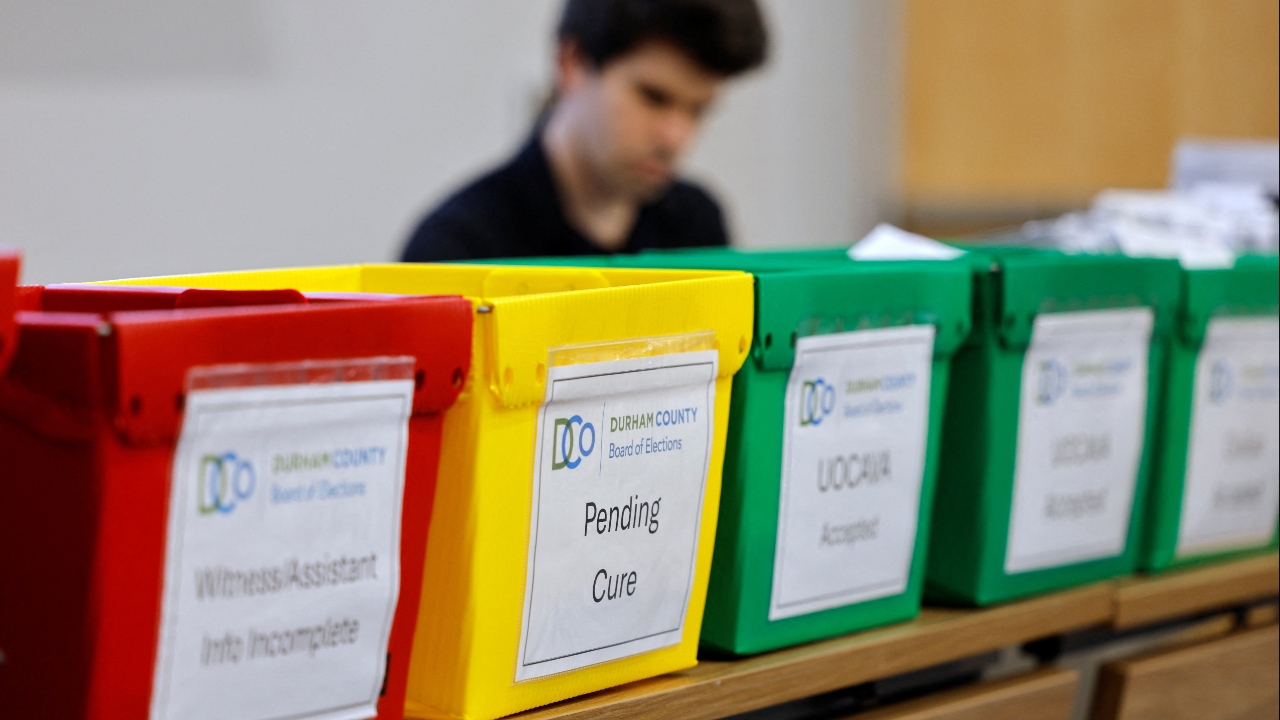
On US midterm election night, it's not only the win-loss outcomes in each state that draw attention, but also figures from key voter groups that might reflect political trends about which party may secure the congressional majority.
The US midterm elections involve contests at multiple levels, including governors, senators, representatives, and state legislatures, making election night results complex to follow. However, six key indicators can help clarify which party holds the advantage and how control of Congress might unfold.
1. Early election results reflect Republican votes and Latino voter trends.
Indiana and Kentucky will begin releasing election results around 6:00 p.m. Eastern Time, while Florida, which spans both Eastern and Central time zones, will start reporting results in several congressional districts from about 7:00 p.m. State-level results, such as Senate and governor races, may not be declared until at least 8:00 p.m.
Key districts to watch early on include Indiana's 5th district, Kentucky's 6th district, and Florida's 22nd and 27th districts.
Indiana's 5th and Kentucky's 6th districts are currently held by Republicans, but this election cycle sees tighter races compared to the campaign's start. Close results or a Democratic lead could signal lower-than-expected Republican turnout and growing Democratic support.
Florida's 22nd district was traditionally Democratic but was redrawn to favor Republicans, while the 27th district, where Donald Trump won by double digits in 2024 and has a large Latino population, is a key indicator of Latino voting direction.
2. Will Republicans secure at least 46% of independent voters?
Independent voters are a crucial group that can swing results but typically turn out less in midterms than in presidential elections.
Historically, Republicans have needed high support from independents, higher than during Trump's era. For example, Mitt Romney received 55% of independent votes in 2012 but still lost the presidential race.
However, US political demographics have shifted over the past decade: white working-class voters have trended toward Trump, self-identified Democrats have decreased, and highly educated white voters have moved toward Democrats.
Since Trump's emergence, Republicans have tended to perform well when capturing at least 46% of independent votes; falling below this threshold often leads to losses. Thus, this figure is a key benchmark on election night.
3. African American vote in key states.
The Michigan Senate race is pivotal for Senate control. If Republicans flip this seat, Democrats would need to reclaim five seats from Republicans to control the Senate, up from four.
For Democratic candidate Abdul El-Sayed, African American votes in Wayne County—especially Detroit and its surroundings—are critical. Strong performance there could secure victory; weak results would make winning much harder as this area is a challenge for him.
Since Trump's era, Democrats have needed at least 68% of Wayne County's African American vote to win Michigan, unless they overperform in suburban districts, as Senator Elissa Slotkin did in 2024.
Historical data show winning Democratic candidates in Michigan often secure high percentages in Wayne County: Joe Biden got 68% in 2020, Senator Debbie Stabenow 69% in 2018, and Kamala Harris 62% in 2024 despite losing the presidential race.
4. Vote margin among young voters.
Voters aged 18-29 are important to Democrats, but turnout in midterms is much lower than in presidential elections.
Since 1992, about 43% of registered young voters participate in presidential elections, but only about 21%, roughly one in five, vote in midterms.
Nevertheless, young voter support strongly influences Democratic success. Over the past 20 years, when Democrats lead Republicans by more than 20 points among 18-29 year olds, they tend to perform well in both presidential and midterm elections.
An exception was the 2022 midterms, where Republicans won the House but Democrats gained a Senate seat. High youth support helped reduce Democratic losses that could have been worse.
Past data show Democrats led Republicans by 35 points among young voters in 2018, helping win the House; 25 points in 2020, aiding Biden's presidential victory; but only 11 points in 2024, when Trump won the presidency.
5. Texas battle: Republican vs. Latino votes in the south.
Texas is a key battleground, notably the Senate race between Democrat James Talarico and Republican Ken Paxton.
Polls show Talarico leading but doubts remain about whether his lead will translate to victory, as Texas polls often underestimate Republican support.
In 2018, Democrat Beto O’Rourke generated strong momentum against Republican Ted Cruz, who had low approval, but Cruz still won with less than a 3-point margin.
No Democrat has won a statewide election in Texas since 1994, and no Democrat has been elected senator from Texas in 38 years. Trump won Texas by 14 points in 2024.
For Talarico to make history, the key voter groups to watch are Republicans and Latinos. Paxton is unpopular, while Republican Governor Greg Abbott faces a closer race but is viewed as stronger than Paxton.
In 2018, Cruz received about 400,000 fewer votes than Abbott but still won by more than 200,000. If Abbott outperforms Paxton by over 400,000 votes this time, it could boost Talarico’s chances.
Another critical factor is Latino votes in South Texas. In 2018, O’Rourke received 64% of Latino votes statewide; Latinos made up 26% of voters. If Talarico exceeds these figures, it may pave his path to victory.
Counties to watch include Cameron (O’Rourke got 63%), Hidalgo (69%), Webb (71%), and Nueces (51%), as well as rapidly growing Dallas-area suburbs Collin (47%), Denton (46%), and Tarrant (51%).
6. Percentage of voters identifying as Democrats.
Another important figure is the share of voters who identify as Democrats in exit polls.
In 2024, this share fell to 31%, the lowest in recent years, coinciding with a more liberal party base and some dissatisfaction with party leadership.
However, Democrats are among the most enthusiastic supporters this year, according to a recent NPR poll on 27 October, suggesting the party may need to mobilize beyond 31% to perform well.
Historical data show the Democratic share was 37% in 2020 and 2018, dropping to 33% in 2022 and 31% in 2024, compared to highs of 39% in 2008 and 2010.
Anti-Trump sentiment may help unify the left’s base this election. The latest NPR poll found 53% of likely voters strongly disapprove of Trump's performance.
Beyond numbers, Democratic unity is crucial, especially in Michigan’s Senate race and the 7th district, where progressive Democrats face competitive races in closely divided areas.
Results here may reveal how well Democrats can unify diverse factions, shaping the 2028 presidential primary landscape and the future of the US left for years.
These six factors are not just election data but signals showing who is voting, how party bases are shifting, and how Trump-era politics are influencing the balance of power in Congress.
Source:NPR.org
Click to read related news aboutInternational News