

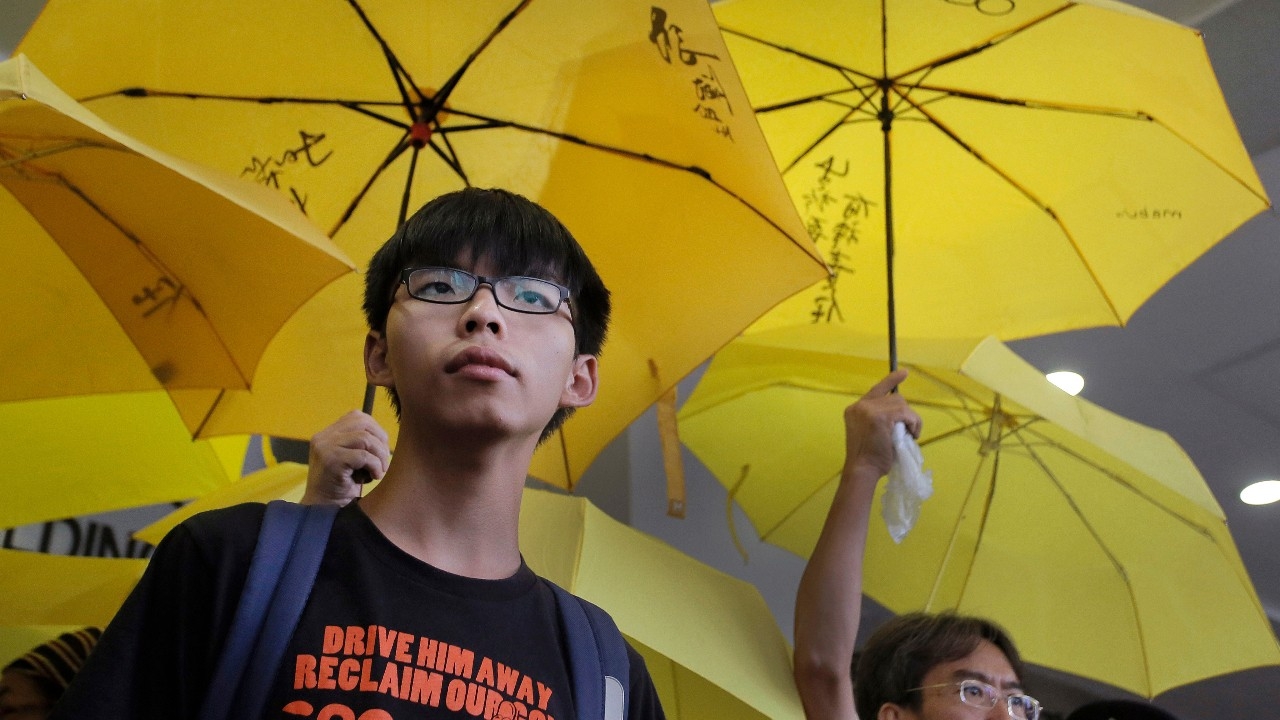
Joshua Wong, a well-known Hong Kong democracy activist, was sentenced by a court to 10 years in prison for colluding with foreign forces under the National Security Law. This is an additional sentence beyond his previous case after nearly six years in custody, while human rights organizations condemned it as an effort by authorities to suppress dissenting voices and imprison political opponents for as long as possible.
Joshua Wong, a key democracy activist in Hong Kong, was sentenced by the court to 10 years in prison for colluding with foreign forces under Hong Kong's National Security Law, which the Chinese government implemented in 2020 after massive pro-democracy protests opposing Beijing's expanding influence.
The court stated in its summary that Joshua Wong was sentenced to 10 years imprisonment, with an additional 2 months and 2 days to be counted towards his existing sentence.
Wong, who turned 30 last month, has been in custody for nearly six years. He was originally scheduled for release in January next year after serving 4 years and 8 months for conspiracy to overthrow the state. However, Hong Kong authorities charged him anew under the National Security Law in June 2025, accusing him of calling on foreign countries and organizations to impose sanctions on Hong Kong and China.
Prosecutors stated that Wong collaborated with other activists, including Nathan Law who is in exile abroad, to push foreign nations to impose sanctions and isolate China. These activities took place between July and late November 2020. Wong and Law co-founded the now-dissolved Demosisto party, a pro-democracy political group in Hong Kong.
Joshua Wong was born in October 1996 to Roger, who works in information technology, and Grace, a homemaker. He was diagnosed with dyslexia—a reading and writing disability—from childhood, which caused difficulties in his studies.
Nonetheless, Wong was bold in challenging rules and customs he found unreasonable. In secondary school, he organized classmates to protest via Facebook against overpriced school cafeteria lunches.
In 2011, at just 14 years old, Wong co-founded Scholarism, a youth pro-democracy activist group that rapidly grew and played a key role in Hong Kong society. The following year, the group mobilized more than 100,000 protesters against a government plan to impose "patriotic education" in schools, forcing authorities to back down.
Wong was born eight months before Hong Kong's handover from Britain to China in 1997 and has spent most of his life fighting against the restrictions imposed by China on his homeland. In 2014, he became one of the most recognized figures of Hong Kong's pro-democracy movement through his front-line role in the "Umbrella Movement" civil disobedience protests. In 2016, he co-founded the Demosisto party with Nathan Law and Agnes Chow, who is also now in exile.
However, Wong expressed discomfort with being called a "protest leader," saying the movement had many coordinators and was not top-down but rather a grassroots movement with decision-making centered among the people.
In 2020, Demosisto disbanded after China implemented the National Security Law in Hong Kong, a law with severe penalties covering multiple types of security offenses.
Nathan Law fled to the UK and continued pro-democracy activism abroad, while Wong remained in Hong Kong and attempted to run for the Legislative Council but was disqualified, with authorities citing his opposition to the National Security Law as a reason.
Wong's legal troubles increased continuously. On 23 November 2020, he pleaded guilty to several charges related to participation in protests at the Hong Kong police headquarters in 2019.
Later, in February 2021, while still in prison, Wong was among 47 people charged with "conspiracy to overthrow state power" in the so-called Hong Kong 47 case, marking the largest prosecution under the National Security Law in Hong Kong.
By 2024, Wong and dozens of other pro-democracy activists were imprisoned in this case, with some released in recent months after completing sentences. Wong is the only individual in the group charged twice under the National Security Law.
Amnesty International stated that the charge of colluding with foreign forces reflects the authorities' fear of prominent dissidents and shows an effort to imprison them as long as possible.
Before sentencing, Wong's lawyers requested a shorter prison term, proposing a sentence between 3 to 10 years and asking the court to consider the time he has already been detained.
On 5 Nov, Wong arrived at court wearing a dark blue long-sleeve shirt, khaki pants, and black-framed glasses. He appeared thinner compared to previous public appearances but remained calm, nodding to supporters and those in the courtroom and taking notes as the judge read the sentencing rationale. After the verdict, Wong waved and thanked supporters waiting outside, with chants of "We will wait for your release." Dozens queued for hours to attend the hearing, while numerous police were stationed outside the court.
Steve Tsang, director of the China Institute at SOAS University of London, told AFP that Beijing views Wong as a key leader of what it considers an open rebellion in 2019, even though Wong is a moderate activist. This sentence will serve as a warning to others.
Tsang said before the verdict that Wong's punishment signals Beijing's continued strict control over Hong Kong and that the city will not return to the more relaxed era before 2019.
Wong's friend Louis Lee revealed that Wong remains energetic and motivated in prison but sometimes feels anxious about the verdict. During visits, Wong often appeared disappointed and sighed periodically. Lee said many uncertainties remain, but Wong must accept reality rather than dwell on sadness or dissatisfaction.
Supporter Margaret Chan, 61, said she is deeply saddened that a talented young man, prominent since youth, must spend many more years in prison and may be middle-aged by the time he is released.
The harshest sentence under Hong Kong's National Security Law so far is 20 years, given to Jimmy Lai, a former media tycoon, for colluding with foreign forces.
Critics say the National Security Law suppresses opposition and political activism in Hong Kong, while Chinese and Hong Kong authorities insist the law is necessary to maintain stability and security and deny it undermines Hong Kong's autonomy.