

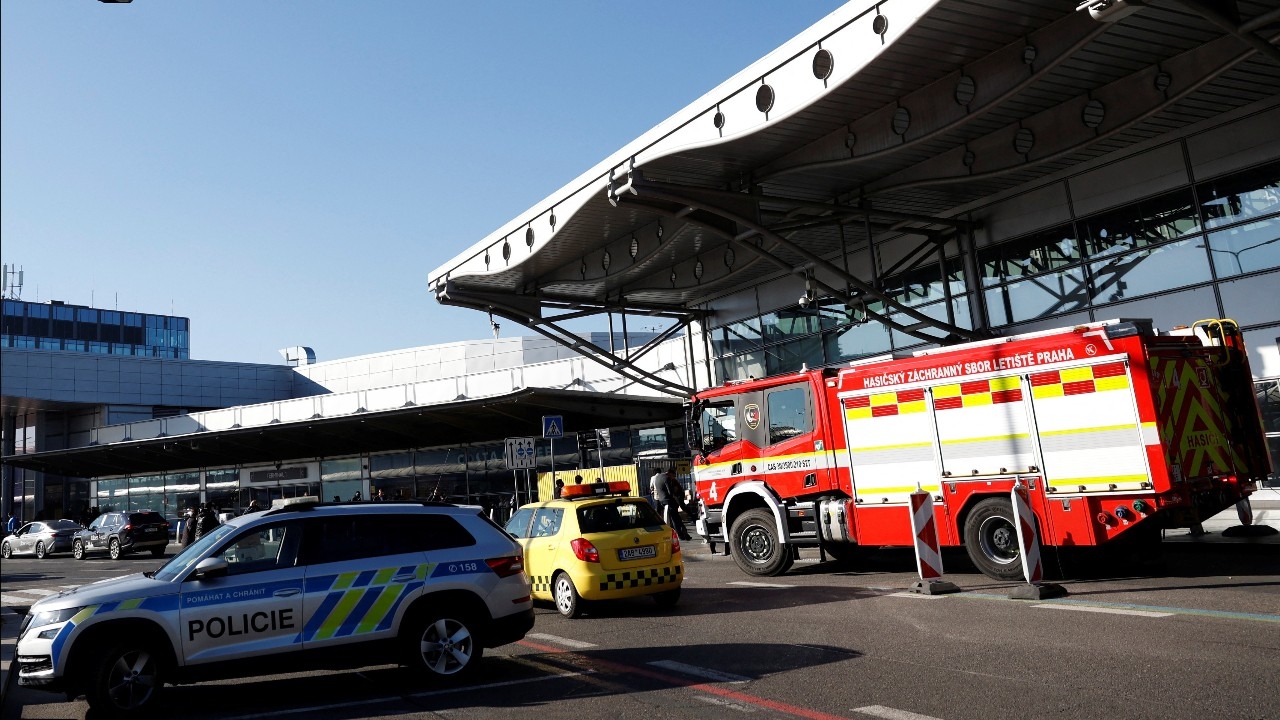
Military analysts point out that while no dangerous objects were found in the bomb threats against European flights, these threats caused massive economic damage and disrupted aviation systems. They also suggest that Russia might benefit from this situation.
Jacob Funk Kirkegaard, a military analyst at the Bruegel institute, a European policy research center, sees the bomb threats against European airline flights as an effective strategy to create chaos and uncertainty in air travel systems, especially amid rising international security tensions.
Kirkegaard notes that although it is still speculative who is behind these incidents, he believes only one party likely benefits from causing disruption at this time—the Russian government. However, there is no evidence confirming Russia's involvement in the threats.
The recent incidents occurred last Thursday after dozens of flights across Europe received bomb threats, forcing some aircraft to divert for emergency landings, while others required military escort to airports in France, Italy, and Bulgaria.
Reports confirm that over 12 flights from cities including Copenhagen, Dublin, Helsinki, Madrid, Milan, and Warsaw were targeted by these threats. Most planes had to land at alternative airports for inspections, though some flights reached their destinations safely. Preliminary searches found no dangerous or suspicious items on board.
Why did just a few threats cause such extensive damage?
The analyst explains that bomb threats, whether made by phone or other means, are a highly effective method to cause disruption because security protocols require authorities to seriously investigate every threat. This includes thorough searches, cleaning, and inspections of aircraft before they can resume service.
These procedures cause flight schedules to be halted or altered and affect numerous connected flights in a cascading manner, resulting in widespread economic harm.
Kirkegaard points out that even if only a few individuals made the threatening calls, the resulting impact is disproportionately large compared to the low cost of carrying out such acts, making it a cost-effective strategy for adversaries to inflict damage.
Testing the readiness of Europe's aviation security system
Another important issue raised by analysts concerns airport security measures within the European Union. Despite having aligned guidelines and standards, ultimate responsibility for security lies with each member state's government.
This incident serves as a test of how prepared member countries are and how well they coordinate their responses, particularly regarding the speed and rigor with which they handle such threats. For instance, whether Polish authorities respond as swiftly and seriously as those in Italy.
Hedy Alexander, the UK Secretary of State for Transport, stated that the recent threats are malicious hoaxes following similar bomb threats earlier in the week.
Meanwhile, Apostolos Tsitsikostas, the European Union Commissioner for Transport, affirmed that any threat targeting civilians is unacceptable. He revealed that the European Commission is coordinating with affected member states and has activated the EU-level aviation security information exchange mechanism.
However, he said it is too early to conclude whether the incidents are connected. National investigations are ongoing, and it remains unclear if cyberattacks are involved.
These bomb threats come amid heightened geopolitical tensions in Europe, which has recently experienced various irregular incidents such as attacks on supermarket cooling systems, drone incursions into airspace, and malfunctions in alert applications. European security agencies have increased vigilance against hybrid threats that use diverse methods to undermine confidence and create social unrest.
Source: AP
Click to read related news aboutInternational News