

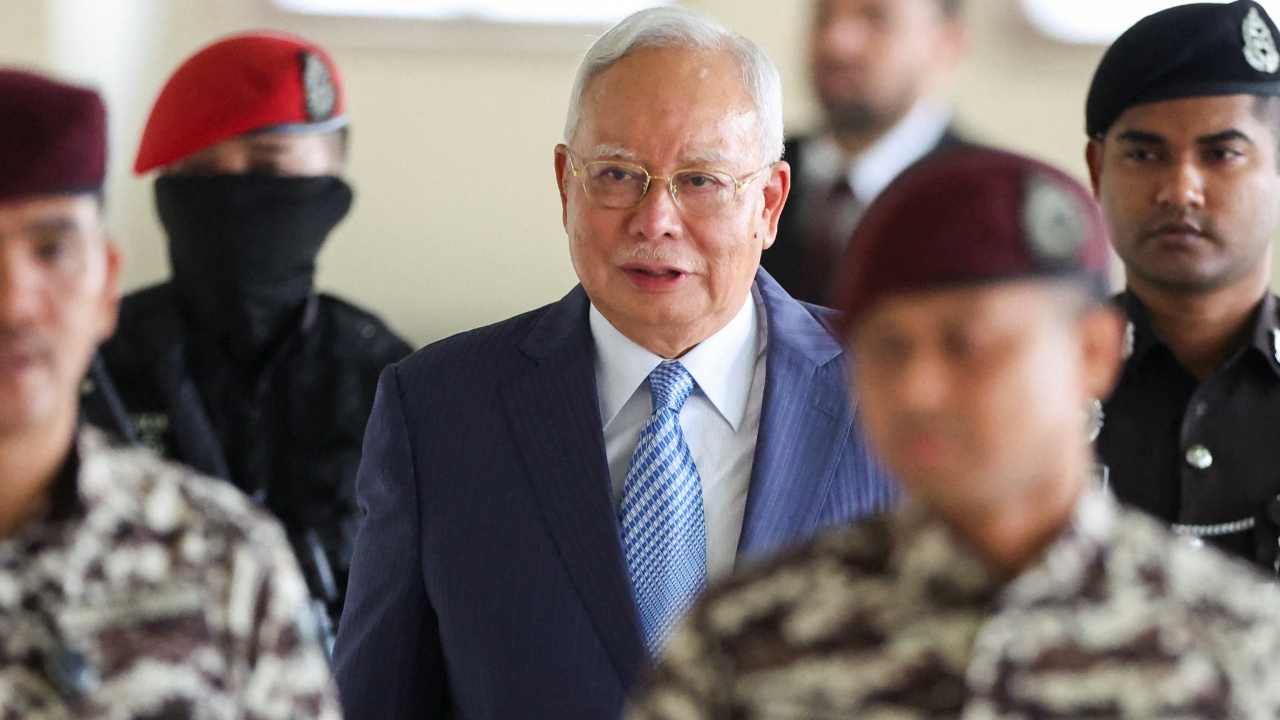
Former Malaysian Prime Minister Najib Razak was allowed to leave Kajang Prison to serve the remainder of his sentence under house arrest after UMNO confirmed payment of a 50 million ringgit fine, approximately 413 million baht, under the royal pardon conditions granted by Malaysia's King. The move to house detention may increase pressure on Prime Minister Anwar Ibrahim's coalition government.,
Najib Razak, 73, left Kajang Prison today (6 Nov) after the United Malays National Organisation (UMNO) confirmed it had fully paid the 50 million ringgit fine, about 413 million baht, fulfilling the royal pardon condition allowing Najib to serve the remaining sentence at home.
Najib's lawyer revealed that the Kuala Lumpur High Court issued an order permitting the former prime minister's transfer to house detention. The lawyer said they had received the court order documents and would submit them to Kajang Prison immediately to proceed accordingly.
AFP reporters noted that shortly afterward, a silver car carrying Najib was seen leaving Kajang Prison, followed by a motorcade. At the entrance to the former prime minister's luxury residence, police tape and traffic cones blocked the area, with police officers, patrol cars, mobile operations vehicles, and tents stationed near the entrance to maintain order and control crowds.
UMNO issued a statement confirming that it had completed payment to the Kuala Lumpur High Court this morning and announced the closure of the Najib Razak reconciliation fund, which had collected public donations. The party stated there was no longer a need to accept further donations for this purpose.
Previously, UMNO raised funds from the public to pay Najib's fine because his bank accounts were frozen, preventing him from paying the fine himself.
Malaysia's King Sultan Ibrahim granted Najib a conditional royal pardon in September, allowing him to serve the remaining prison term at home if the fine was paid. This marked the second royal pardon related to the former prime minister's cases.
Najib was sentenced to 12 years in July 2020 in his first case involving the embezzlement of substantial funds from SRC International, a subsidiary of the state investment fund 1MDB. Later, the pardon board reduced the sentence by half to six years and lowered the fine to 50 million ringgit, with this sentence due to end in August 2028.
However, in December last year, Najib received an additional 15-year sentence in another 1MDB corruption case and was fined 11.4 billion ringgit (about 2.8 billion USD) for abuse of power and money laundering.
Najib appealed this latter verdict and requested suspension of the sentence pending appeal, citing deteriorating health and inability to pay the huge fine. However, in October, the judge denied the request, stating no exceptional reason existed and the severity of the crime outweighed other considerations for public interest.
The 15-year sentence will commence after the six-year sentence from the first case ends. Najib has consistently denied all charges.
The 1MDB corruption scandal is one of the largest national wealth fund frauds in history. US and Malaysian prosecutors stated approximately 4.5 billion USD was diverted through shell companies and complex financial transactions, with over 1 billion USD allegedly funneled into accounts linked to Najib.
Prosecutors said Najib used his roles as prime minister, finance minister, and chairman of the 1MDB advisory board to transfer massive amounts into his personal accounts. Investigations found some funds were used to buy luxury real estate, yachts, and priceless artworks, including pieces by Claude Monet and Vincent van Gogh.
The 1MDB fund was established in 2009 during Najib's premiership to invest in infrastructure and urban development projects but became the center of a massive corruption network. Jho Low, a fugitive financier believed to be a key architect of the embezzlement, remains at large.
Ongoing investigations under successive Malaysian governments also implicate Najib's wife, Rosmah Mansor, who faces corruption allegations. Najib lost power in the 2018 election amid public outrage over the scandal.
Najib's transfer to house detention may heighten tensions within Prime Minister Anwar Ibrahim's coalition government, as Anwar's Pakatan Harapan party strongly opposes leniency toward the former prime minister.
Although Najib remains an influential figure within UMNO, part of the current coalition government, he continues to cause political divisions in Malaysia. The next general election is not scheduled until early 2028, though Anwar has said he might dissolve parliament early if internal conflicts worsen.
Tony Pua, former member of parliament from the Democratic Action Party (DAP), a key player in exposing the 1MDB scandal, criticized UMNO's fundraising as channeling large sums to aid a former prime minister with a serious corruption record instead of helping ordinary citizens. On Facebook, he said the party chose to "release Malaysia's most corrupt individual" rather than use funds for public benefit.