

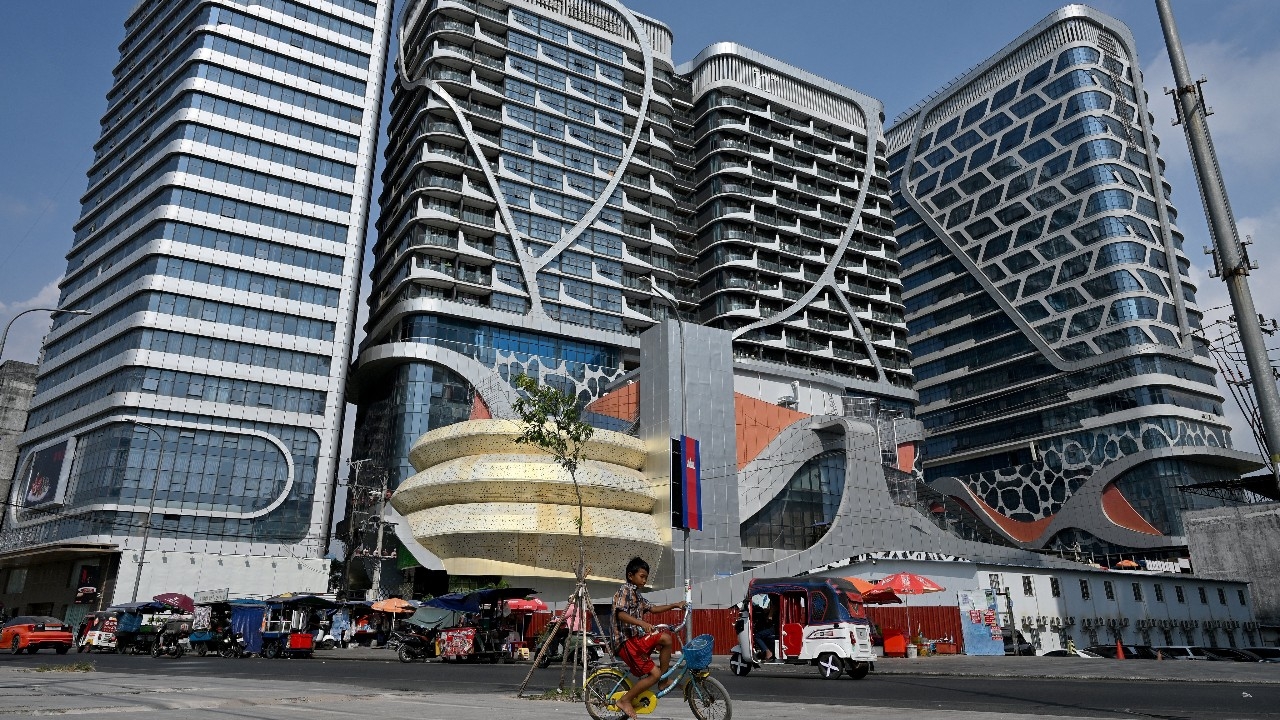
The U.S. Treasury Department announced sanctions on 4 individuals and 41 companies linked to Prince Group, a Cambodian business conglomerate accused of operating an international criminal network involved in online fraud, money laundering, and human trafficking.
On Thursday, 5 Nov 2020 GMT+7, the U.S. Treasury Department announced sanctions on several individuals and companies connected to the Prince Group crime network in Cambodia, including an online scam gang in Madagascar targeting Americans.
The Office of Foreign Assets Control (OFAC) under the U.S. Treasury Department stated it sanctioned 4 individuals and 41 companies supporting the Prince Group business network, previously designated by the U.S. government as a transnational criminal organization involved in cyber fraud, money laundering, and human trafficking.
Additionally, the U.S. sanctioned Malaysian national Chui Kok Wa, accused of running a scam network in Madagascar. The Treasury Department said the network used cyber technology and cryptocurrency to defraud many Americans, causing losses exceeding $400,000.
The latest measures target the business structures and financial networks enabling Prince Group’s illegal activities, including offshore companies, financial intermediaries, and individuals who conceal the true ownership of companies to evade previously imposed sanctions.
The U.S. Treasury stated that the Prince Group network generated billions of dollars in illicit income from online scams, especially involving digital asset investment fraud, romance scams, and other financial frauds, with victims both in the U.S. and globally.
Many operations are run from large scam centers in Southeast Asia, exploiting trafficked or coerced laborers to deceive internet users worldwide, then laundering the proceeds through front companies, offshore holding companies, financial intermediaries, and digital asset transactions to obscure the money’s origin and legitimize it.
U.S. Treasury Secretary Scott Bessent said cyber scam networks continue to steal billions from Americans, relying on complex international business networks to launder money. He affirmed the Treasury’s commitment to dismantle every level of these organizations, from leaders to companies and financial facilitators enabling their impunity.
One sanctioned individual is Qiu Yong, a key figure in the Prince Group network, accused of controlling multiple companies in the British Virgin Islands that own Hong Kong firms engaged in lending and other businesses.
The U.S. Treasury said Qiu holds multiple passports, including Cambodian, Saint Lucia, and Turkish, and uses lending business networks, as well as wine and other enterprises, to launder Prince Group’s money.
Several Hong Kong companies linked to Qiu were sanctioned, including Premium Financial Limited and Solar Scape Financial Limited, both involved in lending, along with other firms connected to wine sales and business management.
Also sanctioned was Amy Zhao Mengyao, Qiu’s personal assistant, who serves as company secretary and co-director of several companies controlled by Qiu.
The U.S. also targeted individuals and companies holding assets on behalf of or co-managing operations with Chen Bo, a Prince Group executive previously sanctioned, including Chen’s wife He Yujing and Visal Pang, associated with Prince Group in Cambodia.
The Treasury stated that after Chen Bo was sanctioned in October 2025, he transferred ownership of a Tokyo mansion to his wife, while Visal Pang controls 11 Cambodian companies, many with Chen Bo as co-director.
These 11 companies, engaged in construction, logistics, entertainment, real estate, construction machinery, duty-free shops, hotels, and app businesses, were also sanctioned in this action.
Simultaneously, the U.S. sanctioned 11 Cambodian companies still controlled by Chen Bo, including firms in insurance, energy, investment, industry, aviation, and real estate sectors.
The sanctions also cover companies in Singapore, Mauritius, and Malaysia linked to Dai An, a senior Prince Group executive sanctioned in June 2026, as well as Singapore’s Greenbay Multi Media, wholly owned by Thet Lee, another previously sanctioned Prince Group executive.
Cambodia has become a hub for criminal networks conducting online scams such as romance scams and cryptocurrency investment fraud. Some offenders join voluntarily, while others are victims of human trafficking forced to scam internet users worldwide.
Under pressure from multiple countries, including the U.S., UK, and China, Cambodian authorities say they are accelerating efforts to crack down on this industry.
Cambodian Prime Minister Hun Manet said at an anti-fraud meeting in September that Cambodia will not tolerate being a "safe haven" for cyber scam gangs. However, analysts believe that protection networks involving high-level individuals, financial structures, and illegal activity venues remain intact.
Previously, Chen Zhi, Prince Group’s Chinese-born founder, was extradited from Cambodia to China in January after the U.S. and UK sanctioned the group months earlier. Cambodian authorities said Chen was among at least six senior executives arrested, with casinos, buildings, and other properties worth nearly $1 billion seized. Prince Group has denied involvement in cyber scam networks.
The sanctions were coordinated with the FBI field offices in New York and Honolulu, the U.S. Department of Justice, the Scam Enforcement Task Force, and the U.S. Attorney’s Office for the District of Alaska, with investigative support from the British Virgin Islands Financial Investigation Agency and the UK Foreign, Commonwealth & Development Office.
The U.S. government said these measures are part of efforts under President Donald Trump’s March 6, 2026, executive order aimed at combating cybercrime, fraud, and scams targeting Americans, using legal tools and sanctions to disrupt transnational criminal networks and block their access to international financial systems.