

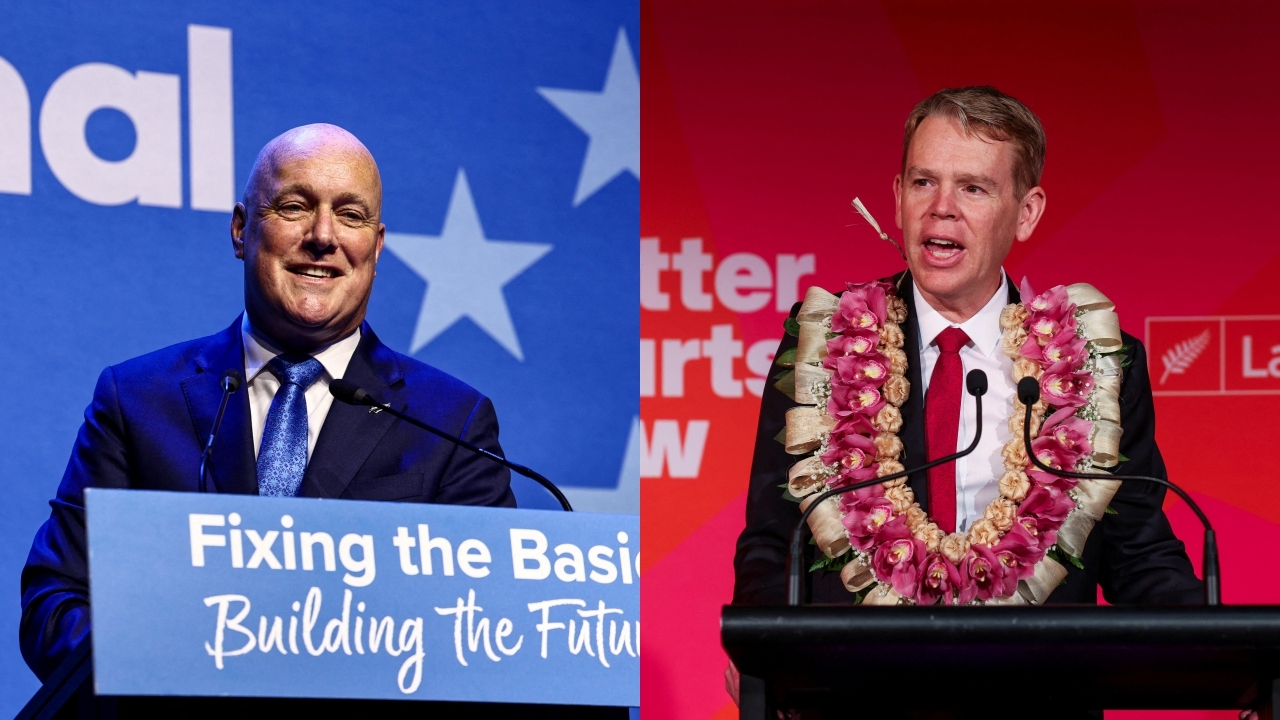
New Zealanders may face at least three weeks of political uncertainty after unofficial general election results indicated no decisive winner for forming a new government. The incumbent coalition led by Prime Minister Christopher Luxon is projected to hold about 67 of 131 seats, narrowly exceeding the minimum majority threshold of 66 seats by a slim margin.
New Zealand continues to face political uncertainty weeks after last Saturday's (7 Nov) general election, with no party securing a clear victory. The formation of a new government depends on the remaining vote counts.
Preliminary results from the New Zealand Electoral Commission show the National Party, a centre-right party led by Prime Minister Christopher Luxon, winning 42 seats, while the Labour Party, led by opposition leader Chris Hipkins, has 36 seats. Both parties have popularity below 30%, the lowest since New Zealand adopted the mixed-member proportional voting system in 1996.
The National Party, together with coalition partners ACT and New Zealand First, which have 13 and 12 seats respectively, likely form a coalition with 67 seats out of an expected 131 in parliament. The majority threshold requires at least 66 seats.
However, approximately 14% of votes classified as Special Votes remain to be counted, including ballots from New Zealanders abroad and those voting outside their electoral districts. Historically, these votes tend to favor left-leaning parties.
The Electoral Commission will announce official results on 27 November, meaning it will take about three more weeks before it is clear which party or coalition will form the government.
Luxon said the election was highly competitive and that the outcome remains uncertain until the final vote count. He added that the National Party still has a possibility to form a government with its existing allies.
Hipkins stated that the public has expressed its will through the election but that it will take time to understand how the results reflect political demands. He emphasized that the new parliament will require compromise, cooperation, and finding common ground among parties.
A key development in this election is the entrance of the centrist Opportunity Party, led by Quila Wong, which won 7 seats and is poised to be a decisive factor in determining which political bloc can form the government.
If the National Party and its allies lose their majority after official counting, both right- and left-leaning groups may need support from the Opportunity Party to establish a government.
Previously, Luxon had dismissed the possibility of working with the Opportunity Party, but on Sunday he softened his stance, no longer ruling out cooperation and saying that building relations with the party is appropriate, though details of any collaboration remain undecided.
Wong told supporters that the party aims to shift the country's political direction toward the future, focusing on the next generation and finding common ground among differing sides. She confirmed the party is ready to work with both political blocs and will begin negotiations with the party holding the most seats first.
An electoral law academic from the University of Otago noted that the Opportunity Party could become a key variable deciding which political bloc governs. The outcome may hinge on small differences in party and electorate votes.
The election's central issues included a sluggish economy, cost of living, and unemployment. The combined popularity of the National and Labour parties is about 60%, reflecting public dissatisfaction with both major parties.
Political analysts say slow economic growth under Luxon's government and skepticism about Hipkins' promises to revive the economy have led voters to support alternative parties more.
The Greens won 16 seats, slightly increasing their vote share from the previous election. The party proposes requiring the country's two largest supermarket chains to sell or spin off some stores to allow government-run shops to compete.
National Party's low vote share means several senior members may not enter the new parliament, including Finance Minister Nicola Willis, who will remain in her post during the caretaker government for about four more weeks.
National Party member Simon Brown said the election results bring both joy and disappointment due to the loss of several key personnel.
New Zealand uses a mixed-member proportional voting system where each voter casts two votes: one for their local electorate representative and one for their preferred political party. This system usually requires coalition governments formed through negotiations among multiple parties.
The election results do not yet clarify who will govern the country for the next three years, as special votes are still being counted and official coalition negotiations continue.