

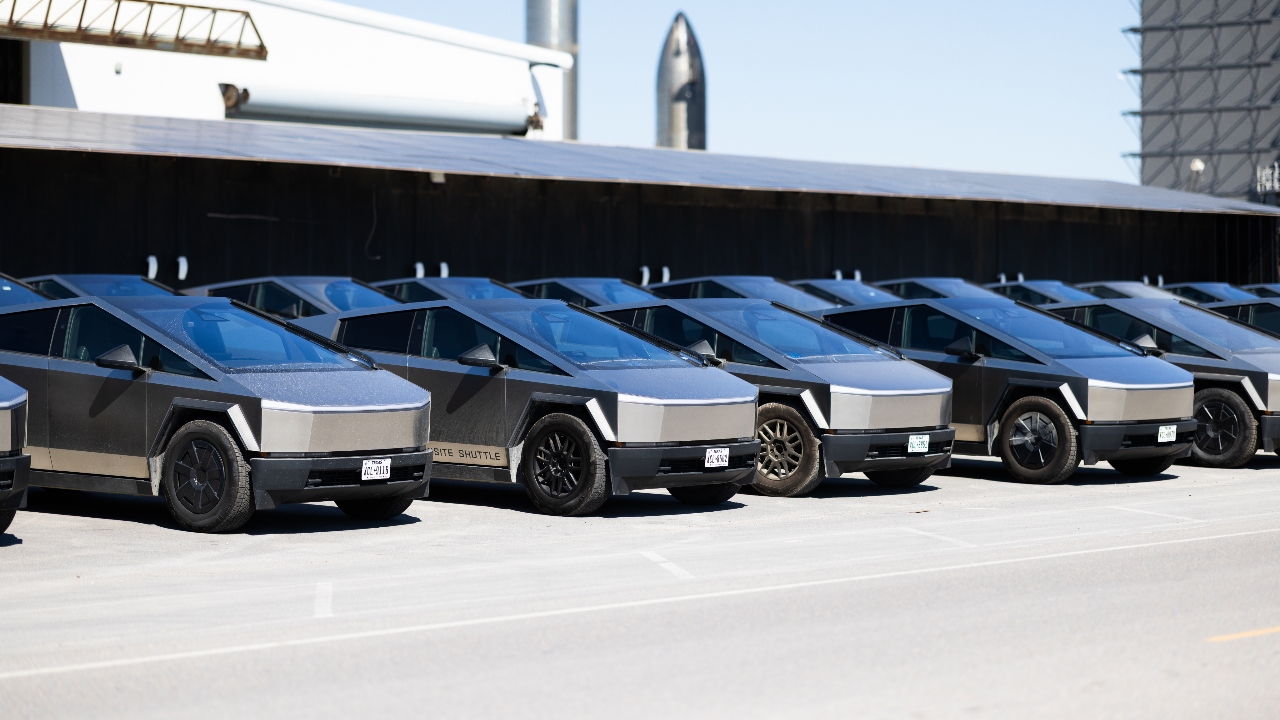
Elon Musk, Tesla's CEO, announced plans to gradually stop production of the Cybertruck electric pickup at the company's Texas factory around mid-2027. This move will free up space to increase production capacity for the self-driving Cybercab taxi after Cybertruck sales fell short of targets, despite strong initial interest and the vehicle becoming both a fan favorite and a subject of widespread criticism.
Elon Musk, Tesla's CEO, stated that the company plans to gradually end production of the Cybertruck at the Gigafactory Texas in the U.S. state of Texas around mid-2027 to make room for increasing production of the autonomous Cybercab taxi.
Musk posted on the X platform that Tesla will gradually reduce and cease Cybertruck production at its Texas factory around mid-next year to accommodate the ramp-up of Cybercab production.
However, Musk did not specify whether Tesla will fully end Cybertruck production or relocate it to another plant, nor did he clarify how pending orders will be handled.
Separately, Wes Morrill, chief engineer of the Cybertruck project, posted that the vehicle was a remarkable technology development project and that the technologies developed will continue through the Cybercab, thanking everyone involved in bringing this futuristic vision to reality.
After the announcement, many Tesla fans expressed regret on the X platform. One user praised the Cybertruck as the best vehicle Tesla has ever made, to which Musk replied that it was true but assured that existing Cybertrucks will remain in service for a long time.
The Cybertruck was a special focus for Musk and seen as a symbol of his future-focused technology and design vision. Yet, the vehicle also faced heavy criticism for its unusual appearance, becoming a product with both devoted fans and clear detractors.
Tesla first unveiled the Cybertruck in November 2019, notable for its sharp geometric shape, stainless steel body, and design distinct from typical pickups. Musk stated then that 250,000 pre-orders were received within days. However, production originally scheduled for 2021 faced multiple delays before deliveries began in late 2023.
During the 2019 unveiling, an embarrassing incident occurred when a demonstration of the supposedly ultra-strong armored glass ended with the glass breaking live in front of the audience. Despite this, the vehicle initially received many orders.
Tesla planned a maximum annual production capacity of 250,000 Cybertrucks at the Texas factory, but actual sales fell far short of this target.
According to Kelley Blue Book data, Tesla sold only 20,237 Cybertrucks in 2025, down from 38,965 in 2024. Cox Automotive estimates total cumulative sales at around 72,702 units, with over half occurring in 2024 before steadily declining.
The Cybertruck also faced multiple recalls, including one in 2025 involving over 46,000 vehicles due to concerns that some exterior trim parts might detach, along with complaints about assembly quality.
Price was another limiting factor. Musk had indicated early on that the company needed to produce a vehicle affordable to consumers, but fully equipped models started at about $61,000, while the high-performance Cyberbeast model in 2026 was priced around $102,000.
While fans admired the retro-futuristic look, likening it to a vehicle from the sci-fi film Blade Runner, many critics found the design unattractive.
Musk once praised the Cybertruck as Tesla’s greatest product with more potential than many realized, but initial enthusiasm did not translate into sustained broad market demand.
Stephanie Valdez Street, director of industry data analysis at Cox Automotive, said the decision to end Cybertruck production reflects the difficulty in turning initial hype and excitement for a new vehicle into ongoing demand in the mainstream market. She noted that Tesla had seen the Cybertruck as an opportunity to enter the large U.S. pickup market, which is highly valuable, but ultimately it became a niche product.
This production adjustment aligns with Musk’s strategy to transform Tesla’s image from an electric vehicle manufacturer into a full AI and robotics technology company, with the Cybercab as a key product.
The Cybercab is an electric vehicle designed as a two-seat autonomous taxi without a steering wheel or accelerator and brake pedals, first unveiled in October 2024.
Tesla began producing the Cybercab at its Texas factory in April and started offering paid rides in Austin, Texas, through its existing Robotaxi service from September.
However, the success of this business plan depends on Tesla’s ability to develop fully autonomous driving technology, which has yet to prove effective at large-scale service deployment.
After Musk announced plans to phase out Cybertruck production, Tesla’s shares rose 4.7% on Friday, reflecting market reaction to the company’s strategic shift toward autonomous driving and robotics technology.