

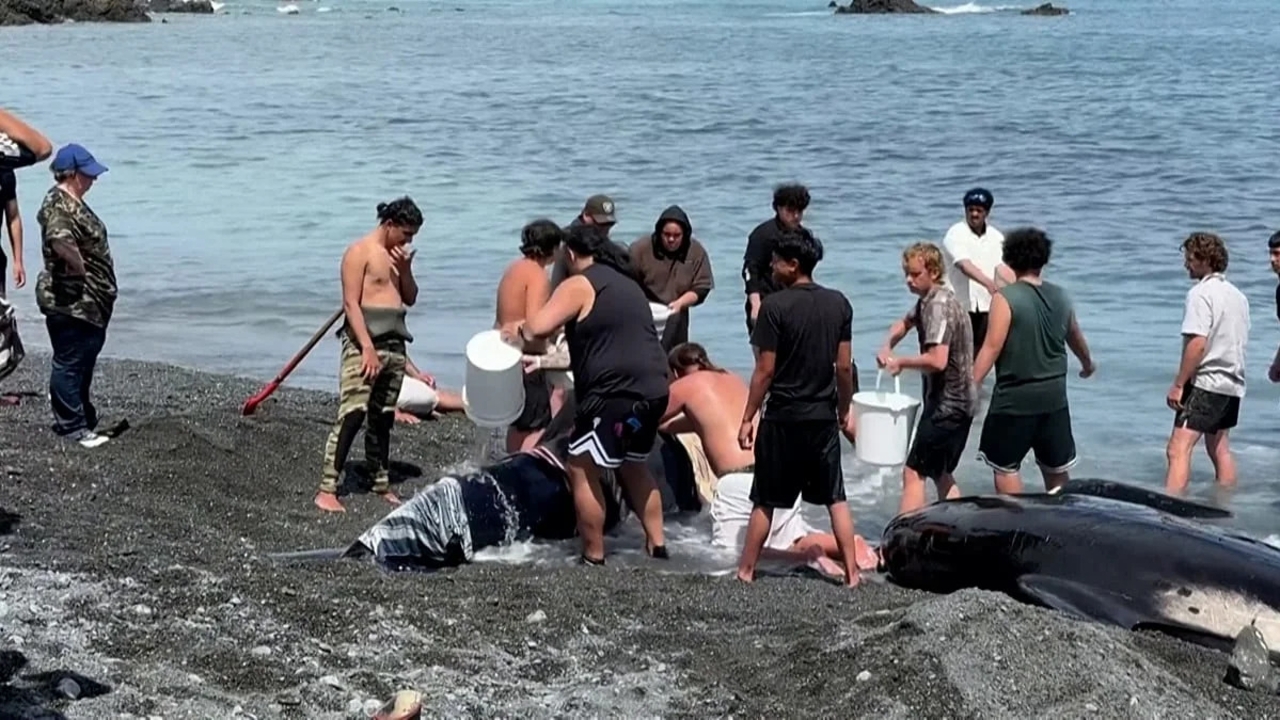
A pod of pilot whales stranded on the southern coast of New Zealand's North Island. About 50 whales were found trapped among rocks and beaches before all died. Despite efforts by officials and rescue teams to help the surviving whales, including successfully returning some to the sea, none ultimately survived. The rough seas and remote coastal conditions made the rescue operation very difficult.
Approximately 50 pilot whales died after stranding near the town of Ngawi, close to the village of Cape Palliser, at the southernmost part of New Zealand's North Island. Rescue teams described the event as challenging and deeply distressing.
The New Zealand Department of Conservation reported that a pod of pilot whales was found stranded on the coast around 08:00 local time on Thursday. Initially, at least 20 whales were stranded, among which four were still alive.
Project Jonah New Zealand, a marine animal rescue organization working with the Department of Conservation and local Māori tribe Ngāti Kahungunu (Ewe), quickly assessed the whales' condition and prepared a plan to return the surviving whales to the sea during high tide. Previously, officials managed to return two whales to the sea, but later all four surviving whales, including those rescued, ultimately died.
Project Jonah stated that many whales had already died before officials arrived. The pod was spread along several kilometers of coastline. The surviving whales gradually died throughout the day. The organization described the rescue as difficult and emotionally hard for those involved, and thanked local residents who first helped by keeping the whales moist and as comfortable as possible.
The southern coast of the North Island faces strong sea waves from the Cook Strait, with pebble beaches and sharp rocks making access and rescue efforts very challenging. The remote location further hindered the rescue teams' operations.
The New Zealand Department of Conservation said it is working with local Māori tribes to manage the burial of the whales according to customs and ceremonies that honor these animals, which are considered valuable natural resources by the Māori.
Andrew Sym, a local fisherman, told RNZ news that the event was very sad. Having lived and worked along the coast for more than 40 years, he has witnessed many whale strandings but had never seen pilot whales strand in this area in such numbers before.
The New Zealand Department of Conservation noted that pilot whales often strand in groups, but the exact causes of mass strandings remain unclear.
The department explained that pilot whales have strong social behavior; if one whale gets lost, others often come to assist. The most likely theory is that their echolocation system for navigation may malfunction in shallow, sloped coastal waters.
New Zealand is currently in summer, a season when whales tend to move closer to shorelines following food sources, and mass strandings are more common during this period.
The largest recorded mass stranding of pilot whales in New Zealand occurred at the Chatham Islands in 1918, with about 1,000 whales. In recent years, the Oceania region has seen several mass strandings, including about 500 pilot whales dying after stranding near a remote New Zealand island in 2022, an area known for many sharks.
In February 2025, over 150 whales stranded along Tasmania's coastline in Australia, marking the first mass stranding there in 50 years. All whales either died or were euthanized.
Earlier, in 2024, about 160 pilot whales stranded on Western Australia's coast, resulting in 28 deaths. Most of the pod was rescued and successfully returned to the sea.