

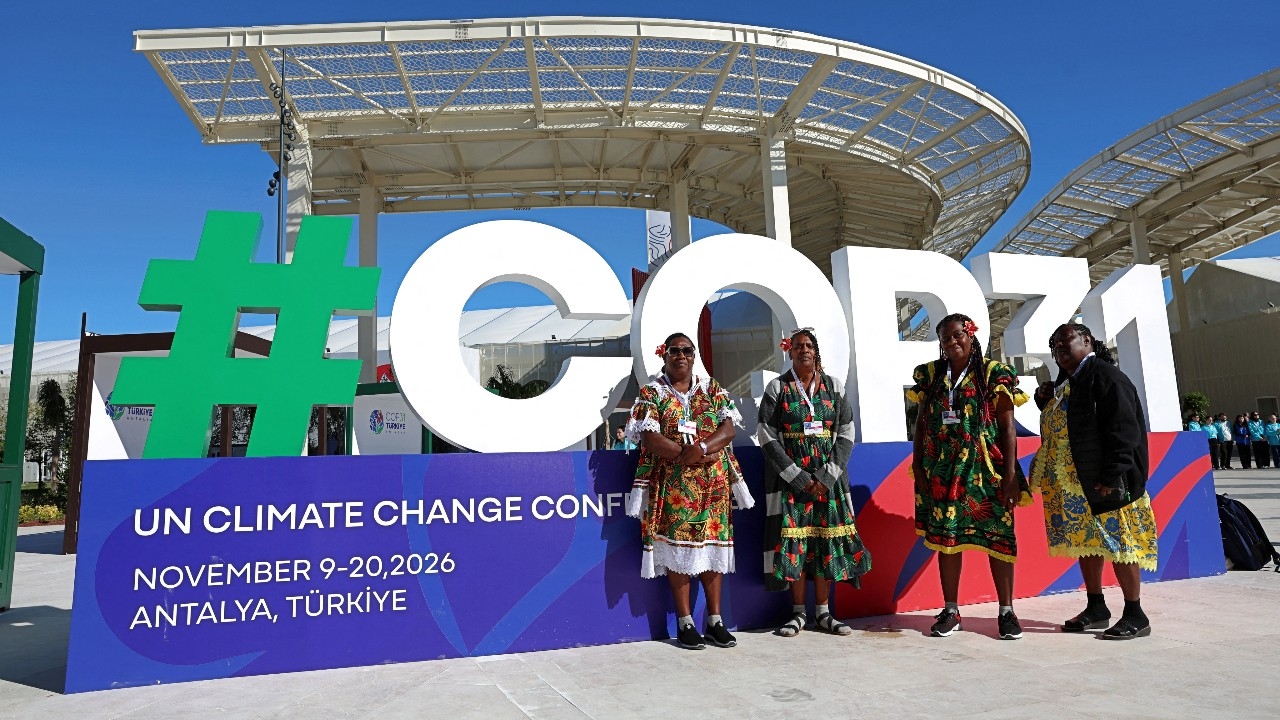
Antonio Guterres, Secretary-General of the United Nations, called on world leaders to urgently tackle climate change as the global environmental summit COP31 opened in Turkey amid disputes over climate funding allocations to support developing countries and warnings that the world faces its hottest year on record due to global warming and the El Niño phenomenon.
Antonio Guterres, Secretary-General of the United Nations, urged world leaders to take climate change seriously as the UN Climate Summit COP31 was set to open today (9 Nov) in Antalya, on Turkey's Mediterranean coast, amid early disagreements over funding to address the climate crisis.
Guterres stated in a press release that the world has entered a new era of extreme climate and called on leaders to accelerate greenhouse gas reductions, push for a just transition away from fossil fuels, and provide necessary funding and protections to vulnerable countries.
Thousands of participants gathered at a large exhibition center in Antalya following a year marked by severe heatwaves in Europe, massive wildfires in Indonesia, and catastrophic floods in Nepal, while an unusually strong El Niño is increasing global climate variability.
However, the COP31 opening ceremony was delayed by one hour without explanation, and delegates continued talks late into Sunday after developing countries demanded that climate finance be officially included on the agenda.
Jasper Inventor, head of the Greenpeace delegation at COP31, said the summit's start was difficult, noting that developed countries are taking a hardline stance against proposals to include discussions on funding from wealthy nations to developing countries, as agreed at COP30 in Brazil last year.
Under the UN climate agreement, developed countries, responsible for most historical greenhouse gas emissions, must provide financial aid to developing nations to adapt to climate impacts and transition to clean energy, but poorer countries say the funding received remains insufficient.
African countries are also pushing for discussions to triple funding for climate adaptation, which would enable poor nations to implement measures such as building sea walls or planting drought-resistant crops.
However, senior European Union officials warned last week that COP31 may lack the political will to advance additional funding commitments.
Observers expect limited major progress at this meeting, as many countries face pressures from rising oil prices and geopolitical tensions from conflicts involving the US and Iran, as well as the Russia-Ukraine war.
As negotiations proceed in Antalya, the World Meteorological Organization (WMO) released a report Monday stating that 2026 continues to experience abnormally high temperatures, melting ice, and rising sea levels.
The US independent research group Berkeley Earth estimates a 95% chance that 2026 will break the record for the hottest year in history, previously set in 2024, even with two months remaining in the year.
Dr. Robert Rohde, a researcher from Berkeley Earth, said the world is entering multiple years of record-high temperatures, consistent with predictions from global warming, leading to glacier collapse, severe heatwaves, and droughts.
Last Friday, the EU’s Copernicus climate monitoring agency confirmed that October was the hottest October ever recorded.
Meanwhile, the WMO offered a more cautious estimate, predicting 2026 will be among the four hottest years on record and warned that 2027 will continue to see high temperatures due to the unusually strong El Niño effect extending into next year.
Celeste Saulo, Secretary-General of the WMO, said the phenomenon makes the term "extreme high temperatures" more meaningful beyond previous measurement limits.
A UN report in September warned that global temperatures are likely to exceed 1.5 degrees Celsius above pre-industrial levels—the most ambitious target of the Paris Agreement—heightening risks of severe climate impacts.
Scientists indicate the primary driver of rising global temperatures is increased atmospheric carbon dioxide, mainly from burning fossil fuels, which traps additional heat on Earth; about 90% of this excess heat is absorbed by the oceans.
Saulo explained that El Niño does not add new heat to the planet but releases heat stored in oceans, which are at the highest temperatures ever recorded, resulting in greater accumulated heat being emitted.
Currently, the world is on track for a 2.8 degrees Celsius temperature rise by the end of the century compared to pre-industrial times, making it almost impossible to meet the Paris Agreement goal of limiting warming to 1.5 degrees Celsius.
Turkey is hosting COP31, with Australia leading negotiations under an unusual cooperative arrangement after resolving a dispute over hosting rights.
Both countries have designated this summit as the "COP of Implementation," aiming to convert numerous climate pledges made in recent years into concrete actions. Turkey has proposed an agenda alongside formal negotiations encouraging countries to voluntarily commit to issues ranging from artificial intelligence to waste management.
A key proposal focuses on promoting electricity use within energy systems to increase the global share of energy demand met by electricity from the current 20% to 35% by 2035.
However, this approach could spark controversy as the European Union insists that the transition to electricity must be based on clean energy, potentially leading to debates over the role of fossil fuels in Turkey's proposals.
Countries previously pledged at COP28 in Dubai in 2023 to phase out fossil fuels but have yet to agree on how to implement these commitments.
COP30 in Brazil last year concluded with an agreement that avoided explicit mention of fossil fuels after oil-producing countries opposed such language, while Brazil introduced a voluntary plan for phasing out fossil fuels adaptable to each country's circumstances.
Simon Steele, UN climate official, is expected to tell governments at the summit's opening that no single COP meeting can solve all problems or bridge the gap between scientific evidence and reality alone, but the urgency now demands global progress because global warming is already causing damage.
He will also highlight that expanding renewable energy is both a climate and economic solution, with renewables saving about 500 billion US dollars globally last year.
The International Energy Agency (IEA) forecasts that renewable energy capacity expansion over the next six years will be 57% higher than the previous period, reflecting progress in the energy transition despite ongoing increases in global greenhouse gas emissions.
Nonetheless, funding for developing countries remains a critical issue; latest 2024 data shows only about one-third of the targeted finance has been secured, while the UN warns that current climate change damages are extensive and will require much more funding.
Many countries have redirected aid budgets towards increased military spending and short-term household relief due to soaring oil and gas prices from the US-Iran war. Governments also plan to use COP31 to discuss global AI policies, especially increased energy and water demands from data centers, key infrastructure for AI expansion.
A draft EU position states that European countries will support the transition to electricity only if no country can achieve targets by relying on natural gas. The EU's memo to member states says progress must be based on clean energy sources.
However, countries like Saudi Arabia and Russia have previously advocated for natural gas as a cleaner transitional fuel compared to coal.
WMO Secretary-General Saulo said she cannot explain why countries fail to reach agreements on some past issues, but it is clear that lack of consensus leads to more extreme weather events.
The United States, under President Donald Trump—who expressed skepticism about climate change action—did not send government officials to attend COP31. However, a US congressional delegation will travel to Antalya, with Democratic members upbeat following their historic midterm election wins last week.