

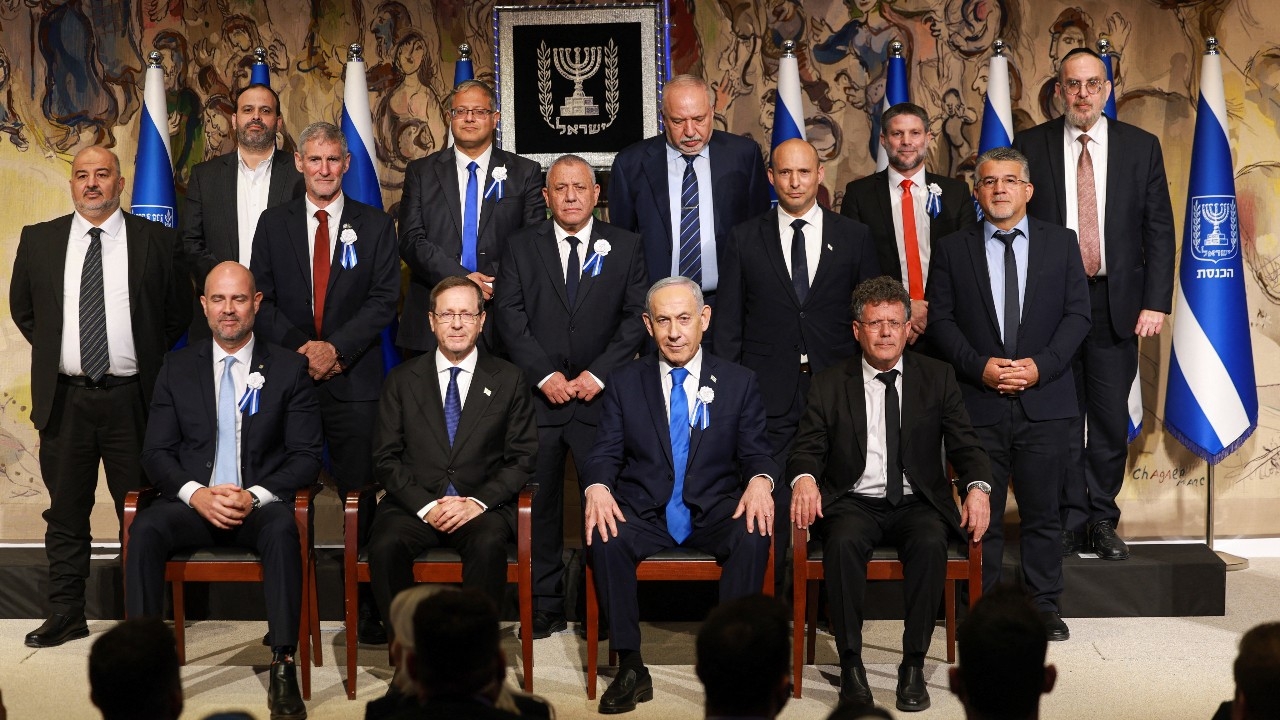
Israel's parliament convened and new members were sworn in amid political conflict after the opposition sought to form a government to unseat Benjamin Netanyahu. A record 19 Arab MKs took office, while the opposition leader has less than four weeks to gather support to form a government.
Israel's parliament convened its new session on Tuesday, 10 Nov 2023 GMT+7, with members elected last month sworn in amid political tension and protests by far-right groups attempting to disrupt the ceremony.
Nineteen Arab MKs were sworn in, the highest number ever. During the ceremony, far-right members shouted jeers at them, and some members from the Joint List and Ra'am parties walked out during the Israeli national anthem, drawing strong criticism from the right.
Opposition leader Kade Eisenkot, tasked by President Isaac Herzog to form a government, said Israel faces one of its most challenging periods since its founding and pledged to quickly establish a national emergency government to end Benjamin Netanyahu's tenure.
However, Eisenkot has 28 days to secure enough support to form a government, with a possible 14-day extension. His four-party opposition alliance holds 48 seats, while Netanyahu's bloc has 53 out of 120 seats in parliament, leaving neither side with a majority.
The election results also gave Arab-led political parties a combined total of 19 seats, an unprecedented increase, potentially making them key players in government formation. Netanyahu has rejected forming a coalition with Arab parties, and three opposition parties also oppose including them in government.
Netanyahu has called for a national unity government, citing threats from Iran and nuclear risks, and warned that a government relying on Arab parties would endanger Israel.
Eisenkot countered that Netanyahu's statements sow division and hatred, reinforcing his conviction that Netanyahu is unfit to remain prime minister even for a minute longer.
Meanwhile, the Arab parties Joint List and Ra'am, representing Israeli Arabs, affirmed their support for resolving the Israeli-Palestinian conflict by peaceful means and backing an independent Palestinian state alongside Israel.
However, government formation faces major obstacles, notably over the conscription of ultra-Orthodox Jewish men, who currently receive exemptions if they study full-time in religious institutions, a change strongly opposed by far-right parties.
Additionally, some Arab party leaders have refused to label Hamas a terrorist organization, despite condemning the October 7 massacre and supporting Hamas's disarmament.
Although no government has been formed yet, the opposition has submitted a bill to establish an independent commission to investigate failures that enabled the October 7 attacks, a matter Netanyahu has consistently blocked.
Netanyahu will remain acting prime minister until a new government is formed, a process that could take from several days to several months.
. . .BBC/The Telegraph