

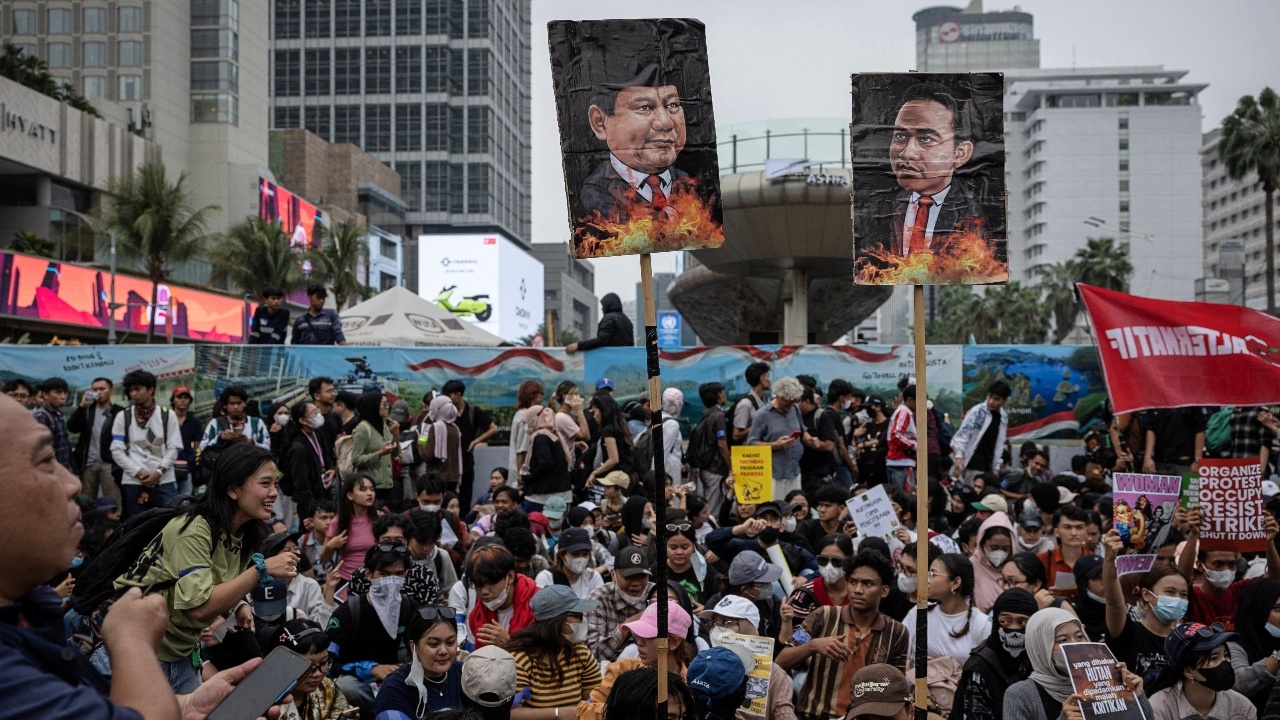
More than 100 Indonesian parliament members signed a petition that could lead to the impeachment of Vice President Gibran Rakabuming Raka, the eldest son of former Indonesian President Joko Widodo. This follows rulings by the Constitutional Court and Supreme Court determining that his educational documents do not comply with election requirements. Meanwhile, Gibran expressed his intention to resign to President Prabowo Subianto.
Over 100 Indonesian parliament members from various political parties have signed a petition paving the way for proceedings to impeach Vice President Gibran Rakabuming Raka amid risks of escalating political tensions in Indonesia, Southeast Asia's largest economy.
Muhammad Khoirid, one of the parliament members who signed the petition, stated that parliamentarians believe Gibran is no longer qualified to serve as vice president because the court rulings render him "non-compliant with the eligibility criteria for vice presidential candidates."
Khoirid said they will submit the petition to the speaker of the house, and that the official declaration of parliament members' stance on this matter will trigger the impeachment process. Previously, about 50 parliament members had submitted a motion that could also lead to impeachment proceedings.
Gibran, 39, the eldest son of former Indonesian President Joko Widodo, also known as "Jokowi," is under intense scrutiny after rulings by the Constitutional Court and Supreme Court last month questioned whether his educational documents meet the legal qualifications for political office.
The Indonesian Supreme Court published its ruling online on the evening of Tuesday, 10 Nov 2023 GMT+7, ordering the Ministry of Education to revoke Gibran's educational equivalency certificate after the court annulled the document.
Gibran, who studied abroad, used this educational equivalency certificate to meet the academic requirements to run in the 2024 presidential election, which he won alongside Prabowo.
Indonesian election law requires vice presidential candidates to have completed senior high school or possess an equivalent qualification, but the court found that the certificate submitted was based on evidence that could not prove Gibran met this criterion.
The court's ruling stated no evidence was found showing that Gibran held a diploma or educational certificate from abroad that could serve as a basis for equivalency to senior high school level. The court also referenced the Constitutional Court's earlier ruling that Gibran's educational documents failed to meet election requirements.
However, the previous Constitutional Court ruling did not immediately remove Gibran from office because the court dismissed challenges to his qualifications on procedural grounds.
Earlier, Gibran expressed his desire to resign from the vice presidency during talks with President Prabowo Subianto on Tuesday.
Prasetyo Hadi, Minister to the Presidential Office, confirmed they discussed the matter but said no formal resignation letter has been submitted, and Prabowo did not reject Gibran's proposal. The Indonesian government later clarified that Gibran remains vice president and continues performing his duties as normal.
Gibran maintained a firm stance, telling reporters that Prabowo, whom he regards as a father figure, has encouraged him to pursue legal action.
Political critic Lukas Luwarsa believes Gibran's expressed wish to resign might be a way to gauge public opinion rather than a genuine intent to step down. He added that Gibran wants to keep his vice presidency and will not relinquish it without a fight.
The crisis arises amid rising tensions between Prabowo and Joko Widodo, former president and once political ally who played a key role in supporting Prabowo's 2024 presidential victory.
Analysts warn that Gibran's resignation or impeachment could trigger internal competition within the coalition government for the vice presidency and complicate Prabowo's task of selecting a successor without alienating key political allies.
Under Indonesia's constitution, if the vice presidency becomes vacant, the president must nominate two candidates, and the People's Assembly will select the replacement within 60 days.
Rendy Pahrun Wadipala, a political scientist from the Indonesian National Research and Innovation Agency, warned that conflicts among the seven coalition parties' interests could complicate this process, as each party may push to promote its own candidate for vice president.
Potential successors mentioned include Puan Maharani, Speaker of Indonesia's Parliament and daughter of former president Megawati Sukarnoputri, and Agus Harimurti Yudhoyono, chairman of the Democratic Party and son of former president Susilo Bambang Yudhoyono.
However, Marcus Mietzner, a political scientist from the Australian National University, questioned whether Prabowo would benefit from these changes, since they might spark intense competition among coalition parties for the vice presidency.
Gibran's situation also represents a political setback for Joko Widodo, whose support helped secure Prabowo's 2024 election victory.
Gibran's candidacy previously faced significant controversy after the Constitutional Court allowed him to run despite being under the minimum age of 40; the court's then-chief justice, Gibran's uncle, was later found to have violated ethical standards.
Jokowi’s political standing faces additional pressure after Listyo Sigit Prabowo, former national police chief and political ally, was arrested on charges related to wiretapping the president's phone.
Sana Jaffrey, a researcher at the Australian National University, said it is hard to believe parliament members would act against Gibran without Prabowo’s knowledge or approval.
She noted Prabowo's silence suggests he may want Gibran out of office without bearing the political burden of openly pushing the issue, particularly given the risk of backlash from Jokowi’s supporters who helped him win the election.
Jaffrey also warned that the crisis reveals how the political interests of a small elite are taking precedence over the country's need for effective and stable governance, adding that prolonged uncertainty at the leadership level will increase domestic and international concerns about Indonesia's direction.
.sourceReuters/Malay Mail