

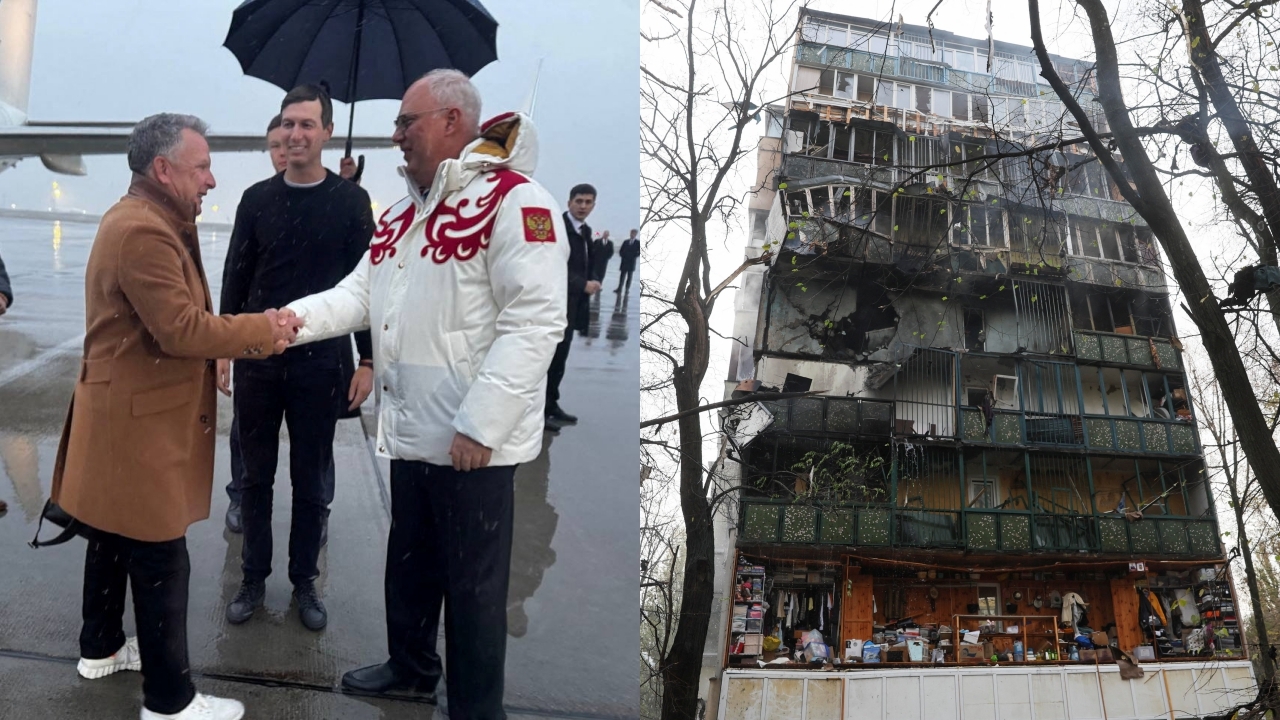
Russia and Ukraine launched retaliatory attacks in Moscow and Kyiv as Jared Kushner and Steve Witkoff, representatives of President Donald Trump, arrived in Moscow to meet President Vladimir Putin following peace talks in Abu Dhabi that reached a conclusion on prisoner exchanges but showed no clear progress on territorial and security guarantee issues.
Russia and Ukraine initiated retaliatory attacks in each other's capitals early today (12 Nov), just one day after peace talks between the two countries ended, while a US delegation arrived in Moscow to meet President Vladimir Putin on the same day.
The US delegation, led by Jared Kushner, son-in-law of President Donald Trump, and businessman and US negotiator Steve Witkoff, were welcomed at Moscow airport by Kirill Dmitriev, Putin's special envoy, who shared images of shaking hands with Witkoff on the social media platform X.
This trip follows negotiations among representatives from Russia, Ukraine, and the US in Abu Dhabi, United Arab Emirates, which lasted two days and concluded last Wednesday. Both sides agreed on a prisoner exchange, but US mediators noted significant differences remain, especially on territorial issues.
The Russian Ministry of Defense stated via Telegram that Russian forces attacked military targets and energy infrastructure in Ukraine, including an ammunition depot in Kyiv, while Reuters reporters heard explosions in Kyiv early Thursday morning.
Local officials in the Rivne region of western Ukraine reported that the attacks caused damage to energy infrastructure and civilian buildings.
On the Russian side, Moscow Mayor Sergey Sobyanin announced that air defense systems intercepted five drones headed for Moscow, while officials in other regions, including Rostov and Tula, also reported shooting down drones.
After concluding talks with Putin, the US delegation is scheduled to travel to Dublin, Ireland, to meet Ukrainian President Volodymyr Zelensky, who is attending a meeting with European leaders.
Kushner stated that the discussions with Putin will review topics covered during the two-day talks in Abu Dhabi and attempt to push for progress, as he sees some opportunities and potential pathways toward an agreement.
Upon arriving in Ireland on Wednesday, Zelensky said there might be a chance to open the way to end the war with Russia before 2027. He hopes the US representatives will bring concrete proposals to discuss with Putin and return with clear progress, expressing cautious optimism despite ongoing doubts about the negotiation approach.
Zelensky also mentioned a positive shift in the US stance toward allowing European involvement in the talks, noting that the US is more open and friendly to this idea.
This issue is significant because European countries are concerned about Russia’s proposal to revise the continent’s security structure, while the US has also suggested concepts for a new security framework.
The Abu Dhabi talks made progress on prisoner exchanges, which Kushner described as the largest such swap ever. However, neither Russia nor Ukraine has yet disclosed the number of prisoners to be released.
Zelensky said Ukraine is awaiting a response from Russia regarding a prisoner exchange proposal on a 1,000-for-1,000 basis, possibly increasing to 1,200 for 1,200.
Additionally, Zelensky noted that the talks delved more deeply into security guarantees for Ukraine, a key issue to prevent future Russian attacks.
Although both sides said they would continue negotiations, Russia questioned the need for European countries to join the negotiation table.
Vladimir Medinsky, head of Russia's negotiation team, said after the Abu Dhabi talks that Russia does not understand why it needs to negotiate with European countries, as it has not received any peace initiatives or concrete proposals from them.
Later, Medinsky told Russian television that Russia's goal is to establish a so-called "New Yalta" agreement, referencing the 1945 Yalta Conference where Western leaders and the Soviet Union discussed post-World War II European arrangements.
Ukraine warned against allowing such an agreement, while Kushner said one topic for discussion with Putin would be how to involve European countries in the negotiation process.
Previously, officials from the UK, France, Germany, and Italy, along with representatives from NATO and the European Union, traveled to Abu Dhabi for parallel talks alongside the main negotiations.
However, EU officials view the talks as lacking substantial progress toward peace and maintain that Europe sees no need to discuss broad security structures with Russia before fighting stops.
The war between Russia and Ukraine began in February 2022 when Russia launched an invasion, resulting in hundreds of thousands of deaths and millions displaced, especially in eastern and southern Ukraine, areas heavily damaged by continuous air attacks.
Russia demands Ukraine withdraw forces from certain eastern areas still under Ukrainian control and seeks a broad agreement on a “European security structure,” seen as part of Russia’s long-term aim to limit NATO’s expansion in Eastern Europe and end Western military support to Ukraine.
Ukraine insists on a ceasefire before discussing territorial issues and calls for direct talks between Zelensky and Putin to address key disagreements, but Putin has rejected this approach.
Kushner said the talks so far have been useful, although it is too soon to reveal which issues both sides might agree on. He noted some areas show potential for compromise, while others require more discussion, but overall it represents a good first step in the negotiation process.