

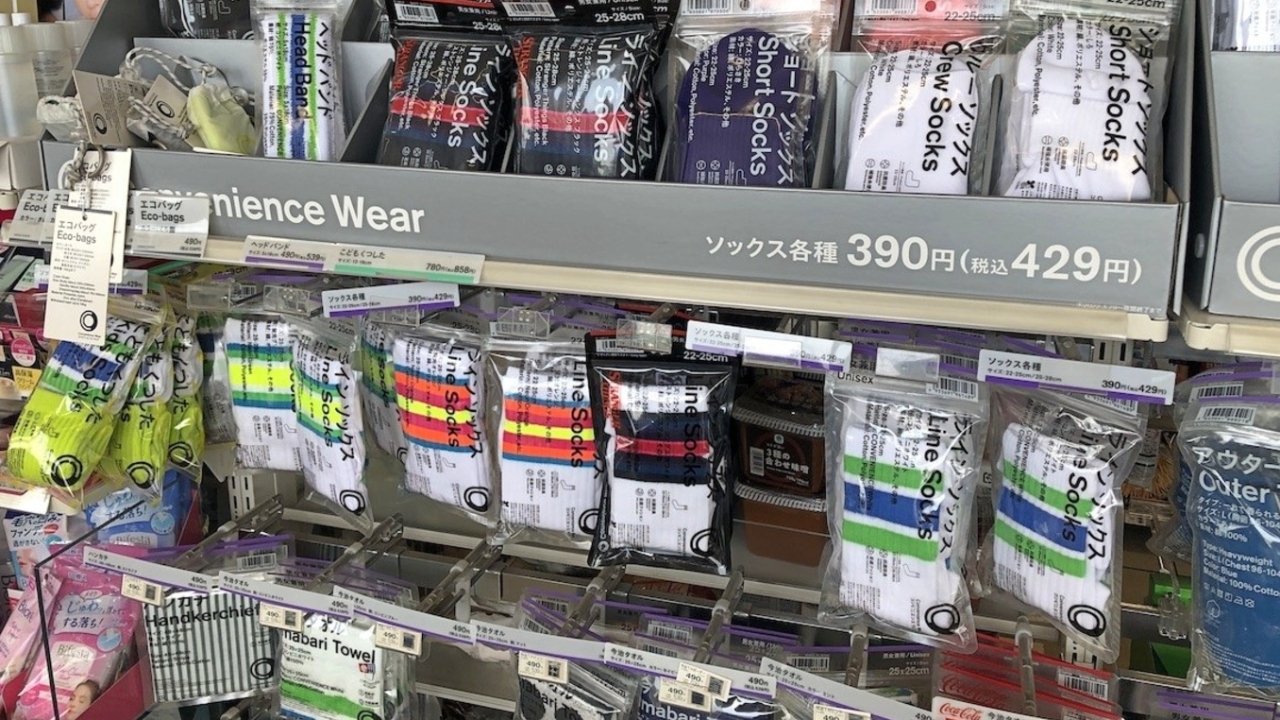
Blue-green-white striped socks priced at 390 yen have become a hit item that transformed "FamilyMart" from an ordinary convenience store selling food and daily goods into a phenomenon-level fashion lifestyle brand. This boosted clothing sales beyond 20 billion yen, while the company plans to expand its pet product line and collaborate with global celebrities to differentiate itself amid Japan’s increasingly saturated convenience store market.
For many, the blue, green, and white striped socks priced at 390 yen (about 82 baht) hanging near the entrance of FamilyMart convenience stores might seem like an emergency purchase item rather than a fashion statement.
However, these socks have become one of the most famous products in Japanese convenience stores, with cumulative sales reaching 40 million pairs since their 2021 launch. They have been a key driver in transforming FamilyMart, Japan’s second-largest convenience store chain, into a full-fledged lifestyle brand amid fierce competition in the "konbini" market.
Recently, FamilyMart has been building on its fashion success by expanding its lifestyle product line, including launching pet items such as scarves, collars, and leashes designed for matching owner-and-pet outfits in February. This is alongside a major brand image campaign featuring global superstar Lady Gaga.
This modern branding strategy has helped FamilyMart stand out at a time when Japanese consumers face inflation and cut back spending, while drugstores encroach on basic consumer goods market share. Additionally, Japan’s declining population limits new store openings in a saturated market with over 56,000 convenience stores nationwide.
Starting with “Convenience Wear” to a 20-billion-yen business: FamilyMart, known colloquially in Japan as "Famima," launched the Convenience Wear fashion line in 2021. It leveraged textile expertise from its parent company Itochu and partnered with Hiromichi Ochiai, a renowned streetwear designer from the Facetasm brand.
Thanks to viral social media buzz, this business segment has grown to over 20 billion yen in value, with sales expected to rise another 30% in the fiscal year ending March. Although clothing sales account for less than 1% of FamilyMart’s total sales and are a small fraction of Itochu’s 2.65 trillion yen annual gross profit, analysts see Convenience Wear as enhancing the brand image and increasing customer spending per visit across over 16,500 stores.
Takehiko Sugai, head of the Convenience Wear product group, revealed at FamilyMart’s new flagship store in Tokyo—where Nigo, founder of the legendary streetwear brand A Bathing Ape, oversees creative direction—that "we have taken a bold and daring approach with Convenience Wear."
Highlighting exclusivity to attract collectors and fans, Sugai explained that FamilyMart combines everyday necessities with special limited-edition collections in collaboration with major brands like Netflix’s Stranger Things series and the famous manga "JoJo’s Bizarre Adventure," drawing customers into stores.
Sugai said, "Exclusivity is our most important differentiator from competitors. If customers want our products, they have to come to our stores." Although the company does not disclose exact figures on how much Convenience Wear increases overall store traffic, each limited-edition product launch consistently generates a surge of customers.
This aligns with feedback from regular customer Tatsuhiko Yuki, a 56-year-old taxi driver, who sees FamilyMart as a collection hub. He has purchased 20 pairs of striped socks, including limited editions inspired by Nintendo’s Animal Crossing game, plus dozens of other items like towels. "Their designs have a perfectly balanced retro vibe. I stop by just to see what’s new. It’s more than just a convenience store now," he said.
Amid this intense competition, other rivals are also moving quickly. Lawson, jointly owned by Mitsubishi Corp and KDDI, has partnered with Ryohin Keikaku to sell the Muji brand in its stores. Meanwhile, 7-Eleven, managed by Seven & i Holdings, expanded its fashion offerings through collaborations targeting younger customers as of last September.
However, analysts believe no competitor has matched the cultural impact of FamilyMart’s Convenience Wear. Takahiro Suzuki, an economist at Hyakunen Consulting, commented that FamilyMart will maintain its competitive edge for some time by building a loyal customer base that chooses Famima first among multiple options, even as foot traffic declines due to widening income disparities and consumer cost-cutting.
Although the fashion strategy carries risks from fleeting trends and challenges in reaching broader customer groups through youth-focused products, Sugai is confident the sustained popularity of the striped socks proves Convenience Wear has moved beyond a passing fad to become a core, sustainable product line.