

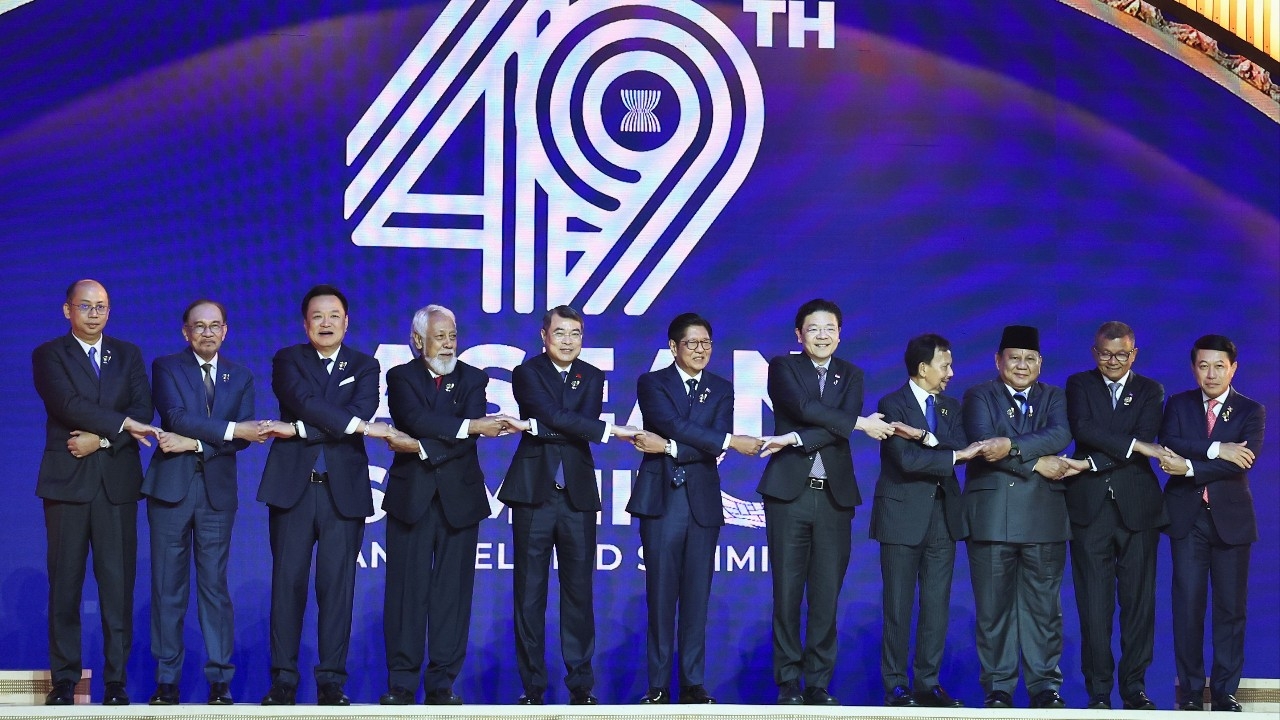
Philippine President Ferdinand Marcos Jr. inaugurated the 49th ASEAN Summit, declaring "Moving Forward Together" amid tests of ASEAN's unity as the world faces geopolitical tensions, a Middle East crisis, soaring energy prices, and transnational threats. He pushed for cooperation in digital economy, security, and energy, while the summit focused on Myanmar, the South China Sea, and the visit of US President Donald Trump.
As ASEAN Chair, Philippine President Ferdinand Marcos Jr. officially opened the 49th ASEAN Summit this morning (15 Nov) at the Philippine International Convention Center in Pasay City, Manila. He called on ASEAN's 11 member states—diverse in size, history, and culture—to unite their strengths and "move forward together."
The Philippine leader referenced the summit's symbol, the ancient "Balangay" boat from the pre-Spanish era, stating, "We come together as equals, carrying the hopes of our people and shared responsibilities, to transform these into a single goal."
President Marcos highlighted that ASEAN faces a "current of change," including geopolitical tensions, economic uncertainties, new technologies, climate change, the El Niño phenomenon, and transnational threats—especially the Middle East crisis impacting ASEAN citizens abroad and energy supply stability.
He said, "Rather than cancel the summit, member states agreed this is the most crucial moment for ASEAN to unite. No single country has all the resources, potential, or solutions alone. When each country's capacities are tested, the region's collective strength will serve as mutual protection."
The Philippine leader summarized progress and key goals to improve people's lives, including enhancing maritime cooperation, combating human trafficking, cybercrime, and online scam gangs, as well as linking economies through the ASEAN Digital Economy Framework Agreement (DEFA), the ASEAN Power Grid project, strengthening supply chains, and supporting MSMEs and the creative industries.
During the summit weekend, ASEAN foreign ministers and leaders discussed rising energy costs exacerbating inflation and affecting populations in fuel-importing countries like the Philippines. They are studying proposals for a regional joint oil reserve and preparing for next week's Asian Zero Emission Community (AZEC) summit led by Japan.
A key challenge to ASEAN unity remains Myanmar's situation since the 2021 coup. The United Nations estimates the civil war has caused over 100,000 deaths and displaced more than 3.5 million people.
Dominic Xavier Imperial, spokesperson for the Philippine Department of Foreign Affairs, revealed that ASEAN leaders will review progress on the "Five-Point Consensus" and issue a joint statement post-summit amid attention on some ASEAN countries and the United States reengaging with Myanmar’s military government led by Senior General Min Aung Hlaing, which is supported by China, India, and Russia.
Meanwhile, the South China Sea dispute will be discussed with China. The Philippine foreign ministry spokesperson stated that negotiations on the long-delayed Code of Conduct in the South China Sea have overall progressed about 70%.
The summit's opening atmosphere was dignified, with President Marcos and First Lady Lisa Araneta Marcos welcoming ASEAN and world leaders alongside cultural performances.
A major highlight is US President Donald Trump's visit to the Philippines on Tuesday, 17 November, near the summit's conclusion. Trump is expected to hold an offside meeting with Quad leaders—India, Japan, and Australia—for the first time during his second term to counterbalance China’s regional influence before traveling to Shenzhen, China, for a historic meeting with Chinese President Xi Jinping and Russian President Vladimir Putin.
Earlier this week, Trump indicated he likely would not order further military strikes against Iran following requests from Qatar and other countries, easing some energy market concerns, but security risks remain.
The ASEAN forum is also seeing a strong turnout of global leaders, including Brazil's President Luiz Inácio Lula da Silva, recently re-elected, and Australian Prime Minister Anthony Albanese, who is scheduled to sign a new defense agreement with the Philippines.
Philippine authorities have deployed nearly 20,000 police officers to secure Manila, closing traffic around the convention center to allow access only for official summit vehicles.
However, civil society groups, labor unions, and students predict thousands will protest Tuesday at the summit venue against President Trump's visit, demanding an end to Middle East conflicts, the cancellation of the US-led Pax Silica framework, and pressure on ASEAN to maintain sanctions excluding Myanmar's military leader Min Aung Hlaing from the summit.