

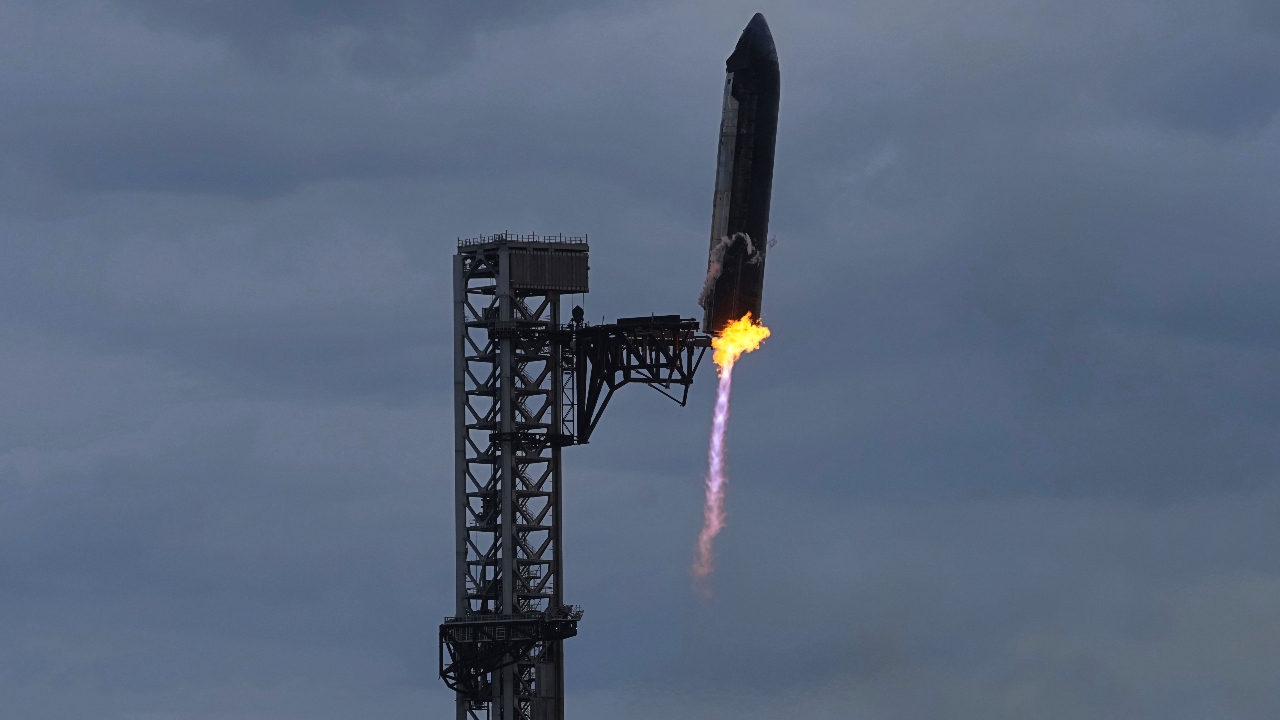
SpaceX has marked a major milestone in the global space industry by successfully bringing the Starship spacecraft back into the atmosphere and landing it using the giant robotic arm "Mechazilla" at its launch site in Texas for the first time. This followed the spacecraft completing 14 orbits around the Earth and deploying 26 Starlink satellites, underscoring the success of their fully reusable rocket system development.
Elon Musk's SpaceX achieved a historic success during the 15th test flight of the world's largest and most powerful rocket system by using the giant robotic arm known as "Mechazilla" at the Starbase launch tower in Texas to catch the Starship spacecraft returning from orbit for the first time on Saturday (14 Nov).
The 52-meter-tall Starship pierced through thick clouds above the Gulf of Mexico coast before igniting its engines to flip upright and gently descend amid roaring engine sounds. The upper clamp of the spacecraft was precisely caught by the giant robotic arm above the second launch pad, amid cheers from the crowd gathered on the nearby beach.
The Starship was launched into space on the previous Friday atop the "Super Heavy" booster rocket. The spacecraft completed 14 orbits around the Earth over 22 and a half hours and successfully deployed 26 Starlink internet satellites at an altitude of 260 kilometers.
However, about 10 minutes after launch, the Super Heavy booster experienced technical issues during its descent, forcing it to divert and land in the Gulf of Mexico instead of being caught by the robotic arm as planned. This prevented SpaceX from recovering both rockets simultaneously in a single mission.
During Starship's return on Saturday, it ignited its engines to reduce its orbital speed of over 17,000 miles per hour, enduring intense heat and friction with the atmosphere. Senior SpaceX engineer Lars Blackmore revealed that the flight path was carefully designed to avoid populated areas, flying over sparsely inhabited desert regions, making a wide curve around cities in the Rio Grande Valley, and approaching the launch site from the east.
Within hours after landing, Elon Musk and his engineering team immediately inspected the spacecraft. Musk posted photos and videos on the X platform with the message: "Ship 42 looks amazing!"
Previously, SpaceX had successfully used the robotic arm to catch the lower booster rocket three times, but catching the upper "spacecraft" section was much more complex due to its higher drop altitude and greater speed.
Clayton Swopes, a space expert at the Center for Strategic and International Studies (CSIS), described this as a major engineering achievement proving the feasibility of a fully reusable spacecraft concept. Meanwhile, Georgetown University analyst Kathleen Curley noted that SpaceX must demonstrate reliability by repeating this feat multiple times to build confidence for critical mission transport.
NASA Administrator Jared Isaacman praised the achievement as "almost like magic," bringing humanity one step closer to the Moon. NASA has contracted SpaceX for over $4 billion to use Starship as a lunar lander in the Artemis program, which aims to return humans to the Moon by 2028.
However, SpaceX, which has invested over $15 billion in the project, still faces major engineering challenges, including in-space refueling technology for Starship, essential for long-distance missions to the Moon and Mars. Additionally, the hundreds of black hexagonal heat shield tiles protecting the spacecraft during reentry cannot yet be reused immediately without repairs, prompting ongoing development of new versions.
Elon Musk aims for Starship to operate with the speed and frequency of a commercial airliner, capable of taking off and landing every hour to support Starlink satellite operations, orbital data centers, and eventual Mars colonization.
Since SpaceX’s recent public listing in June and raising $85.7 billion, the company has heavily expanded production capacity. During a media tour of the million-square-foot Starbase factory, SpaceX officials revealed they currently can produce one Starship every two weeks and one Super Heavy booster every four weeks.