

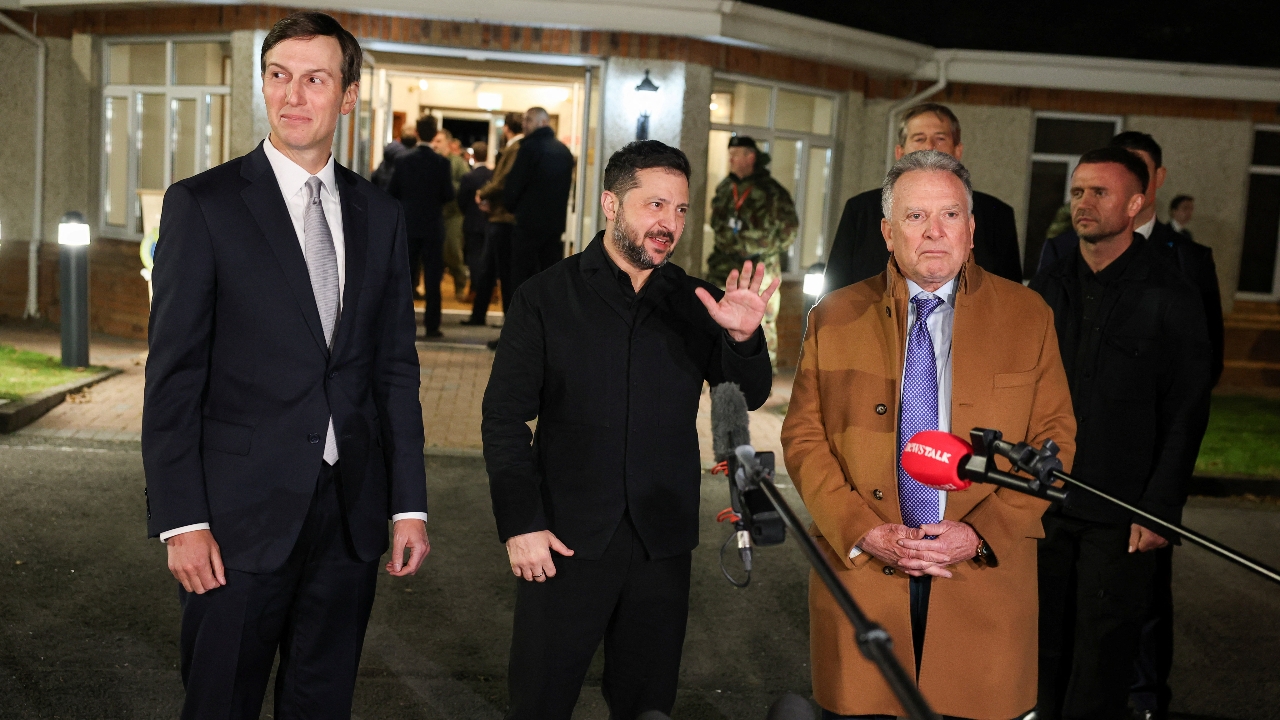
The President of Ukraine revealed that US negotiators proposed Ukraine withdraw forces from the eastern Donbas region in exchange for joining the North Atlantic Treaty Organization (NATO). Meanwhile, Ukraine reaffirmed it is not willing to easily cede territory and may put proposals with sufficient security guarantees to a nationwide referendum amid ongoing peace talks with Russia that have yet to make significant progress.
Ukrainian President Volodymyr Zelensky told the media via a presidential office statement that US negotiators raised the idea that Ukraine might withdraw its remaining military forces from the Donbas region in eastern Ukraine in exchange for NATO membership.
Zelensky said this is the first time NATO membership has been linked to ceding territory at the negotiation table, following tripartite peace talks between Ukraine, Russia, and the US in Abu Dhabi, United Arab Emirates, which concluded on Wednesday.
Zelensky stated, "The Americans asked, ‘What if Ukraine joins NATO? Would Ukraine then withdraw from Donbas?’ That’s why I believe NATO has returned to the agenda. But you have probably also heard signals from Russian President Vladimir Putin that this is a very difficult conversation."
Previously, President Putin consistently stressed that Ukraine’s NATO membership is a "red line" unacceptable to Russia, and a key reason Russia launched a full-scale invasion in February 2022. Currently, Russia controls about one-fifth of Ukrainian territory, including most of Donetsk and Luhansk oblasts that make up the Donbas region, as well as the Crimean Peninsula annexed by Russia in 2014.
However, the Ukrainian leader reaffirmed Kyiv’s position that it is not ready to cede sovereign land to anyone. He said that if Ukraine receives a comprehensive and clear proposal including security guarantees, the right to maintain a strong military without size restrictions, and funding for reconstruction, he is willing to put the proposal to a nationwide referendum.
A few hours after Zelensky’s statement was released, a US official told the BBC that "many ideas are still being discussed, but any final agreement must be approved by both sides."
Meanwhile, Jared Kushner, son-in-law and special envoy of former President Donald Trump, who met Putin in Moscow on Thursday before flying to meet Zelensky in Dublin, Ireland, along with US special envoy Steve Witkoff, posted on social media to downplay the NATO membership proposal and called on all parties to "maintain confidentiality" in the sensitive negotiation process.
Kushner said that during this week’s talks, both sides made maximal demands and used tough political rhetoric, but in private discussions, both Russia and Ukraine "understand that practical compromise is necessary to end this terrible war."
Zelensky dismissed Russia’s demand for a broad agreement on a “new European security architecture,” which is seen as Russia’s code for weakening NATO’s power before agreeing on war termination details. He emphasized, "We cannot turn everything upside down by first discussing changing the world’s or continent’s security framework and then talk about ending the war. This war must end first."
Zelensky also rejected Putin’s proposal for a localized humanitarian ceasefire in the city of Kostyantynivka, Donetsk oblast, saying it reflected Russia’s inability to capture the city by force and was an attempt to trick Ukraine into withdrawing troops for easier occupation. He added that Ukraine has submitted a list of 7–8 frontline communities with civilians and children trapped to Russia for humanitarian ceasefires, but Russia has instead targeted those areas militarily, which Russia has consistently denied.
Although the two-day talks in Abu Dhabi did not yield a major ceasefire agreement, Zelensky revealed both sides agreed to proceed with a large prisoner exchange involving over 1,000 people, with final numbers still being finalized. Regarding a ceasefire on energy infrastructure attacks discussed by US envoys with Putin in Moscow, there has been no progress, with Zelensky noting, "Putin himself does not support a ceasefire."
For the next negotiation round, US negotiators informed Zelensky that all parties agree to allow the European Union and major European military powers to join the peace talks officially. Previously, at Abu Dhabi, European representatives, key financial and military supporters of Ukraine, only held side discussions with US and Ukrainian parties. The European leaders’ summit in Ireland on Friday concluded that the European negotiation team will consist of five major military powers—the UK, France, Germany, Italy, and Poland—along with senior EU officials.
These latest talks occurred amid tense relations between Ukraine and the Trump administration, following Trump’s requests for Ukraine to halt attacks on oil refineries deep inside Russian territory to allow Russian diesel to enter global markets and ease fuel prices. Ukraine continued attacks, leading Zelensky to accuse US officials of deliberately limiting "Starlink" satellite internet signals used by the Ukrainian military for coordination. Trump criticized, saying "It’s time for Ukraine to have a new president" and called for new elections. However, Zelensky had earlier announced readiness to hold elections within months after a peace agreement and expressed willingness to resign if it secured Ukraine’s NATO membership.