

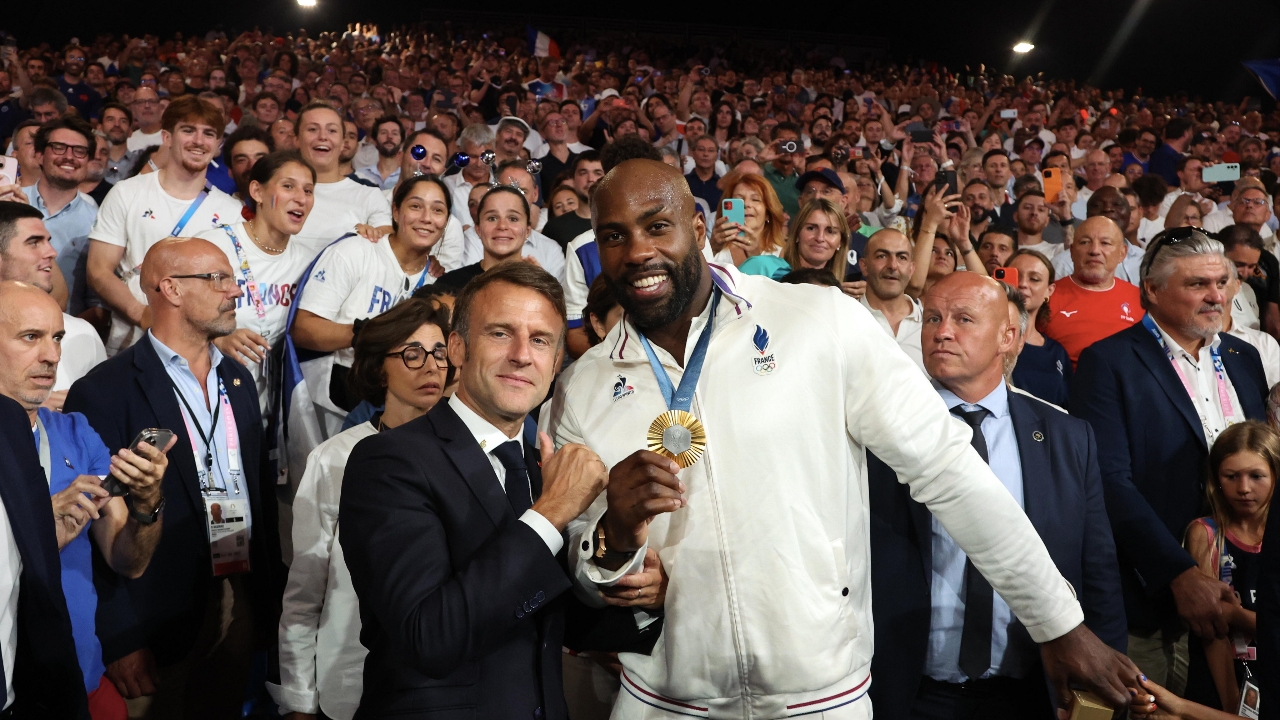
"Teddy Riner," the famous judoka with five Olympic gold medals, has unexpectedly announced his candidacy for the French presidency in next April's election, promoting himself as a "political outsider, neither left nor right," aiming to unite the country and solve economic hardships. Despite lacking administrative experience and clear policies, his launch video has surpassed 28 million views, and polls indicate that up to 22% of French citizens might vote for him.
Teddy Riner, a renowned French judoka, has surprised the political world by announcing his presidential bid for next April's election. The 37-year-old athlete, born on Guadeloupe island, has no prior political office experience, lacks party support, and has yet to officially reveal his campaign policies.
Currently, Riner offers only a campaign slogan, "La France qu'on aime" or "France as We Love It," which he has shared via social media and during campaign visits to a hospital in the Saint-Denis district near Paris.
However, analysts caution against underestimating Riner's chances, noting he is among France's most popular figures today and consistently ranks highly in polls reflecting national values.
Riner has achieved remarkable success in sports, winning five Olympic gold medals and 11 world judo championships. He also has notable accomplishments in business.
His presidential announcement video, shared on Instagram and X, has amassed over 28 million views. An Ifop poll conducted within 24 hours of the video's release found that 22% of respondents might vote for him.
Riner's case raises questions about whether famous athletes can become national leaders, similar to former professional footballer George Weah, who served as Liberia's president, or entertainers who have entered politics in various countries.
Analysts believe being an outsider is not necessarily a barrier for Riner's candidacy, but it doesn't guarantee success either.
French politicians are now closely watching Riner's candidacy, partly because of his high popularity; mocking or dismissing his political ambitions could backfire on critics.
Another key factor is France's current political turmoil, especially among centrists who have yet to present a candidate able to rival the popularity of far-right leader Marine Le Pen and far-left leader Jean-Luc Mélenchon, who are expected to face off in the May runoff.
Riner has stated he is neither left nor right but seeks to unify the country, improve citizens' disposable income, and stands firmly against racism and gangs that cause fear on the streets.
While his initial surge in popularity may fade, if Riner maintains momentum and campaigns seriously, he could disrupt other candidates' vote calculations, especially within centrist politics.
Riner's campaign strategy emphasizes his status as a non-politician, trying to communicate that he understands everyday life better than Parisian politicians who are seen as disconnected from ordinary people's problems.
In his social media video, he said some see him as a fool for running for president, but if refusing to watch France drown in debt, refusing to see parents worry every week when shopping, or fearing for their children outside is foolishness, then he accepts being called a fool.
This statement gained significant attention and was seen as a powerful campaign start, but if serious about his candidacy, Riner still faces many important unanswered questions.
These include his policy priorities, the team he would assemble to govern, and his positions on major issues like pension reform, education investment, cost of living, public debt, populism growth, and the Russia-Ukraine war.
A key question is how Riner will convert his global sports fame into political votes and trust.
On economic and law-and-order issues, Riner tends to lean right, while anti-racism is a major focus due to his Caribbean heritage. When opposing extremism, he mainly targets Marine Le Pen's ideology.
This stance places Riner politically near the center, opposing extremes on both sides, but the problem is that France's centrist political space is already crowded with many candidates.
Among likely candidates are former Prime Minister Édouard Philippe and Gabriel Attal, neither of whom has gained strong popularity, plus about a dozen others, from socialist-backed Raphael Glucksmann to right-wing Republican Bruno Retailleau.
Additionally, Christine Lagarde, European Central Bank president scheduled to step down in February next year, is mentioned as a possible candidate.
President Emmanuel Macron has expressed admiration for Riner's decision, calling him a great athlete and saying politics should not be reserved only for career politicians.
Riner sees Macron's praise as potentially more problematic than helpful and told reporters he is not Macron's representative nor a supporter.
Ultimately, though politics and judo are vastly different, Riner may find political competition fiercer and harsher than battles on the tatami mat, where respect is shown before matches—something political rivals may not extend, often attacking each other vigorously.
For Riner, this candidacy is not just a shift from sports to politics but also means facing intense scrutiny and proving to the public whether his world judo champion success can translate into effective national leadership.