

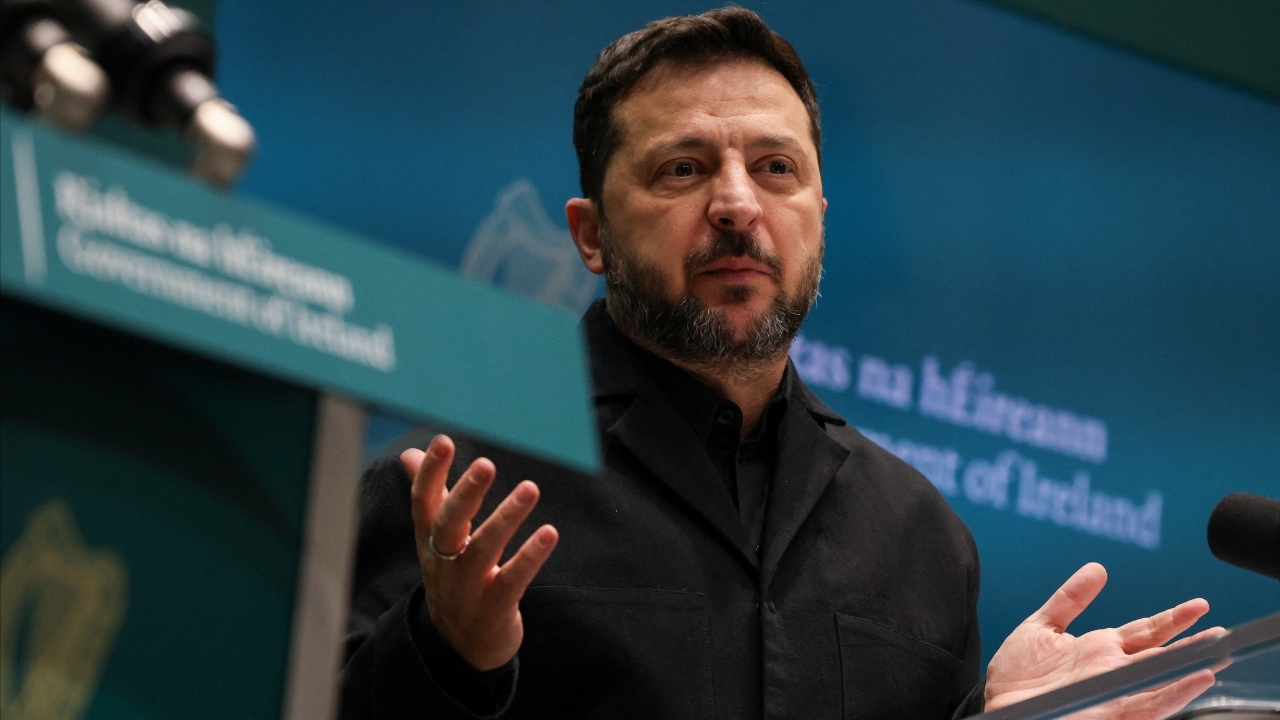
Zelensky has called on the U.S. government and Elon Musk to lift the speed restrictions on the Starlink satellite internet, stating that these limits prevent their weapons from intercepting Russian drones in time.
On Sunday, 15 Nov 2026 GMT+7, Ukrainian President Volodymyr Zelensky urged the U.S. government and Elon Musk to lift the speed restrictions on the Starshield satellite internet system (a military-grade version of Starlink), emphasizing that protecting civilians and energy infrastructure before winter depends directly on this system.
"Speed restrictions on Starshield receiving stations along the front lines and in temporarily occupied areas remain," Zelensky said, adding, "Our interceptor drones lose connection with their controllers at speeds of 161 km/h and cannot keep up with Russia's jet-powered 'Shahed' drones."
Zelensky also stated he has ordered officials to "work as closely as possible" with the U.S. government and Musk's companies, stressing, "What matters is being on the right side of history."
This issue has persisted since October amid diplomatic tensions between Zelensky and former President Donald Trump, who was displeased with Ukraine's attacks on Russian oil refineries.
In an interview with the New York Times on Friday, 13 Nov 2026 GMT+7, Zelensky said the speed limit was set at about 161 km/h only in Russian-occupied areas, adding, "This has political implications; setting restrictions there essentially acknowledges, in part, that those temporarily occupied territories are not ours."
Both Musk and Trump have blamed each other for ordering the speed limit. In October, Musk stated that the U.S. government was responsible since the Starshield system is under U.S. government control.
Meanwhile, Donald Trump later denied responsibility for the speed restriction, claiming he had told Musk to "make it back to normal."
Amid the latest developments, Russia has taken advantage of Ukraine's shortage of Patriot air defense missiles to launch concentrated attacks on energy and railway infrastructure across several Ukrainian regions from Saturday night through Sunday morning, resulting in dozens of injuries and two deaths in the Chernihiv region.
In response, the Ukrainian military struck petrochemical plants and oil refineries in Nizhnekamsk in central Russia, as well as the port city of Taganrog and the Luhansk region, causing three fatalities in total.
Meanwhile, Estonian authorities announced plans to close border crossings with Russia starting 1 December after arresting eight suspects attempting to set fire to the drone manufacturer Threod Systems. Estonian officials believe the attack was ordered by Russia's military intelligence agency, the GRU.
Follow international news:https://www.thairath.co.th/news/foreign
Source:bbc