

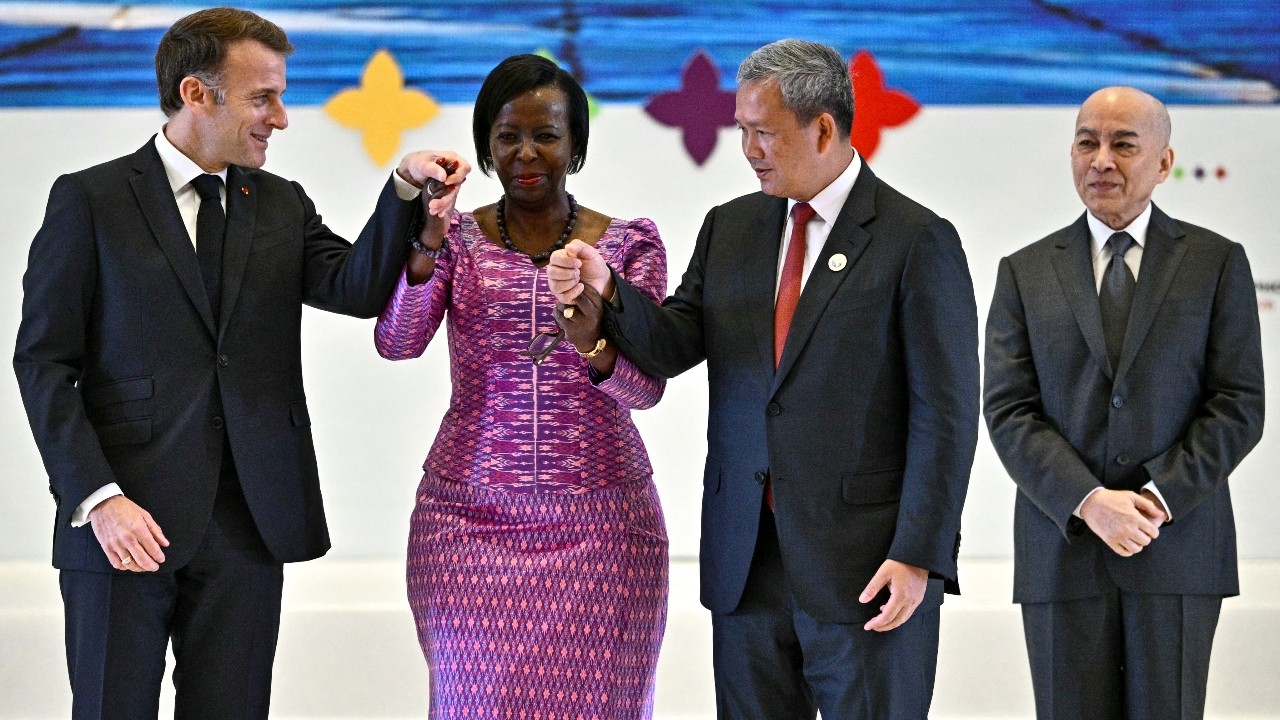
Cambodian Prime Minister Hun Manet proposed establishing a conflict prevention and mediation network among French-speaking countries, or Francophone nations, involving diplomats, experts, and various institutions. He also addressed the Thai-Cambodian border dispute, asserting that Cambodia was not the first to fire, and called for renewed efforts to survey and demarcate the border. Meanwhile, Thailand emphasized that bilateral disputes should not be brought to international forums.
Cambodian Prime Minister Hun Manet proposed creating the "Francophone Prevention and Mediation Network" to support Cambodia and member countries in managing conflicts. This proposal was made on 15 November during the opening of the 20th Francophone Summit held in Phnom Penh.
Hun Manet stated that this network would comprise diplomats, experts, and institutions capable of supporting negotiations upon request before situations escalate into violence. He added that prevention costs less than post-conflict reconstruction.
This proposal is seen as a call for France—which governed Cambodia for 90 years until 1953—and other Francophone member countries to support Phnom Penh in case of conflicts.
Attendees at the summit included French President Emmanuel Macron, who visited Cambodia; Vietnamese President Võ Văn Thưởng; and Rwandan President Paul Kagame.
In a roughly 10-minute speech in French, Hun Manet initially addressed the Thai-Cambodian border conflict occurring between July and December 2025.
He stated that Cambodia was not the first to fire and noted that the conflict caused deaths and forced many residents to flee their homes, emphasizing that peace cannot be taken for granted.
During the peak of the 2025 conflict, about 1 million people in both Cambodia and Thailand were displaced, with at least 100 deaths. Although most displaced Thai citizens have returned home, the Cambodian government reports that around 20,000 people remain homeless.
Hun Manet also mentioned the temporary ceasefire between Thailand and Cambodia, describing the situation as fragile and complex, and called on both sides to resume joint land boundary surveys and demarcation.
He stated that the border is not a recent creation but an internationally recognized and clearly defined boundary for over a century, which should be respected according to international law.
These remarks are likely to cause dissatisfaction in Thailand, which has consistently maintained that the border conflict is a bilateral issue that should not be internationalized.
Previously, on 11 November, Thailand's Deputy Prime Minister and Foreign Minister, Don Pramudwinai, expressed concern that Cambodia might use international forums to accuse Thailand with distorted information, stating that Thailand does not want unfair accusations or one-sided presentations and urged avoiding escalation of the bilateral dispute to international levels.
Beyond land disputes, Thailand and Cambodia also have overlapping maritime claims, currently under arbitration under the United Nations Convention on the Law of the Sea (UNCLOS) at the Permanent Court of Arbitration. The third meeting is scheduled for 24 November in Kuala Lumpur, Malaysia.
This summit marks the first time Cambodia has hosted since joining the International Organization of La Francophonie (OIF) as an observer in 1991 and becoming a full member in 1993.
The Francophone group includes about 400 million French speakers worldwide. The OIF has around 90 member and associated countries, including France, Canada, Congo, Vietnam, and Laos, who convene to discuss political, economic, and cultural cooperation. Thailand, not a French-speaking country, participates as an observer.
French President Emmanuel Macron said the summit is highly significant as it returns to Southeast Asia for the first time since it was held in Vietnam in 1997.
Although Macron did not directly respond to Hun Manet's proposal for a mediation network, he stated that amid multiple global crises, the shared French language serves as a special tool and space for reconciliation.
Macron said the shared language calls on countries to open dialogue and mediation, strengthens the capacity to connect people, and develop solutions through discussion. He added that French is also a tool that upholds the rule of law over the use of force.
The French president urged Francophone member countries to unite more to face challenges while respecting international law and the United Nations Charter.
At the end of the two-day summit on 16 November, members will endorse three key documents, including the Phnom Penh Declaration, which reaffirms members' commitment to promoting peace, peaceful coexistence, unity, and sustainable social and cultural development.
The other two documents will address conflict prevention and crisis management, as well as initiatives to enhance cultural heritage protection and promote cultural diversity.
/sourceThe Straits Times