

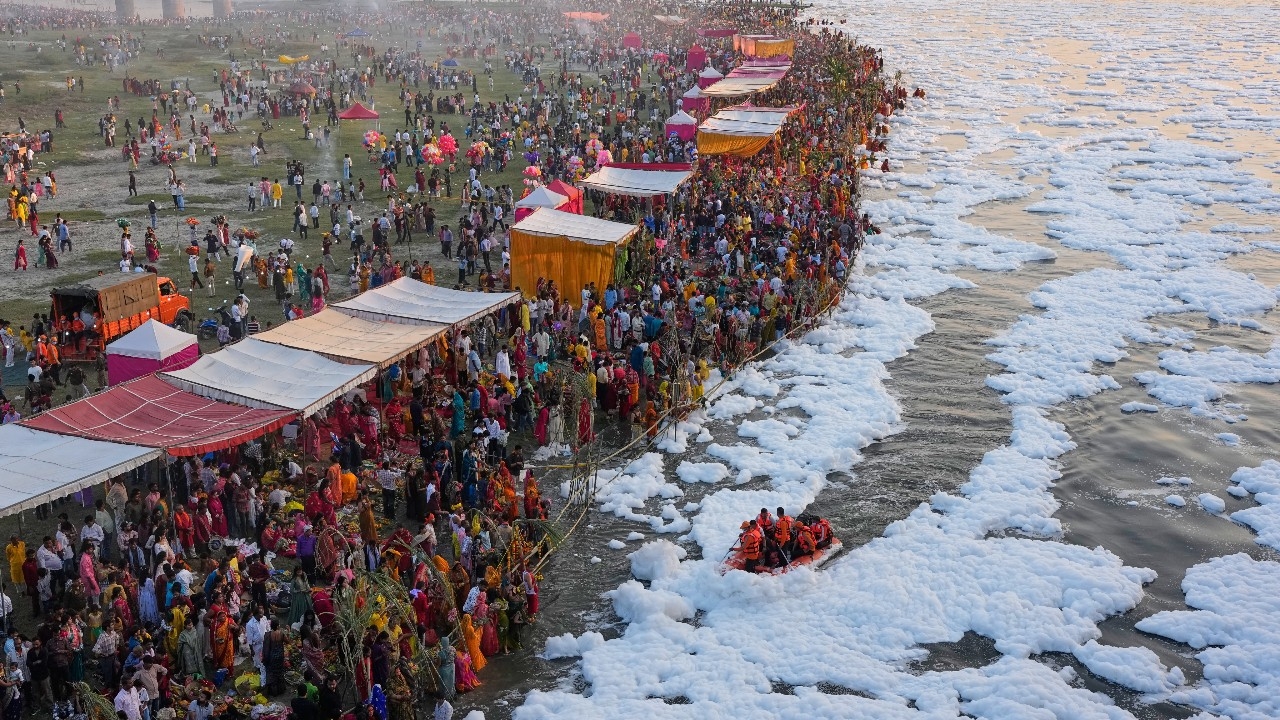
The Hindu Chhath Puja festival in Noida, near New Delhi, India, faces a pollution crisis in the Yamuna River, where toxic white foam covers the water surface. Official data shows sewage-related bacterial levels in the river before the monsoon season exceed safe bathing standards by 660 times.
Hindu devotees stood knee-deep in the Yamuna River amid thick toxic white foam floating around them as they participated in the Chhath Puja festival on Sunday (15 Nov) in Noida, near New Delhi, India's capital.
As the sun began to set, many women performed rituals on the riverbank, holding clay lamps as offerings. Chhath Puja is an important Hindu festival honoring the sun god, during which devotees pray and immerse themselves in rivers or water bodies as part of the ceremonies.
However, pollution in the Yamuna River cast a shadow over the celebrations. Some attendees expressed concern over water quality after seeing large amounts of white foam on the surface, though many continued their rituals in the river.
Vivekanand Chaudhari, who came with his family to perform the water immersion ceremony, told the Associated Press that the Yamuna's condition in that area is very poor. He said the water is too dirty to be used for religious rituals and contains significant industrial waste contamination.
Chaudhari added that some devotees experienced itching after entering the water and called on the government to urgently restore and clean the river. Another participant, Ganhaiya Kumar, reported seeing large amounts of foam and described the water as visibly dirty.
Official data indicates that fecal coliform bacteria—microorganisms originating from human and animal excreta—in the Yamuna River at Asgarpur, where the river exits the capital region, were 660 times higher than the limits set by India's Central Pollution Control Board (CPCB) for safe bathing water in May, before the monsoon season.
Water quality improved in September, as typically happens annually after the monsoon season when increased water flow dilutes pollutants. However, New Delhi's government has not yet released water quality data for October.
Religious Significance of the Yamuna River
The Yamuna River holds religious importance for people from the Purvanchal region, covering eastern Uttar Pradesh and Bihar states. This group forms a significant voter base in New Delhi, and many favor immersing themselves in the river during Chhath Puja ceremonies.
On Sunday evening, many devotees gathered at Kalindi Kunj in southern New Delhi, standing knee-deep in the river amid toxic white foam contaminating the water—a common sight during the Chhath Puja festival.
New Delhi already suffers from severe air pollution; the dangerous water quality of this vital river adds to public concern.
Over the years, the Yamuna has steadily deteriorated due to sewage discharge from New Delhi, pesticide runoff from nearby agricultural areas, and industrial waste from various cities, despite laws prohibiting pollution of water bodies.
Lack of Tangible Results from Ganges Water Diversion Plan
Since the Bharatiya Janata Party (BJP) took power in New Delhi in February 2025, there have been discussions about a major plan to divert water from the Ganges River to help flush pollution from the Yamuna as it flows through New Delhi. However, no concrete progress has been made.
This proposal is part of a broader Yamuna River restoration plan presented to Prime Minister Narendra Modi in April last year. After approval, Home Minister Amit Shah held multiple meetings to monitor progress, according to sources.
An official who spoke anonymously to The Hindu said that although the plan has been finalized, diverting water from the Ganges to New Delhi might take about 2-3 years. A detailed project report (DPR) has been submitted to the government, but no definitive timeline has been set.
Under the current plan, the government proposes diverting about 500 cubic feet per second of water from the Upper Ganga Canal—a main canal carrying Ganges water through western Uttar Pradesh—to release into the Yamuna near Wazirabad in New Delhi.
Officials noted this is the second Ganges water diversion plan New Delhi is considering after the first was canceled due to opposition from the Uttar Pradesh state government.
Improving Sewage Treatment to Reduce Pollution
Experts have long emphasized that restoring the Yamuna requires two simultaneous approaches: increasing river flow and controlling pollution sources entering the river.
Regarding sewage management, Amit Shah, who chaired the Yamuna restoration monitoring meeting in July last year, ordered New Delhi's government to nearly double sewage treatment capacity to 1.5 billion gallons per day by 2028.
To enhance treatment capacity, the government awarded contracts this year to build 29 decentralized sewage treatment plants (DSTPs), aiming for completion by January 2028.
However, officials from the Delhi Jal Board (DJB) said the 29 plants are expected to be completed by January 2028, with some possibly finished earlier. Construction of sewer networks connecting to these plants is anticipated to complete by June 2028.
DSTPs are key to the restoration plan as they will treat sewage from unauthorized settlements lacking sewer connections, whose waste currently flows directly into the river.
The sewage treatment projects have faced years of delays, mainly due to land acquisition issues and conflicts between New Delhi's previous government led by the Aam Aadmi Party (AAP) and the central BJP-led government, since most necessary land is federally controlled.
The same official added that other projects to increase sewage treatment capacity are expected to finish before December 2028, which will significantly improve river water quality.
Pollution as a Political Issue
Restoring the Yamuna was a key campaign promise of Prime Minister Modi ahead of the 2025 New Delhi Legislative Assembly elections, in which the BJP won and regained control of the capital for the first time in 27 years.
This year, before the Chhath Puja festival, the Aam Aadmi Party (AAP) and BJP exchanged accusations over Yamuna pollution problems.
The BJP government launched cruise services on the cleaner upper stretches of the Yamuna flowing through New Delhi, accusing the previous AAP administration of doing little to tackle river pollution.
The AAP countered by citing numerous fish deaths as evidence of ongoing pollution and accused the BJP of misleading the public by claiming the Yamuna has been restored.
Historical Unaddressed Warnings
The Yamuna River originates from the Yamunotri glacier in the Himalayas, flowing through Uttarakhand, Himachal Pradesh, Haryana, New Delhi, and Uttar Pradesh before merging with the Ganges.
Pollution in the Yamuna has been closely monitored for decades. In 1994, the Indian Supreme Court took up a newspaper article titled “Quiet Flows Mainly (Dirty) Yamuna,” calling on the Central Pollution Control Board (CPCB) to report on the river’s condition.
Subsequently, multiple agencies, including the New Delhi government, Delhi Jal Board, local authorities, and the Uttar Pradesh and Haryana state governments, became parties to the case.
On 13 January 2015, India’s National Green Tribunal (NGT) issued a significant ruling on a case filed by former Indian Forest Service officer Manoj Misra, establishing the “Mainly to Nirmal Yamuna Revitalisation Plan, 2017,” with a completion deadline of 31 March 2017. However, the plan was not implemented as scheduled.
In July 2018, the NGT formed a monitoring committee chaired by two former senior officials to push compliance with the 2015 ruling. The committee was dissolved in January 2021, assigning progress monitoring to state ministry secretaries.
In 2023, the BJP-led central government appointed a new committee chaired by V.K. Saxena, then New Delhi’s Lieutenant Governor, to oversee Yamuna restoration. Progress since then has been limited.
Despite decades of plans and directives, water quality data shows the Yamuna flowing through New Delhi remains heavily polluted almost year-round, with temporary improvement only during monsoon floods that wash away contaminants. This ongoing issue remains a major challenge for the Indian government in restoring this vital river integral to local livelihoods and religious beliefs.
SourceThe Hindu/TIMES OF INDIA