

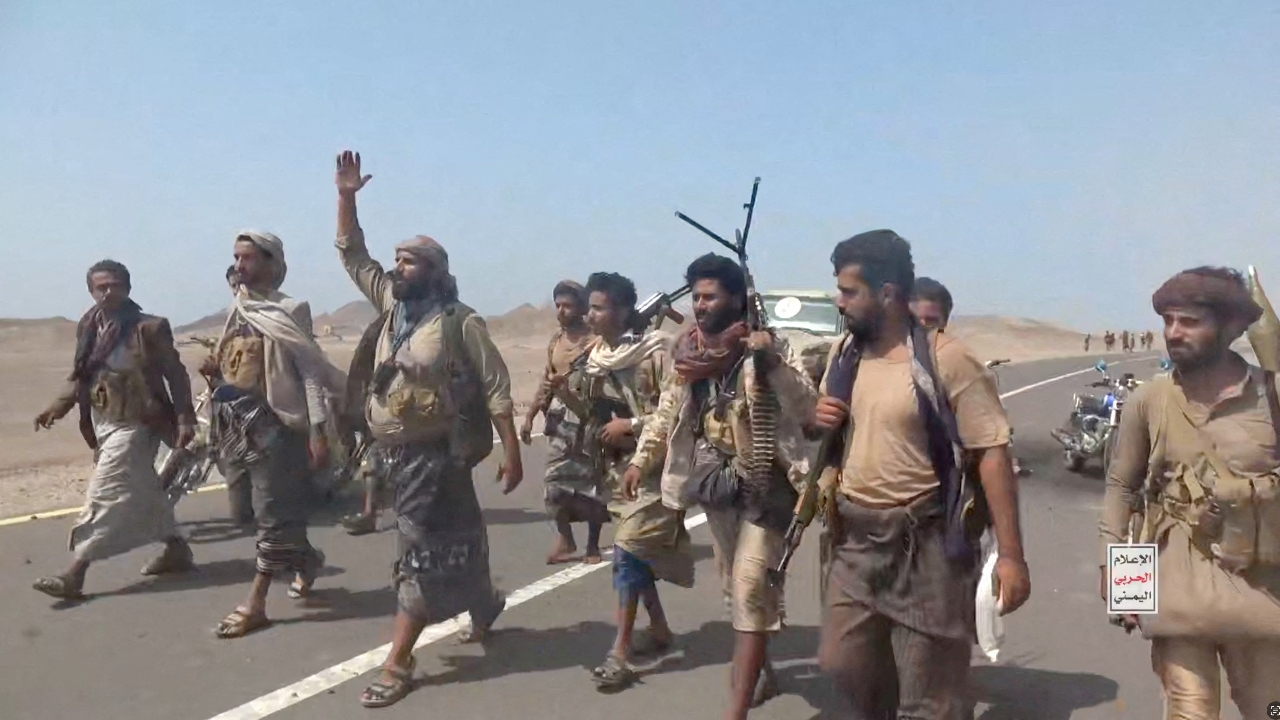
Yemen government forces, backed by Saudi Arabia, announced their withdrawal from the Bab al-Mandeb Strait area in the southern Red Sea to strengthen defenses in the city of Aden. This withdrawal has allowed the Iran-supported Houthi group to regain control of this strategic area amid Middle East tensions affecting oil transport and international maritime navigation.
Yemen government forces, supported by Saudi Arabia, declared their pullback from the Bab al-Mandeb Strait, a strategic maritime route at the southern entrance to the Red Sea, clearing the way for the Iran-backed Houthi group to take control of the area.
The Yemen military stated that this withdrawal is part of a redeployment plan, moving troops from the Dubab Airport area and Bab al-Mandeb Strait to reinforce defenses in Aden, the internationally recognized temporary capital of Yemen, which is currently a critical priority.
A statement from Yemen's Southern Forces said the decision aims to strengthen defensive lines, address existing threats, and maintain the security of Aden and its surrounding provinces.
Media controlled by the Houthi group reported they have taken control of the area, while Saudi Arabia has not yet commented on the withdrawal.
This move marks a failure of the Yemen government's roughly six-week counteroffensive aimed at pushing the Houthis out of the Red Sea coast, after the Houthis launched a surprise attack in September and seized coastal areas, including Perim Island at the strait's entrance and the strategically important port city of Mocha.
Although Yemen government forces backed by Saudi Arabia announced in early October that they had retaken key areas around Bab al-Mandeb Strait, they failed to fully expel the Houthis or regain control of the city of Al-Mokha.
The Yemen government's withdrawal has raised concerns that the Houthis may advance further south toward Aden, the stronghold of the internationally recognized government since the Houthis expelled it from the capital Sana'a over a decade ago.
Military sources in Yemen report that government forces stationed at Bab al-Mandeb have relocated to the Al-Suqayyah area, about 150 kilometers west of Aden, while still attempting to push Houthis out of nearby coastal areas.
In the mountainous region north of Aden, where the Houthis have besieged Taiz, Yemen's third-largest city, Houthi fighters are now stationed outside Tur Al-Bahah, approximately 80 kilometers from Taiz.
The situation in Taiz is worsening, with about half of Yemen's roughly 300,000 internally displaced people residing there due to recent fighting. Humanitarian aid cannot reach the area, and civilians are unable to leave.
The United Nations estimates that since the escalation of fighting, nearly 330,000 people have been displaced in Yemen, with several hundred reported dead.
After the Houthis seized strategic coastal areas along the Red Sea in September, they increased drone and missile attacks on Saudi Arabia, targeting main airports and energy infrastructure, leading to flight suspensions and volatility in global oil markets.
The Houthis claimed on Sunday that they attacked King Khalid International Airport and a financial center in Riyadh, as well as two pumping stations on Saudi Arabia's East-West oil pipeline; however, Saudi authorities have not confirmed these reports.
Houthi control of Bab al-Mandeb has also caused global oil prices to rise, as Saudi Arabia increasingly relies on Red Sea routes for oil exports after the U.S.-Israel-Iran conflict severely restricted the use of the Strait of Hormuz for oil transport.
Currently, Saudi Arabia diverts about 4 million barrels per day of crude oil through the East-West pipeline to Yanbu on the Red Sea coast, accounting for roughly 4% of the global oil supply.
Ravina Shamdasani, spokesperson for the UN Office of the High Commissioner for Human Rights, called on all parties involved in the conflict to protect civilians and civilian infrastructure, noting that since fighting intensified in August, over 60% of civilian casualties have been women and children.
Saudi Arabia has responded with hundreds of airstrikes, while the Houthis have launched hundreds of drones and missiles targeting Saudi cities and infrastructure.