

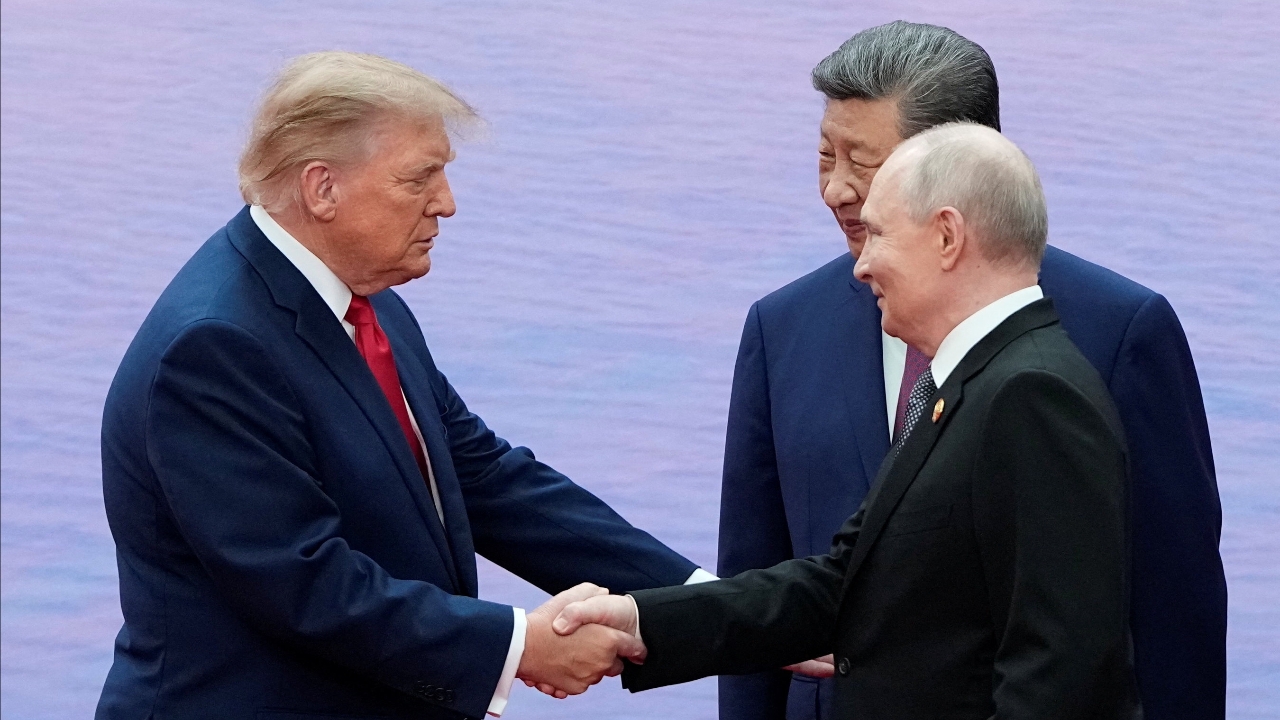
Trump boasted that the historic talks with China's Xi Jinping and Russia's Vladimir Putin were a U.S. victory even before the meeting began, following a grand welcome by the Chinese leader.
U.S. President Donald Trump praised the historic meeting with Chinese President Xi Jinping and Russian President Vladimir Putin as a victory for the United States before the talks had even started. This came after he received a grand reception from Xi, who personally greeted him at Shenzhen Airport on Thursday, 19 Nov 2025 GMT+7, amid close attention on the summit of the world’s three major nuclear powers.
Trump told Fox News about the impressive welcome ceremony, highlighting the formal procession, the many schoolchildren, and the military personnel who greeted him. He praised Xi Jinping as one of China’s great leaders and noted that Xi had never before personally greeted a foreign leader at the airport.
Trump said Xi’s personal presence to welcome him, along with the grand ceremony, was a significant display of respect and represented a major victory for both the United States and China.
This welcome was also symbolically meaningful because Xi Jinping had never personally greeted a foreign leader at the airport since becoming China’s president. It was a gesture reciprocating Trump’s own reception of the Chinese leader at Joint Base Andrews in September during their previous meeting, which included a brief embrace between the two.
The atmosphere of Trump’s welcome contrasted with that of other leaders attending the APEC summit. Vladimir Putin received a comparatively modest reception, while Japan’s Prime Minister Sanae Takaichi arrived without any special ceremony.
The meeting of the U.S., Chinese, and Russian leaders marked an unprecedented diplomatic gathering of the world’s largest nuclear powers. However, analysts suggested the summit might not yield significant agreements due to ongoing disagreements on issues such as the Ukraine war, Iran, nuclear weapons, trade, and China’s military expansion.
Before Trump’s arrival, Xi Jinping and Putin delivered speeches at the APEC meeting, both criticizing Western trade restrictions and sanctions. Xi called for promoting free and open trade, while Putin emphasized Russia’s key role in food and energy security in the Asia-Pacific region.
Trump stated that the U.S. has been a Pacific power for hundreds of years, praised the strength of the American economy, and addressed artificial intelligence (AI) technology, noting its significant benefits but also the need for caution. He opposed overly strict regulations that could hinder industry development.
Trump pushed the issue of nuclear arms reduction, seeking to involve China in negotiations.
A key issue Trump aimed to advance at the summit was nuclear arms control, insisting it be a main agenda item despite China’s historical refusal to join talks with the U.S. and Russia, given that those two countries have much larger nuclear arsenals than China.
Trump stated that China is rapidly expanding its nuclear weapons and he wants China to stop increasing its arsenal. However, he said it would also be difficult if China demanded the U.S. reduce its nuclear warheads by 2,000 in return.
Meanwhile, Trump has expressed interest in meeting North Korean leader Kim Jong-un, but no confirmation of such a meeting has been made yet. South Korean President Lee Jae-myung said on Thursday that he hopes renewed talks with North Korea will help establish lasting peace on the Korean Peninsula.
Trump’s schedule includes a bilateral meeting and lunch with Xi Jinping before the trilateral talks. U.S. and Russian officials confirmed Trump would also meet Putin one-on-one, but Moscow stated there were no plans for a full formal negotiation during their meeting.
Craig Singleton from the Foundation for Defense of Democracies analyzed that while the three leaders have many reasons to appear together, they have far fewer to reach concrete agreements. He observed that joint photos could benefit all three, but reaching consensus on issues would be much more difficult.
. Source:channelnewsasia
Click to read related news aboutinternational news