

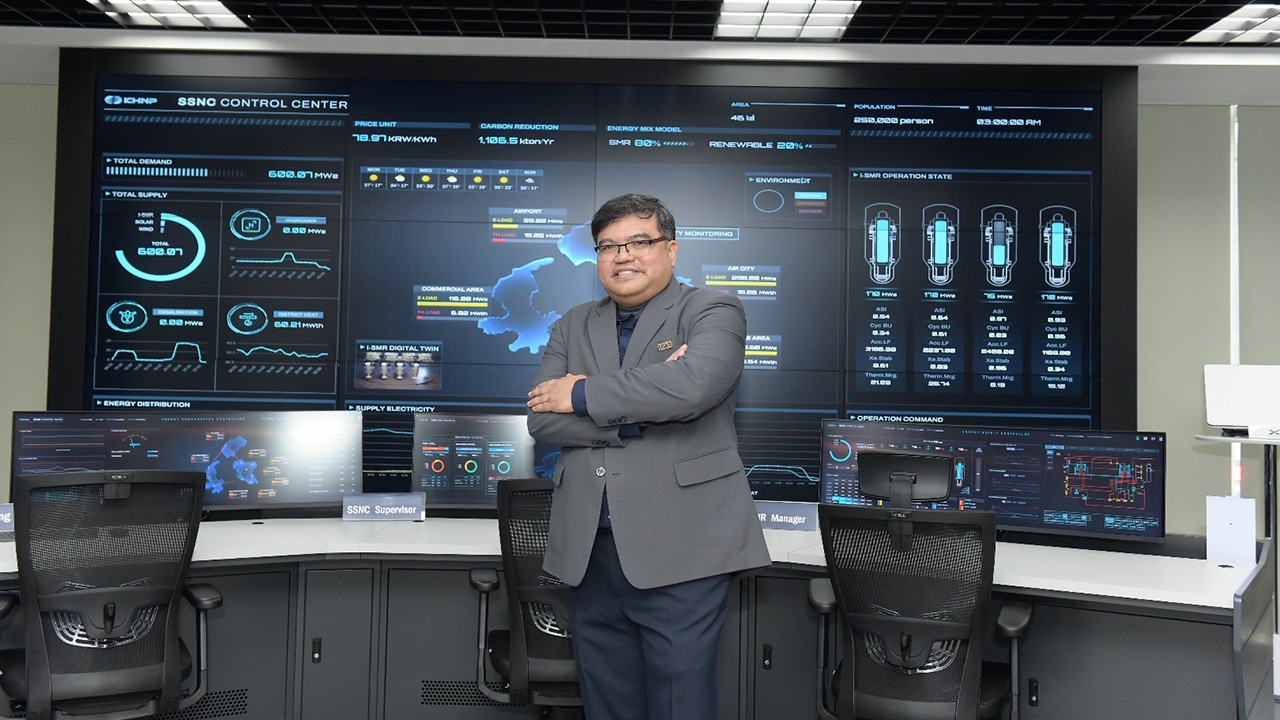
EGAT led the media to update trends in clean energy innovation, studying advancements in Small Modular Reactor (SMR) and hydrogen energy technologies in the Republic of Korea, aiming to promote energy security and drive the country sustainably toward Net Zero.
Mr. Warit Ratanachuen, Deputy Governor of Strategy, Electricity Generating Authority of Thailand (EGAT). He led executives and media representatives from the economic, energy, and industrial sectors on a study visit of Small Modular Reactor (SMR) technology at the Central Research Institute (CRI) of Korea Hydro & Nuclear Power Co., Ltd. (KHNP). The group also toured KEPCO Nuclear Fuel's (KNF) nuclear fuel manufacturing plant and Doosan Enerbility Co., Ltd.'s hydrogen fuel cell factory, exchanging knowledge with energy partners from December 15 to 19, 2025, in the Republic of Korea.

Mr. Warit Ratanachuen, Deputy Governor of Strategy, EGAT. He revealed that as the main agency responsible for the country’s electricity system security, EGAT is committed to driving the transition to clean and sustainable energy by increasing the proportion of electricity generated from renewable sources to over 50 percent, according to the draft Power Development Plan (PDP 2024). EGAT has advanced several key projects, including floating solar panels on EGAT dams nationwide, aligning with the Energy Minister’s Quick Big Win policy; modernizing the power grid to accommodate renewable energy fluctuations; developing pumped-storage hydropower plants; energy storage systems (BESS); and SMR technology to support the country’s Net Zero target by 2050.
The PDP 2024 draft plans for two SMR power plants with a combined capacity of 600 megawatts by 2037. EGAT closely monitors SMR technological developments internationally and collaborates with various government and private agencies both domestically and abroad, including the Department of Nuclear Engineering at Chulalongkorn University and the U.S. Department of State. A key partner is KHNP, which provides technical knowledge transfer and personnel development to support Thailand’s SMR projects. KHNP is recognized as a global leader in nuclear technology.

With over 50 years of experience, KHNP operates the Central Research Institute (CRI) in Daejeon, a leading center for research on new reactor technologies and safety systems. Recently, they developed the i-SMR technology, which uses water as a coolant, is installed underground, and features Passive Safety systems that automatically shut down without electricity or human intervention in emergencies. The center also showcases the Smart City concept integrating energy from i-SMR, renewables, and hydrogen to develop Daegu into a “Smart Net-Zero City,” managed by AI and ICT technologies for comprehensive energy system control.
The Republic of Korea is a leader in nuclear technology, ranking among the top five countries with the most nuclear power plants—26 in total, accounting for 30 percent of the nation's electricity generation. All nuclear fuel is supplied by KNF, the country’s sole nuclear fuel manufacturer, capable of producing fuel for both Light Water Reactors (LWR) and Heavy Water Reactors (HWR) under ISO 19443:2018 standards to support the global nuclear supply chain. The 11th National Energy Plan includes development of a 680 MWe SMR project using “i-SMR (Innovative Small Modular Reactor)” technology, comprising four modules developed by leading Korean firms and research institutes (such as KHNP, KAERI, KEPCO E&C) under the i-SMR Consortium, targeting commercial operation of the first plant by 2035.
Additionally, EGAT emphasizes hydrogen energy, collaborating with partners including Doosan to exchange knowledge on carbon-free technologies such as hydrogen, ammonia, and fuel cells. EGAT is studying the feasibility of blending 5 percent hydrogen with natural gas for electricity generation at six combined cycle power plants: Phra Nakhon Nuea, Phra Nakhon Tai, Wang Noi, Bang Pakong, Nam Phong, and Chana. The study's limitations are currently being reported to EGAT’s board. EGAT also partners with leading Japanese companies such as Mitsubishi Corporation (Thailand) to research and develop hydrogen and ammonia fuel production at EGAT’s potential sites.

The Republic of Korea is among the most advanced developers of hydrogen systems, under the Hydrogen Economy Roadmap policy covering production, transportation, storage, service stations, and energy sector use. Notably, the Shinincheon Bitdream project is the world’s largest fuel cell power plant with a capacity of 78.96 megawatts, employing technology entirely from Doosan.
“SMR and hydrogen are alternative options that can help Thailand achieve Net Zero faster, moving the target from 2065 to 2050. EGAT is ready to advance support alongside international partners to enhance Thailand’s energy security and become a sustainable leader in green energy,” Mr. Warit Ratanachuen emphasized at the conclusion.
Read more news " Government Policy " in detail