

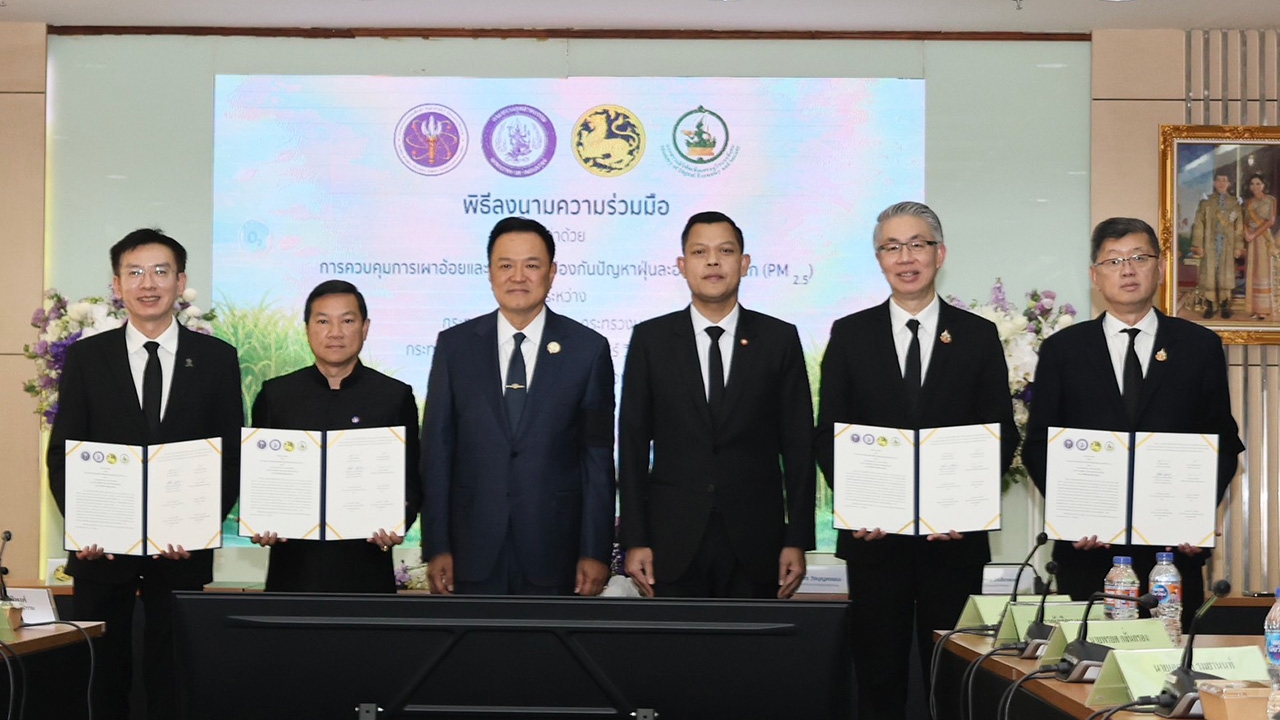
The Ministry of Higher Education (MoHE) teams up with three ministries to reduce PM 2.5 pollution during the 2025-2027 sugarcane production seasons, addressing the sugarcane burning issue comprehensively. They are developing a nationwide real-time sugarcane burning monitoring system using satellite and AI technology.
Professor Dr. Supachai Pathumnakul, Permanent Secretary of the Ministry of Higher Education, Science, Research and Innovation (MoHE). Signed a Memorandum of Understanding (MOU). The MOU concerns cooperation to solve sugarcane burning and fine particulate matter (PM 2.5) pollution issues. Together with Dr. Natthaphon Rangsitpol, Permanent Secretary of the Ministry of Industry; Mr. Arsit Sampanrat, Permanent Secretary of the Ministry of Interior; and Mr. Patchara Anuntasilp, Permanent Secretary of the Ministry of Digital Economy and Society (DES). With Prime Minister and Minister of Interior Anutin Charnvirakul, and Minister of Industry Thanakorn Wangboonkongchana, along with executives from all four ministries witnessing at Meeting Room OK 1, 2nd Floor, Office of the Permanent Secretary, Ministry of Industry.

The signing aims primarily to integrate government agencies' efforts to solve the sugarcane burning problem during the 2025/2026 to 2026/2027 production seasons, focusing on reducing burning before and after harvest while mitigating PM 2.5 impacts through knowledge exchange, technology sharing, and operational networks to achieve concrete economic, social, and environmental outcomes.

Professor Dr. Supachai said this cooperation integrates science and technology to address national environmental issues, especially PM 2.5 pollution from sugarcane burning, which requires precise data and analysis. The Ministry of Higher Education is ready to apply its capabilities in space and geospatial technology to manage the situation effectively.

Under this cooperation, the Ministry of Higher Education, through the Geo-Informatics and Space Technology Development Agency (GISTDA), will apply geospatial technology and satellite imagery in managing sugarcane cultivation and the entire sugar industry system. This includes mapping cultivation areas, forecasting yields using digital technology and artificial intelligence (AI), and monitoring sugarcane burning situations through hotspot detection systems.

The Permanent Secretary of the Ministry of Higher Education added that GISTDA will develop a real-time sugarcane burning surveillance and monitoring system covering target areas nationwide. This system will use high-resolution satellites combined with big data processing to identify burn locations, analyze risk areas, and predict the spread direction of PM 2.5 pollution. This information will greatly benefit relevant agencies in policy making, law enforcement, oversight of farmers and factories, and public dissemination to promote transparency and community involvement.

He also said this cooperation demonstrates the importance of applying research and innovation to solve national problems concretely. The Ministry of Higher Education is confident that with space technology capabilities and collaborative integration across sectors, it will effectively reduce sugarcane burning and PM 2.5 pollution, creating a spatial data foundation to sustainably develop the sugarcane and sugar industries in the future.
Read more news " Government Policy " here.