

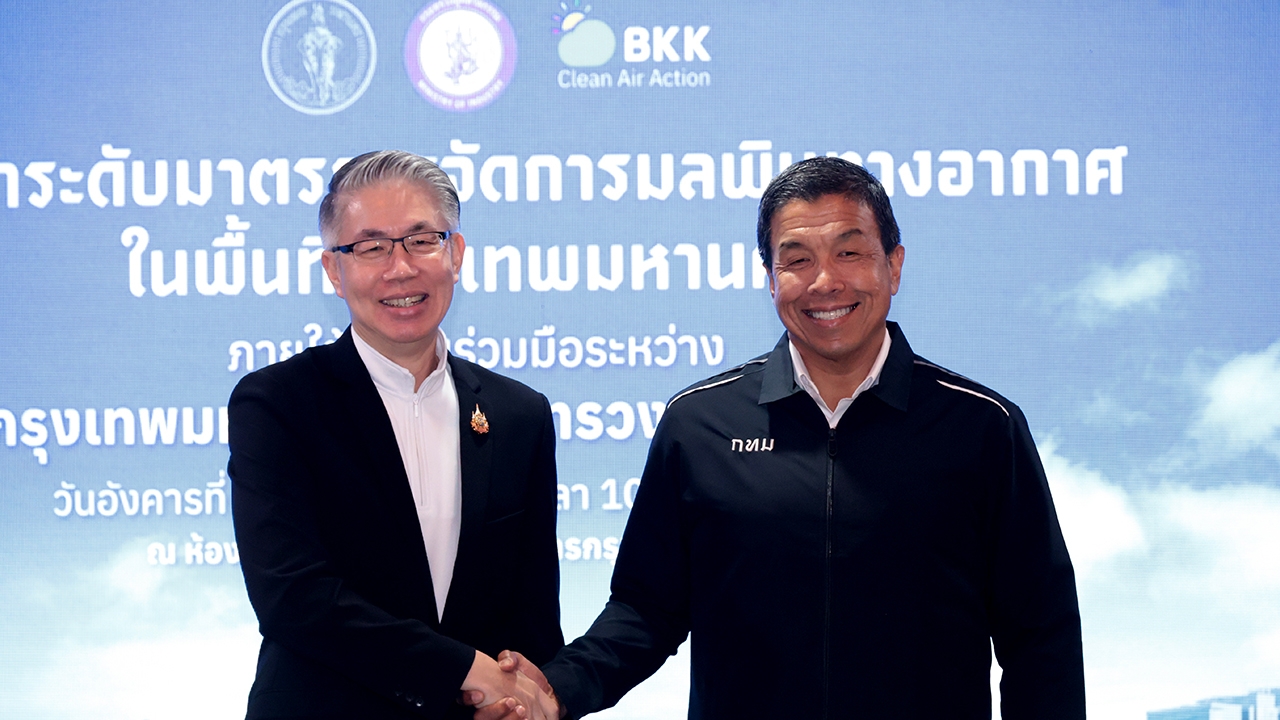
The Ministry of Industry has joined forces with the Bangkok Metropolitan Administration (BMA) to control PM 2.5 dust. Starting from 1 July, stricter controls will be applied to 156 factories in Bangkok, requiring the use of emission monitoring technology, expanding coverage from the previous 8 factories. Additionally, three proactive measures will be emphasized, including raising vehicle emission standards and controlling sugarcane burning.
Mr. Natthaphon Rangsitpol, Permanent Secretary of the Ministry of Industry, revealed that the ministry, in collaboration with the Bangkok Metropolitan Administration (BMA), has developed a project to enhance air pollution management measures to systematically address the PM 2.5 particulate matter problem. The plan includes three key proactive measures:
1. Improving industrial factory supervision by revising the previous uniform emission standards applied in all areas, which did not reflect the context and urban community expansion. The ministry has therefore raised the emission standards for factories in Bangkok to be stricter than the general standards. Factories in Bangkok must control air pollution emissions from fuel combustion in boilers so that particulate matter does not exceed 60 milligrams per cubic meter for natural gas fuel and 90 milligrams per cubic meter for solid and liquid fuels (an increase in strictness of more than 62%).
Furthermore, the Ministry of Industry has upgraded real-time air pollution emission monitoring technology for factories in Bangkok using the Continuous Emission Monitoring System (CEMS), covering more factories than general standards. This system will be officially implemented on 1 July 2026, expanding from only 8 factories to more than 156 large factories, especially those prone to causing pollution such as oil refineries and power plants. The public will be able to access and monitor emissions from all these factories continuously. If emission levels exceed limits, factories must promptly correct and improve their processes.
2. Raising vehicle emission standards: The ministry has enforced Euro 6 emission standards for small gasoline engine vehicles since 1 January 2025 and for large gasoline engine vehicles since 1 January 2026. Additionally, the ministry supports electric vehicles through the EV3.5 measure and government excise tax reductions, focusing on promoting electric vehicle use. 3. Controlling sugarcane burning to achieve “Burn-Free Thai Sugarcane.” For the 2025/2026 harvest season, farmers receive subsidies for fresh sugarcane harvesting and leaf purchasing. The goal is to limit nationwide sugarcane burning to no more than 10%. Factories also stopped accepting sugarcane during the recent New Year festival from 27 December 2025 to 4 January 2026 to reduce truck traffic and lower accident risks during the holiday period.
Moreover, to make control over sugarcane and other crop burning more effective in coming years, the Ministry of Industry has strengthened cooperation with the Ministry of Interior, Ministry of Higher Education, Science, Research and Innovation, and Ministry of Digital Economy and Society. This collaboration focuses on reducing sugarcane burning both before and after harvest and mitigating PM 2.5 dust impacts by exchanging knowledge, expertise, technology, and operational networks among agencies. The aim is to achieve efficient economic, social, and environmental management outcomes.
. Mr. Chadchart Sittipunt, Governor of Bangkok, said that monitoring and analyzing air quality data showed a 40% decrease in the number of days with PM 2.5 levels exceeding standards, and a 12% reduction in average PM 2.5 concentration compared to the same period last year. These figures reflect the effectiveness of pollution source control measures and overall dust management in Bangkok. A key factor behind the improvement is cooperation between Bangkok and provinces in the central and eastern regions in controlling agricultural burning, which reduced burning sites in those areas by 28%. Additionally, stricter control of black smoke emissions from vehicles was implemented, lowering the permissible smoke opacity standard from 30% to 20%.
Read the news " State Policy " for more information.